
House Member Urges Citizens to Support Environmentally Conscious Development
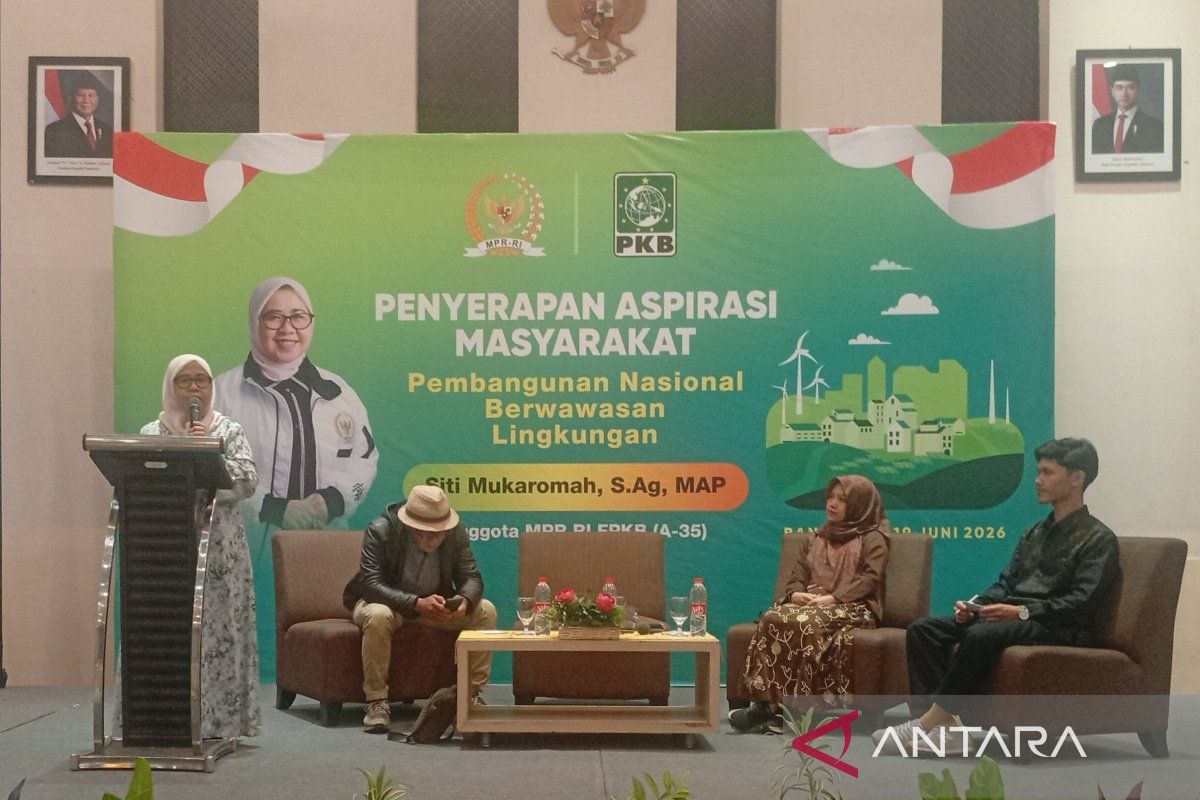
Purwokerto (ANTARA) - Siti Mukaromah, a member of Commission VII of the Indonesian House of Representatives (DPR RI), has invited the people of Banyumas and Cilacap to support environmentally conscious national development by preserving nature, starting from their immediate surroundings.
“When we are kind to the environment, the environment will be kind to us. Therefore, protecting the environment is a shared responsibility, at the very least starting from our own homes,” said Siti Mukaromah during a community aspiration gathering themed ‘Environmentally Conscious National Development’ in Purwokerto, Banyumas Regency, Central Java, on Saturday night.
According to her, Indonesia possesses vast natural wealth, with over 17,000 islands and maritime territories dominating its national area. Consequently, this wealth must be utilised wisely while ensuring its preservation to support sustainable community welfare.
She stated that national development cannot be separated from environmental conservation efforts, as environmental degradation will ultimately impact human life. She also reminded the public to be grateful for the geographical conditions of Banyumas and Cilacap, which are relatively more accessible compared to other regions in Indonesia that still face limitations in transport and connectivity.
“Therefore, the environment and nature we possess in Banyumas and Cilacap must be cherished and protected,” she said.
She urged all elements of society to collaborate in regional development by leveraging existing potential without neglecting environmental sustainability. Speaking during the event, the legislator, affectionately known as Erma, explained that the community aspiration gathering (Asmas) is an MPR RI programme aimed at listening to the hopes, complaints, and issues faced by constituents in her electoral district.
She noted that the aspirations expressed by the community would serve as the basis for representatives’ advocacy in various forums within the DPR RI and MPR RI, according to the authority and substance of the issues raised. “This programme is vital so that the community has a space to convey their aspirations, and we have a duty to listen, record, and fight for them,” said Erma, who is also a member of the Public Aspirations Body (BAM) of the DPR RI.
Regarding the theme of environmentally conscious development, she emphasised that efforts to protect nature must begin at the smallest level—the family and immediate neighbourhood—and then expand to the village, regency, and national levels.
Addressing the opposition from some residents towards mining activities in certain areas of Banyumas, she stated that environmental issues in the region require serious attention. She noted that mining activities, whether legal or illegal, have the potential to cause long-term impacts on ecosystems and community life. According to her, the extraction of materials from rivers or other areas can increase the risk of floods and landslides if not managed wisely.
She also highlighted issues regarding the governance of mining permits, some of which fall under central government authority. She admitted to having raised these concerns with the Governor of Central Java during her recess visit. Based on the information received, permits for several legal mining activities are under the authority of the central government, necessitating cross-institutional attention and coordination.
Therefore, she believes that mining issues in Banyumas are not solely the responsibility of the local government but also require the attention of the central government, the DPR RI, business actors, and the community to ensure that economic interests do not override environmental preservation. “Do not only look at short-term profits. We must also consider environmental sustainability and public safety so that we do not continuously face floods, landslides, or other disasters,” Erma concluded.