
House Commission XI and Finance Minister Purbaya Agree on 2027 Macroeconomic Framework
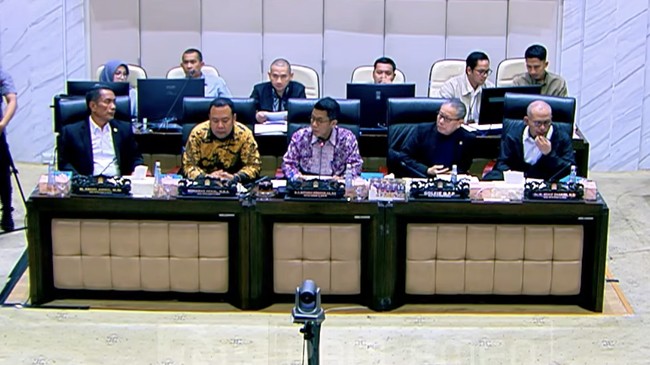
Jakarta - The House of Representatives (DPR) Commission XI and Finance Minister Purbaya Yudhi Sadewa have officially agreed upon the 2027 Macroeconomic Framework and Fiscal Policy Principles (KEM-PPKF) for the 2027 State Budget Draft (RAPBN). The agreement was formalised during a working meeting of Commission XI with the Finance Minister, the Minister for National Development Planning/Head of Bappenas, the Governor of Bank Indonesia, and the Chairman of the Board of Commissioners of the Financial Services Authority (OJK). This decision followed meetings of the Revenue Working Committee, the Financing/Deficit Working Committee, and the Economic Growth Working Committee, held on 10-11 June 2026. “Each working committee has presented its findings, and I have provided a summary of the results. Can these results be accepted?” asked Commission XI Chairman Misbakhun to the government on Thursday. “We can accept and agree with what has been presented,” replied Finance Minister Purbaya representing the government. “The results of the working committee meetings have been approved between the government and Commission XI,” Misbakhun announced, accompanied by the strike of a gavel. Minister Purbaya previously stated that the 2027 KEM-PPKF holds strategic value as it was presented directly by the President for the first time in history. This step reflects the government’s commitment to ensuring an integrated economic and fiscal policy direction to support economic growth and enhance public welfare. The Finance Minister explained that the state budget would be focused on meeting public needs while acting as a catalyst to encourage the private sector’s role in accelerating growth and improving prosperity. Meanwhile, the Danantara sovereign wealth fund is directed at accelerating productive investment in high-value-added strategic sectors. To strengthen the investment climate, the government will also continue debottlenecking and deregulation efforts through licensing simplification, strengthening legal certainty, and enhancing cross-sector and institutional coordination. “This strengthened synergy is expected to drive economic growth in 2027 within a range of 5.8% to 6.5%, on a trajectory towards 8% by 2029. This achievement must be underpinned by very strong investment acceleration, within a range of 6.5% to 7.5%,” the Finance Minister stated. The basic macroeconomic assumptions for 2027 include economic growth of 5.80% to 6.50%, a deficit of 1.8% to 2.40%, inflation of 1.50% to 3.50%, a rupiah exchange rate of Rp16,800 to Rp17,500 per US dollar, and a 10-year government bond yield of 6.50% to 7.30%. The 2027 growth targets and indicators include a poverty rate of 6.0% to 6.5%, a Gini ratio of 0.362% to 0.367%, an open unemployment rate of 4.30% to 4.87%, an extreme poverty index of 0%, a human capital index of 0.575%, a farmer welfare index of 0.803%, and a Gross National Income per capita of US$5,800 to US$5,840.