
House Commission X Visits UPI to Discuss National Education System Bill and PTNBH Governance
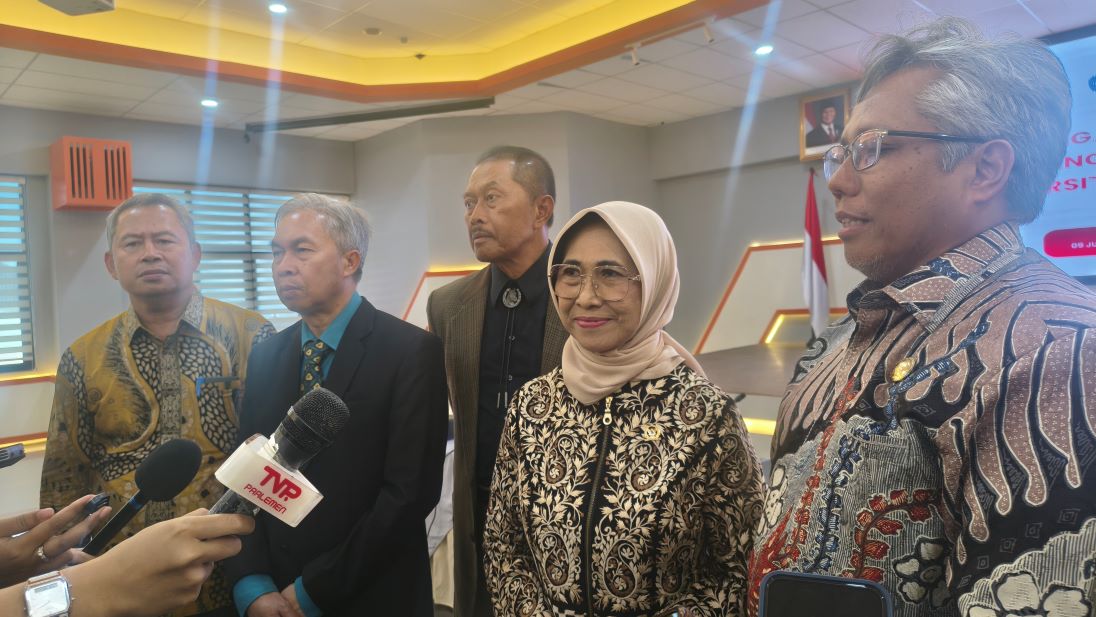
The drafting of the National Education System Bill (RUU Sisdiknas) is expected to be a momentum to address fundamental issues in Indonesian education, ranging from the governance of state universities with legal entity status (PTNBH) and the structuring of national teacher needs, to the sustainability of educational development direction. These strategic issues were the focus of a working visit by the House of Representatives’ Commission X to the Indonesian University of Education (UPI) on Thursday, a follow-up to a hearing with the Forum of Rectors of Indonesian State Teacher Training Institutions (LPTKNI) in December 2025. The working visit, held at the Auditorium of the Faculty of Economics and Business Education (FPEB) at UPI, was led by the Chair of Commission X, Dr. Ir. Hetifah Sjaifudian, and attended by members of the commission, representatives from the Ministry of Higher Education, Science, and Technology, the Ministry of Basic and Secondary Education, LLDIKTI Region IV, university leaders, and various education stakeholders in West Java. The forum served as a strategic space to gather academic input on the substance of the RUU Sisdiknas so that it can comprehensively meet national education needs. UPI Rector Didi Sukyadi highlighted the need to refine PTNBH governance to return to its basic philosophy as an instrument for strengthening academic autonomy, not merely a change in financing schemes. “The main idea of PTNBH is flexibility and autonomy so that higher education institutions can more freely achieve their goals, namely providing quality education services, especially world-class ones,” he explained. According to Didi, in addition to higher education governance, UPI also emphasised the importance of reforming the teacher preparation system through strengthening the Teacher Professional Education programme (PPG) and synchronising regional needs with the capacity of teacher-producing institutions. He stated that teacher needs planning must be integrated through coordination between the central government, regional governments, and universities to avoid distribution imbalances and mismatches between graduate study fields and school needs. UPI also proposed the formulation of a National Education Master Plan as a long-term development direction that remains consistent across government periods. “We need a master plan for education. Other countries like Vietnam have managed to maintain policy consistency in literacy development despite changes in leadership. It is this kind of consistency we need to build so that the quality of Indonesia’s human resources continues to improve,” he said. Chair of Commission X, Hetifah Sjaifuddin, conveyed that input from academics is a crucial part of perfecting the RUU Sisdiknas before it enters further discussion at the House’s Legislative Body. Various issues raised in the forum, such as higher education governance, strengthening the function of teacher training institutions, teacher management, and optimising the 20 per cent education budget, will be considered in drafting regulations to improve quality and expand access to education in Indonesia. “We also emphasise the importance of a more integrated teacher needs planning system so that recruitment, distribution, and welfare improvement can be carried out in a more targeted manner,” she said. In line with this, Commission X member Ferdiansyah stressed that the RUU Sisdiknas must present a National Education Master Plan as the foundation for national education development. The existence of this master plan will ensure that every level, pathway, and type of education has a clear development direction so that the national goal of educating the nation can be achieved sustainably. Through this forum, UPI reaffirmed its role as a teacher-training university that actively provides academic contributions to public policy formulation in the education sector. The various recommendations submitted are expected to strengthen the substance of the RUU Sisdiknas to create a national education system that is more adaptive, sustainable, and oriented towards improving the quality of Indonesia’s human resources.