
House Commission VII highlights obstacles to using intellectual property as collateral for KUR in Bali
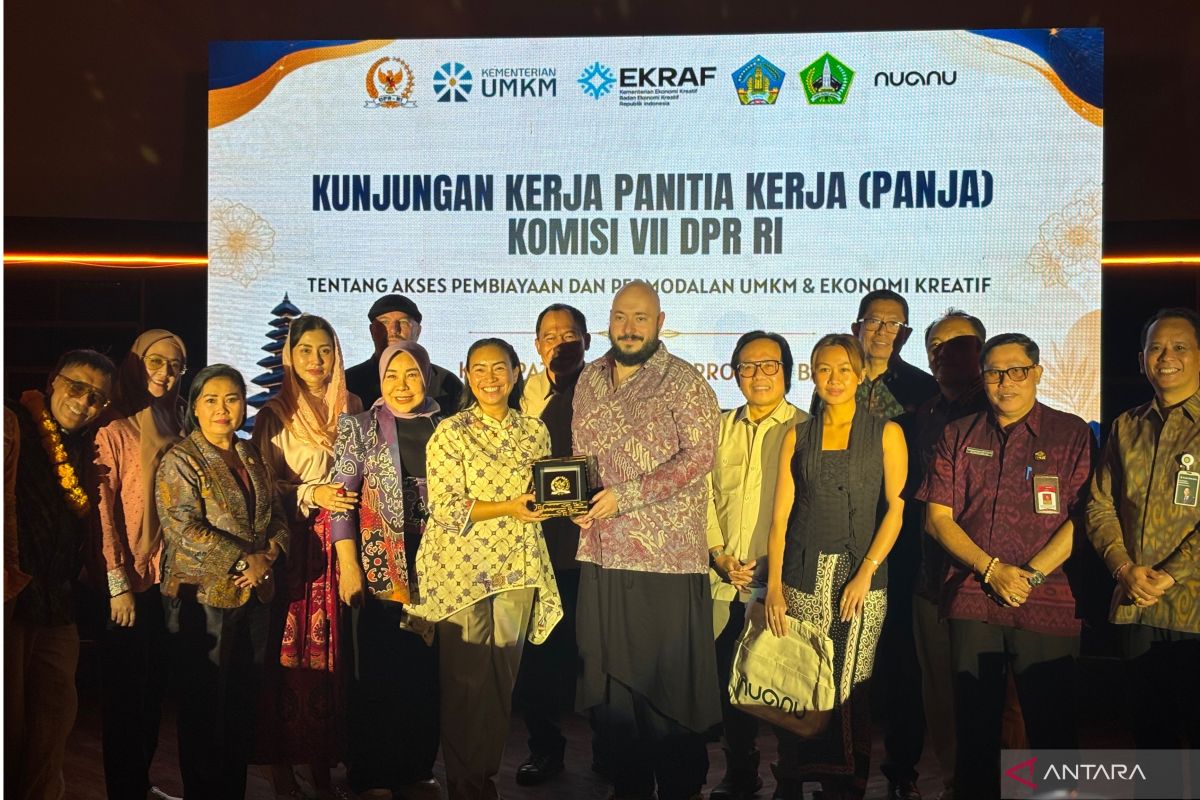
Tabanan (ANTARA) - Commission VII of the Indonesian House of Representatives has identified a number of structural obstacles that have prevented the use of Intellectual Property Rights (HAKI) as collateral for People’s Business Credit (KUR) loans to MSMEs and the creative economy in Bali from being optimised.
Rahayu Saraswati Djojohadikusumo, Chair of the Working Committee on Access to Financing and Capital for MSMEs and the Creative Economy of Commission VII, said in Tabanan Regency, Bali, on Friday that many creative business actors possess intangible assets but lack physical assets that can be used as collateral.
“Many of our MSMEs, especially those in the creative sector, are rich in intangible assets but poor in physical assets, meaning that what can be used as collateral is ideas, but at present the banking sector does not yet have a system for using intellectual property or creative ideas as collateral,” said Rahayu.
According to Rahayu, this situation needs to be addressed so that KUR disbursement can proceed in line with the purpose and objectives of its establishment, including through the work of the Commission VII Working Committee.
These efforts include evaluating the effectiveness of existing policies and encouraging financing and capital schemes that are more inclusive, easily accessible, and suited to the characteristics of MSME and creative economy actors.
Rahayu welcomed the central government’s move to prepare a financing ceiling of up to Rp10 trillion through KUR based on intellectual property, as well as a number of programmes such as the commercialisation of intellectual property, the Indonesian Creative Export Acceleration programme (ASIK), and the development of Creative Villages.
According to her, Bali has a strong MSME and creative economy ecosystem, making it a potential pilot region for developing intellectual property-based financing models.
However, the absence of a risk assessment system and the limited number of appraisers with relevant competence in the banking sector make it difficult to measure the value of intangible assets owned by creative economy actors when they need working capital.
These creative economy actors are spread across 20 sub-sectors, including culinary, craft and fashion, with many of them coming from younger generations.
“We need more evaluators in banks who understand how to evaluate risk in financing, especially for creative economy MSMEs that use HAKI as collateral,” she said.
The problem of valuing intangible assets was also highlighted by Commission VII member Samuel Wattimena.
Samuel said the main obstacle on the ground is the lack of a banking formula for determining the economic value of creative works produced by creative economy actors.
“The discussion about credit for artisans or intangible capacity has been going back and forth. My question is actually more practical: what must these creative actors achieve so that banks will take notice of them? The policy is that we are waiting for the banking sector,” he said.
According to Samuel, banks should have instruments to assess the track record of creative works as one basis for financing.
He cited the example that the track record and quality of work of Balinese painters who have been working for many years could be taken into consideration, so that physical collateral requirements do not become the only measure.
Of the 448,734 businesses recorded in Bali, the majority are still micro-enterprises and face obstacles in meeting banking requirements or becoming bankable.
“The condition of access to financing and capital for our MSMEs in Bali is currently still relatively developing, but there are several obstacles, especially for MSMEs that are not yet bankable, including limited collateral, administrative guarantees, business bookkeeping, and so on,” he said.
Tri said that recognising HAKI as collateral for KUR could be one step to protect distinctive regional works while opening access to capital for local MSMEs.
“Regarding policy support from the central government, the Chair of the Working Committee earlier said that collateral or financing should be able to be provided using Intellectual Property Rights, and we strongly agree with this,” he said.
He said local Balinese MSMEs have potential and distinctive characteristics that need to be protected through HAKI certification.
For this reason, the Bali Cooperatives and SMEs Office is encouraging stronger intellectual property protection as well as expanded access to financing for MSME actors in the region.
Source: jawawa.id (https://jawawa.id/newsitem/house-commission-vii-highlights-obstacles-to-using-intellectual-property-as-collateral-for-kur-in-bali-1787914503)
Originally published by Antara (Indonesian) (https://www.antaranews.com/berita/5715479/komisi-vii-dpr-soroti-hambatan-haki-sebagai-agunan-kur-di-bali), translated from Indonesian