
House Commission IV Pledges No Cuts to Agriculture Budget, Calls for Increase Instead
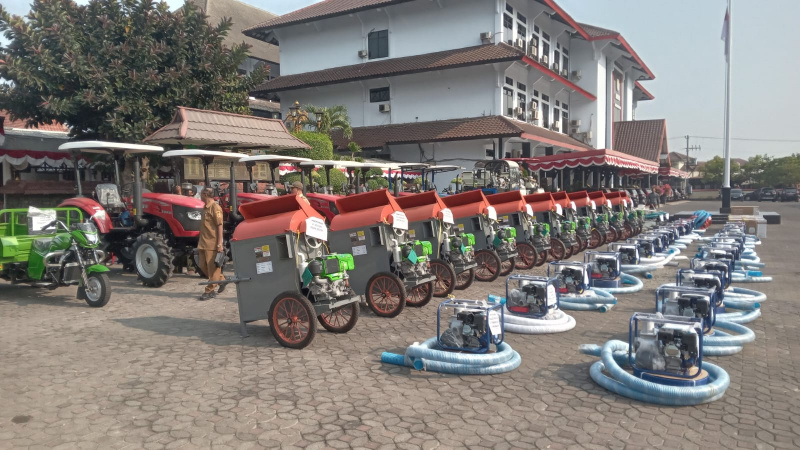
House Commission IV has pledged not to cut the budget proposed by the Ministry of Agriculture, insisting instead that funding should be increased to strengthen the agricultural sector. The commitment was delivered by Commission IV Deputy Chairman Abdul Kharis during an event where Acting Regent of Sukoharjo Eko Sapto Purnomo distributed agricultural facilities and infrastructure aid at the Sukoharjo Regency Government office on Monday (3/8). The IDR 24.045 billion aid package targets 220 farmer groups across the rice, livestock, fish farming, and fisheries processing and marketing sectors.
Kharis, a politician from the Prosperous Justice Party (PKS), stated that the commission, which oversees agriculture, unanimously agreed not to cut the Ministry of Agriculture’s budget as it is deemed key to achieving national food self-sufficiency. He emphasised that all budget proposals from the ministry would be protected and that the commission is pushing for the benefits to be felt more widely by farmers, thereby accelerating national food sovereignty.
He praised the government’s efforts through the Ministry of Agriculture, noting that the target for food self-sufficiency, originally projected for 2029, was achieved earlier in 2025. ‘In 2025, Indonesia no longer imports rice. In fact, for 2026, we are optimistic about a significant production surplus. The government is now considering how to export this excess production to provide added value for farmers,’ he added.
Commission IV observed that the condition of farmers is improving, with the price of unhusked rice at the farm level holding steady at around IDR 7,800 per kilogram, well above the government purchase price of IDR 6,500 per kilogram. The commission’s field monitoring also found that the distribution of subsidised fertiliser is becoming smoother and more accessible, with remaining obstacles being purely technical. ‘We want budget policy to continue favouring the agricultural sector and genuinely improve farmer welfare,’ he concluded.
Acting Regent Eko Sapto Purnomo expressed hope that the IDR 24.045 billion aid package would boost agricultural productivity and strengthen regional food security. He noted that the aid spans food crops, horticulture, plantations, livestock, and fisheries, serving three purposes: improving the welfare of farmers, breeders, and fish farmers; mitigating the impact of climate change, particularly drought threats from El Niño; and supporting Sukoharjo’s 2025–2030 development vision focused on a people’s economy and advanced, modern, resilient, and sustainable agriculture.
Sukoharjo Agriculture and Fisheries Agency Head Bagas Windaryatno detailed that the tens of billions of rupiah in aid came from a combination of the Sukoharjo regional budget, the Central Java provincial budget, and the state budget via the Ministry of Agriculture and the Ministry of Marine Affairs and Fisheries. He confirmed the aid was distributed transparently and accountably following proper planning and verification. The assistance includes seeds, seedlings, fertiliser, pesticides, and various agricultural machinery such as two-wheel and four-wheel tractors, combine harvesters, rice transplanters, power threshers, water pumps, three-wheeled vehicles, and crop dryers. Infrastructure aid covers pump irrigation, groundwater irrigation, tertiary irrigation network rehabilitation, reservoirs, check dams, and farm roads, while the fisheries sector received freezers and supporting equipment. The largest allocations were IDR 8.407 billion for pump irrigation, IDR 6.115 billion for tertiary irrigation rehabilitation, and IDR 2.333 billion for four-wheel tractors.