
Hotspots: The Differences Between the Red, Black and Dead Seas, and the Strait of Hormuz
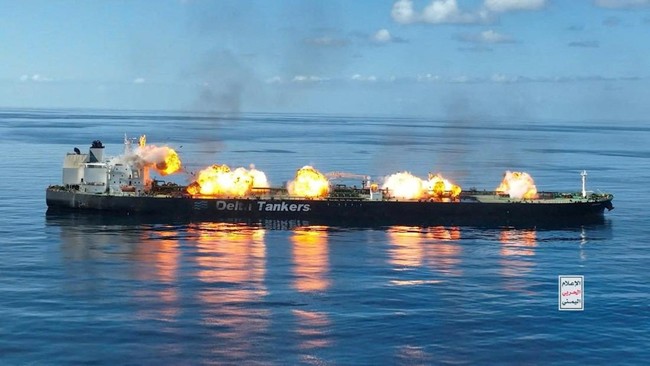
Geopolitical tensions in the Middle East have flared again. Yemen’s Houthi group this week threatened to resume attacks on Saudi airports and oil facilities, raising concerns about the security of global energy trade routes.
Reuters reported that the threat came a day after an attack hit Saudi Aramco’s headquarters in Dhahran, causing extensive damage and fires on several floors. Earlier, an attack on King Khalid International Airport in Riyadh on Saturday (10 October 2026) killed 13 people.
The Houthis described the attacks as retaliation for Saudi Arabia’s military operations in Yemen, amid an escalating confrontation between the United States and Iran that has heightened uncertainty in the Gulf region.
The conflict’s escalation is also putting pressure on global energy markets. On Wednesday (14 October 2026), the International Energy Agency (IEA) warned that global diesel supplies could remain tight until 2027, after exports from the Middle East and Russia fell by 1.3 million barrels a day in September 2026.
The situation highlights the importance of several strategic regions to world trade, from the Red Sea and Strait of Hormuz as energy shipping routes to the Black Sea, which plays a role in distributing oil and food.
The Dead Sea, meanwhile, has a different economic role through its minerals industry and tourism, although it is not an international shipping route.
What role does each of these regions play, and what impact could the conflict have on the global economy, including Indonesia?
Black Sea: A strategic route for food and oil
The Black Sea lies between Eastern Europe and Western Asia, bordered by Russia, Ukraine, Turkey, Georgia, Bulgaria and Romania. It is connected to the Mediterranean through Turkey’s Bosporus and Dardanelles straits.
The region is an important route for food and oil trade. According to the US Energy Information Administration (EIA), about 3.7 million barrels of oil a day crossed the Dardanelles in the first half of 2025.
However, the Russia-Ukraine war has once again disrupted shipping. Reuters reported that a drone attack on a merchant vessel near Bulgaria on Tuesday (13 October 2026) sank one ship and left 11 crew members missing.
The disruption has also put pressure on global wheat trade. According to S&P Global Energy, buyers from Egypt to Bangladesh are facing limited supplies and higher shipping costs.
The impact is broad, given the reliance of several countries on Russian and Ukrainian wheat. In 2024, the two countries accounted for 97.6% of Turkey’s wheat imports, followed by Egypt at 82.2%, Kenya at 81.5% and Indonesia at 29.6%.
Since disruptions intensified in July, the cost of wheat purchases through government tenders has risen compared with before the disruption. The increases included US$63 a tonne in Saudi Arabia, US$57 in Jordan, US$56 in Algeria and US$45 in Tunisia.
Meanwhile, Ukraine’s share of wheat exports transported by sea fell from 98% in July-September 2025 to 78% in the same period this year.
In addition to food, the Black Sea is an oil export corridor for the Caspian Pipeline Consortium (CPC), which connects Kazakhstan’s oilfields to a terminal near Novorossiysk, Russia.
The situation shows how conflict in the Black Sea can increase supply risks and trade costs for food and energy worldwide.
Red Sea: Linking Asia and Europe
The Red Sea lies between Africa and the Arabian Peninsula. It connects to the Mediterranean through the Suez Canal in the north and to the Indian Ocean through the Bab el-Mandeb Strait in the south.
Its location makes it a major Asia-Europe trade corridor, allowing ships to avoid the longer journey around Africa.
According to the EIA, about 4.2 million barrels of oil a day passed through Bab el-Mandeb in the first half of 2025, down from 9.3 million barrels a day in 2023 because of security disruptions.
The region is also served by Egypt’s SUMED Pipeline, which links the Red Sea with the Mediterranean, and Saudi Arabia’s East-West Pipeline, which carries oil to the port of Yanbu on the Red Sea coast.
Yanbu’s role has become increasingly important during 2026. Saudi oil-loading data show that exports through Ras Tanura in the Persian Gulf have fallen sharply since March, while Yanbu on the Red Sea has become the main export route.
This shift in export routes has further increased the importance of tanker activity in the Red Sea. LSEG Shipping Research data show that the number of tracked tankers briefly exceeded 500 in early April 2026, before fluctuating at lower levels through September.
Houthi attacks have nevertheless increased security risks for shipping in the region. Vessels choosing to sail around the Cape of Good Hope in Africa face longer delivery times and higher logistics costs.
Strait of Hormuz: A lifeline for world trade
The Strait of Hormuz lies between Iran and Oman, linking the Persian Gulf with the Gulf of Oman and the Arabian Sea.
It is crucial to oil and LNG trade from Saudi Arabia, Iraq, Kuwait, the United Arab Emirates and Qatar.
According to the EIA, about 20.9 million barrels of oil a day crossed the Strait of Hormuz in the first half of 2025, equivalent to roughly one-fifth of global oil consumption.
The Middle East conflict has, however, reduced shipping volumes. Oil flows through Hormuz fell from about 21.6 million barrels a day in the fourth quarter of 2025 to 4.9 million barrels a day in the second quarter of 2026.
The IEA said shipments began to recover, reaching about 10.9 million barrels a day in September, although attacks on energy infrastructure continue to cast a shadow over the outlook.
To reduce dependence on Hormuz, Saudi Arabia relies on the East-West Pipeline, while the UAE has the Abu Dhabi Crude Oil Pipeline (ADCOP), which runs to Fujairah on the Gulf of Oman.
Even so, the capacity of these alternative routes is not sufficient to fully replace the oil and LNG trade passing through Hormuz.
Dead Sea: Mineral wealth, but no trade route
Unlike the three regions discussed above, the Dead Sea is a landlocked salt lake between Jordan, Israel and the Palestinian West Bank.
It is not connected to the oceans and is therefore not an international shipping route.
Its strategic value lies in the minerals industry, particularly potash for fertiliser and bromine for the chemical industry, as well as tourism.
The Middle East conflict could indirectly affect tourism and investment in the region. A longer-term threat, however, is the lake’s shrinking water level, caused by water use and industrial activity.
Impact on Indonesia and the humanitarian threat
Disruptions to trade across these routes also pose risks to Indonesia, particularly through higher energy, logistics and food-input costs.
As a net importer of oil and fuel, Indonesia faces the risk of higher oil and gas import costs, inflationary pressure and a heavier energy subsidy burden in the state budget. Disruptions in the Red Sea could lengthen shipping routes for goods bound for Europe, while uncertainty in the Black Sea could affect wheat and vegetable oil prices.
The conflict’s impact goes beyond the economy. Reuters reported that hospitals in Yemen are increasingly overwhelmed by war casualties, while the World Food Programme (WFP) said humanitarian aid had been cut off from more than 600,000 people in Taiz, including over 200,000 women and children.
The IEA expects the diesel market to remain tight through the first half of 2027. A recovery in refinery output towards the end of this year is expected to be insufficient to replace supplies lost because of the conflict.
The situation shows that securing global trade routes is not only a matter of maintaining the flow of goods and price stability. Behind disruptions to energy and food trade are millions of people whose safety is also at stake.
Source: jawawa.id (https://jawawa.id/newsitem/hotspots-the-differences-between-the-red-black-and-dead-seas-and-the-strait-of-hormuz-1792248619)
Originally published by CNBC Indonesia (https://www.cnbcindonesia.com/research/20261015100955-128-776374/jadi-titik-panas-ini-perbedaan-laut-merah-hitam-mati-dan-selat-hormuz), translated from Indonesian