
Hotspots in Sumatra Reach 3,734, with South Sumatra Highest
The Meteorology, Climatology, and Geophysics Agency (BMKG) Pekanbaru Station, Riau Province, has detected 3,734 hotspots across Sumatra, with South Sumatra emerging as the region with the highest contribution, reaching 2,639 hotspots.
BMKG Pekanbaru forecaster Gita Dewi S stated that these figures represent updated data as of 07:00 WIB on Wednesday morning (30/9). In addition to South Sumatra, high numbers of hotspots were also observed in Jambi (603), Lampung (263), and Bangka Belitung (183).
“Other regions in Sumatra monitored with hotspots include West Sumatra with 13 points, North Sumatra with 17 points, Riau with 6 points, and Bengkulu and the Riau Islands with four points each,” she said in Pekanbaru on Wednesday, 30 September 2026.
Meanwhile, the distribution of hotspots in Riau is spread across four areas, with the highest numbers located in the Siak and Pelalawan Regencies, each having 2 points. The remainder includes Indragiri Hulu and Bengkalis Regencies with one point each.
The condition of the hotspots in the southern part of Sumatra has resulted in haze in Riau Province. Visibility in Pekanbaru has dropped to 3 kilometres, while in Rengat and Pelalawan, visibility is 5 kilometres, both accompanied by smoke.
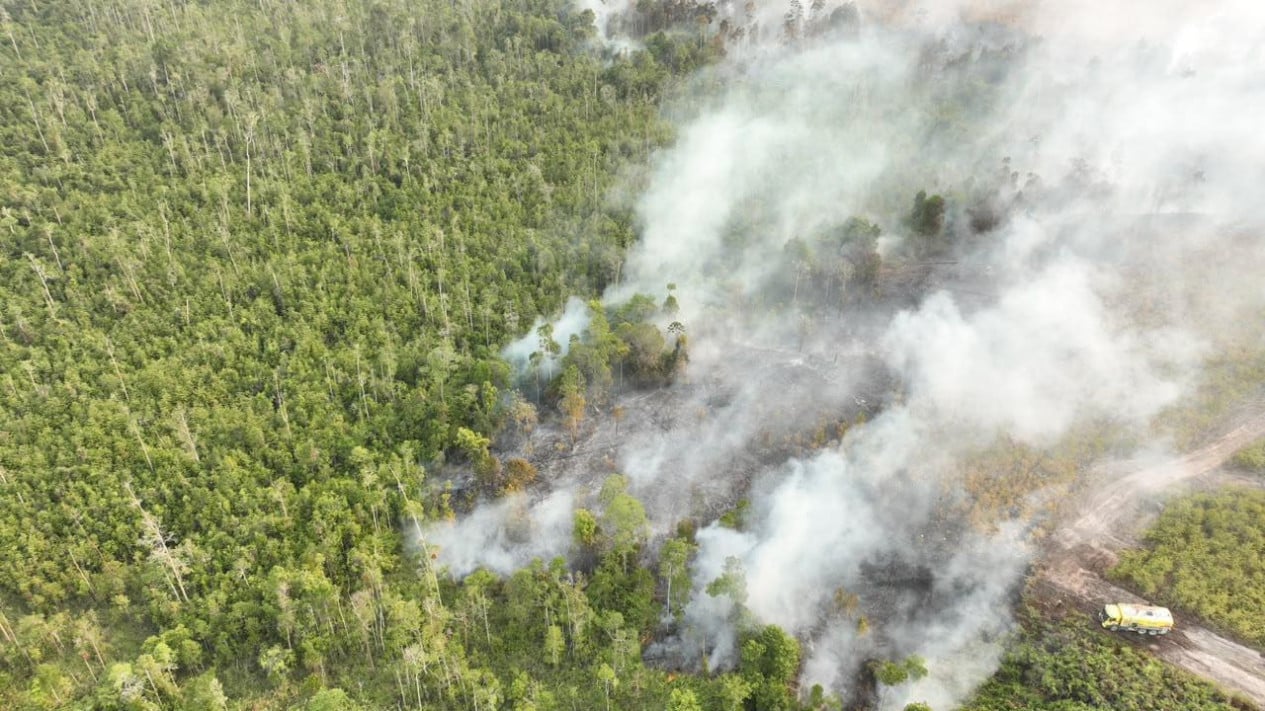
The Head of Daops Manggala Agni Sumatra VI/Siak, Ihsan Abdillah, stated that several personnel are currently being deployed to handle forest and land fires in the Ogan Komering Ilir (OKI) Regency, South Sumatra. The fire conditions in that location are quite serious, with thick plumes of smoke and an expanding affected area.
Based on monitoring by the ASEAN Specialised Meteorological Centre (ASMC), moderate intensity haze is observed in Riau Province. The smoke sources identified via satellite are located, among others, in the South Sumatra region. The movement of the smoke mass is subsequently influenced by wind direction.
“Based on wind direction information from the Forest and Land Fire Early Warning and Detection Information System (Sipongi) and BMKG, the movement is generally from south to north, then turning towards the Strait of Malacca and Malaysia,” said Ihsan.