
Hotspots in Kalimantan Increase, BNPB: Visibility Less Than 1 Km
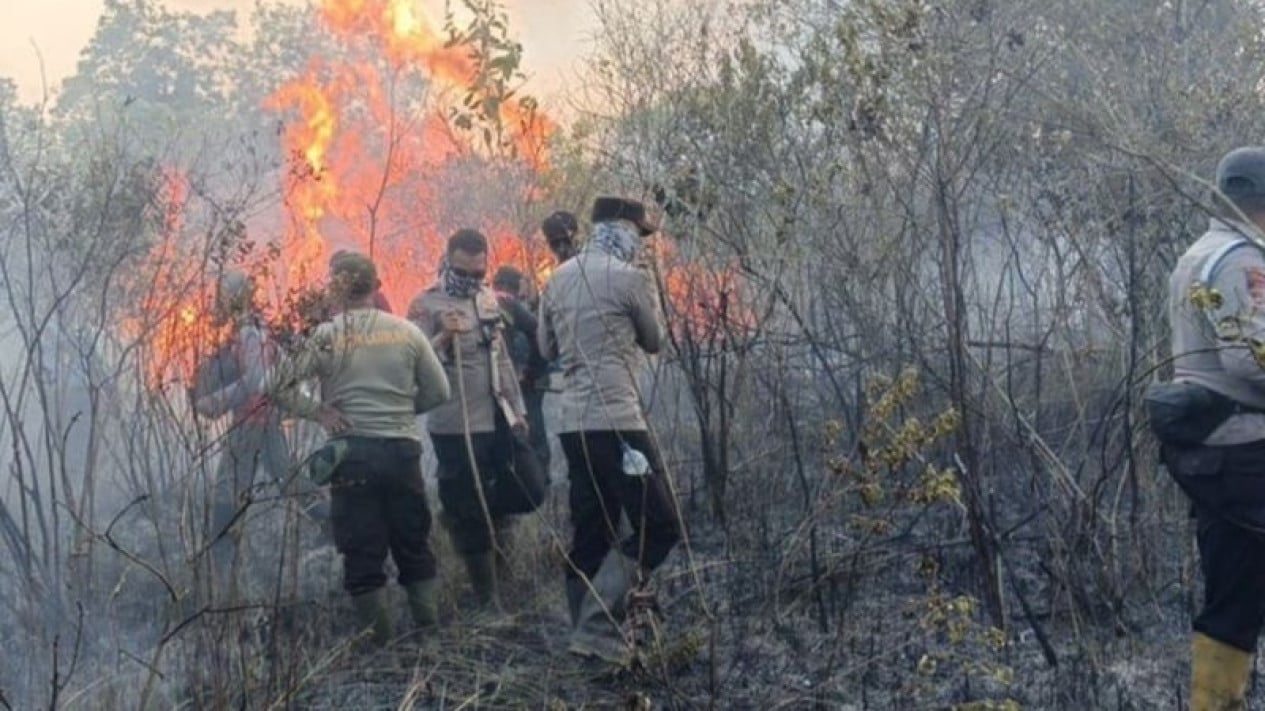
The National Disaster Management Agency (BNPB) has reported an increase in forest and land fire (karhutla) hotspots in three provinces in Kalimantan, namely West Kalimantan, Central Kalimantan, and South Kalimantan.
“We can see that in West Kalimantan, Central Kalimantan, and South Kalimantan, the number of hotspots is relatively increasing. In West Kalimantan, the increase is significant. In South Kalimantan and Central Kalimantan, it is relatively declining,” said Berton SP. Panjaitan, Acting Head of the BNPB Disaster Data, Information and Communication Centre, in Jakarta on Monday, 31 August 2026.
Based on monitoring of fire hotspots in the three provinces, he said, there has been an increase in the number of hotspots with visibility ranging from one to two kilometres.
Meanwhile, in three provinces in Sumatra, namely Riau, South Sumatra, and Jambi, the number of hotspots has generally declined.
Nevertheless, BNPB recorded an increase in hotspots in South Sumatra of 209 points, bringing the total to 1,013 hotspots.
“Meanwhile, in Riau and Jambi, hotspots have decreased significantly. Visibility also varies between four and five kilometres in Riau and South Sumatra, while Jambi is around seven kilometres,” he said.
According to Berton, this condition is also related to air quality, which can be monitored through the Air Pollutant Standard Index (ISPU) provided by the Ministry of Environment (KLH).
He urged the public to utilise the ISPU service through the KLH’s official website to find out air quality conditions down to the district/city level.
“The public can access it, so that preventive measures can be taken properly if the air quality becomes hazardous or unhealthy,” he said.
In addition to air quality, BNPB is monitoring pollutant distribution based on predictions from the Meteorology, Climatology, and Geophysics Agency (BMKG).
Berton said pollutant distribution in several areas of Kalimantan, particularly West Kalimantan, Central Kalimantan, and South Kalimantan, is expected to remain relatively dense.
“We can see that in West, Central, and South Kalimantan, it is relatively very dense. This indicates that the amount of smoke is very thick in these areas,” he said.
Pollutant distribution has also been observed in several areas of Sumatra, including Riau, Jambi, and South Sumatra. Meanwhile, conditions in Papua and Java are expected to see a decline in the intensity of pollutant distribution.