
Hotman's Misunderstanding of Human Rights
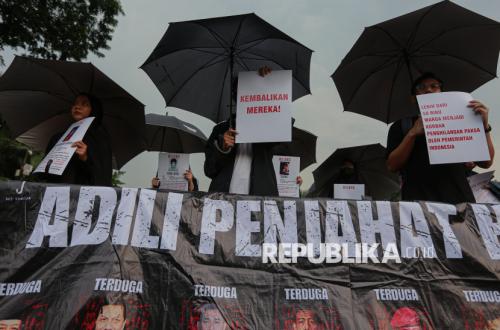
The proposal to dissolve the Ministry of Human Rights by advocate Hotman Paris emerged within the context of differing views with Minister of Human Rights Natalius Pigai regarding the handling of street robbers and the use of force by authorities. However, when disagreement with an official’s views evolves into an argument regarding the unnecessary nature of the institution they lead, the issue is no longer merely about security or law enforcement, but touches upon how to understand the function of human rights and the role of the state in a modern constitutional system.
The issue does not lie in whether one agrees or disagrees with the Minister of Human Rights’ views. The issue lies in the framework of thinking used to reach the conclusion that disagreement with a particular view is sufficient to question the existence of the human rights function within the government. This way of thinking relies on several conceptual reductions regarding law, human rights, and the state that require closer examination.
The first reduction is the assumption that humanitarian issues are resolved as long as legal procedures have been met. This view ignores the most important lesson from the development of modern human rights post-World War II: that legality is not always identical to respect for human dignity. Slavery, racial segregation, apartheid, and various forms of discrimination once occurred through valid legal mechanisms.
Therefore, human rights do not exist outside the law, but rather serve as the normative standard used to assess the legitimacy of laws and state actions. When humanity is reduced to mere legality, the suffering of victims, human vulnerability, and the social impact of a policy can easily be ignored simply because they do not appear as formal legal violations.
The development of modern human rights since the second half of the 20th century shows that human rights issues relate not only to actions taken or omitted by the state, but also to the state’s failure to prevent discrimination, social exclusion, and inequality that hinder citizens’ enjoyment of basic rights. Consequently, human rights encompass civil and political rights as well as economic, social, and cultural rights, which demand changes in policy, budgeting, public services, and governance.
Thus, there is a fundamental difference between the mechanism of rights enforcement and the human rights protection system. The former works primarily through legal instruments, while the latter encompasses the entirety of the state’s obligations to build conditions that allow these rights to be realised in practice.
Advocates play a role in fighting for and restoring rights through legal instruments, whereas the state bears a broader obligation to respect, protect, and fulfil human rights. Equating the two is a categorical error that reduces structural and constitutional issues to mere legal matters.
The third reduction is equating state institutions with the individuals currently serving within them. This way of thinking ignores the fundamental principle of the modern state that ministries are formed to perform permanent public functions, not to accommodate the views or personalities of specific officials.
In modern institutional theory, institutions are formed to perform continuous functions, while officials are merely temporary carriers of those functions. Therefore, the existence of an institution is not determined by who is leading it, but by the state obligations it must fulfil. Disagreement with an official’s views does not change the need for the public function that forms the basis of the institution’s establishment.
A further simplification is the assumption that the abundance of human rights norms and institutions is a reason why the Ministry of Human Rights is no longer needed. This logic confuses the existence of norms with the state’s capacity for implementation. The Constitution, Law Number 39 of 1999 on Human Rights, various international human rights instruments ratified by Indonesia, and their derivative regulations form increasingly broad and complex state obligations.
Within this framework, sectoral ministries, national human rights institutions, courts, and independent bodies perform different and complementary mandates. From a governance perspective, the Ministry of Human Rights functions to strengthen coordination, harmonisation, and the mainstreaming of human rights within government administration, supporting the state’s responsibility in the protection, advancement, enforcement, and fulfilment of human rights as mandated by Article 28I paragraph (4) of the 1945 Constitution.
From a legal politics perspective, the issue is not how many norms are written, but to what extent the state possesses the institutional capacity to transform norms into actions, policies, and protections that can be felt by the community.
Ultimately, human rights issues arise from the awareness that the protection of human dignity cannot be left entirely to individual goodwill, market mechanisms, religious teachings, or formal compliance with the law. A modern constitutional state is built not on the assumption that all power holders will always act fairly, but on the need to provide corrective mechanisms when law, bureaucracy, markets, and social majorities fail to protect the most vulnerable. It is in this context that the function of human rights remains relevant: ensuring that human dignity never falls victim to legality, power, or the moral convenience of groups in secure positions.
In a modern system of government, the issue is not merely the existence or non-existence of human rights norms, but the availability of institutional capacity specifically responsible for coordinating their implementation across sectors.