
Homer After Three Thousand Years
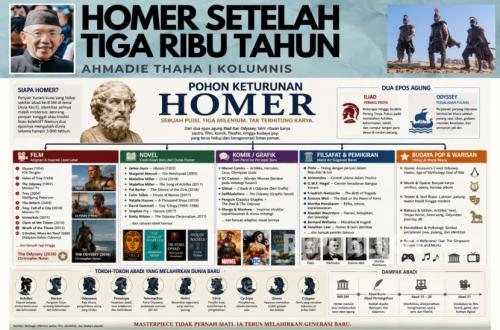
A tree may live a hundred years. A building might last five hundred. But some works outlast stone, kingdoms, and even political religions. They keep changing faces, languages, and mediums, yet their heartbeat remains the same. Homer is one of them.
Imagine a poet—or perhaps a collective of poets—living around the 8th century BC. He had no camera. He knew no printing press. He never dreamed of IMAX. Yet nearly three thousand years later, a director named Christopher Nolan spent around US$250 million, or Rp 4.5 trillion, to bring his story to the screen. That budget exceeds the annual spending of many Indonesian districts. It is a beautiful irony: a tale once passed from mouth to mouth now requires trillions of rupiah to be shown to the world. This might be the most expensive investment in history to resurrect a poem.
Nolan’s film, The Odyssey, premiered in Indonesian cinemas this week. Before audiences even bought tickets, global critics had delivered a near-unanimous verdict. The Guardian, The Independent, The Telegraph, and The Times all awarded it five stars. The New York Times called it a ‘monumental adaptation’. Kevin Maher of The Times described it simply but heavily: ‘A masterpiece in every way.’ Meanwhile, Manohla Dargis wrote that Nolan invites humanity to ‘dare to dream bigger’. Some criticism exists, particularly regarding the simplification of female characters and dialogue that feels too modern. Yet overall, the film is viewed as one of Nolan’s greatest career achievements. If this early reception holds, it will almost certainly be a strong Oscar contender next year.
However, the real headline is not Nolan. The real headline is Homer, the author who birthed thousands of poetic verses. This film is merely a grandchild, perhaps even a great-grandchild, of a work that has produced thousands of intellectual descendants over nearly thirty centuries.
Who exactly was Homer? The ironic answer is that we do not truly know. Some scholars believe he was a Greek poet living around the 8th century BC in Ionia, on the coast of Asia Minor. Others argue that ‘Homer’ may not have been a single person, but rather a collective name for a tradition of oral poets who, over generations, composed the heroic tales of Greece. This debate, known as the Homeric Question, remains unresolved to this day. But whoever he was, the world attributes two great works to him: the Iliad and the Odyssey.
The Iliad is set in the final weeks of the Trojan War. Its focus, however, is not the war itself, but the rage of Achilles, the greatest Greek warrior, after his honour is stolen by King Agamemnon. From this anger flows a cascade of tragedy: the death of his beloved friend Patroclus, a legendary duel with Trojan prince Hector, the lament of King Priam begging for his son’s body, and the constant meddling of gods like Athena, Apollo, Zeus, and Aphrodite, who use the human war as their own stage.
The Odyssey begins after the war is won. Its hero, Odysseus, must endure a ten-year journey to return to his kingdom of Ithaca. His voyage is another kind of war: he must pass the cave of the one-eyed Cyclops Polyphemus, resist the sorceress Circe, survive the deadly song of the Sirens, navigate the monsters Scylla and Charybdis, and escape years of captivity on the island of the nymph Calypso. Meanwhile, at home, his wife Penelope tirelessly defends her fidelity against a horde of suitors vying for the throne, while his son Telemachus grows up searching for traces of his father.
Nearly every name in these epics has since become a world of its own. Achilles spawned novels, films, and comics about heroism. Hector is remembered as a symbol of honour. Helen became the face that launched a thousand ships. Penelope is an icon of loyalty. Circe became the protagonist of best-selling novels. Odysseus is the eternal metaphor for the wandering human. Even the Trojan Horse, the Sirens, the Cyclops, and the Achilles’ heel have transformed into idioms, video games, book titles, films, comics, and even cybersecurity terms.
If the Iliad is about how men win a war, the Odyssey asks a far more eternal question: how does a man find his way home after war has turned him into someone else? That question has proven more durable than any sword. This is why every age feels compelled to retell Homer in its own language. In cinema, Homer’s footprint has never faded. There was Ulysses in 1954 with Kirk Douglas, a 1997 television miniseries, and Wolfgang Petersen’s Troy in 2004 with Brad Pitt as Achilles. Films like Helen of Troy, The Return, and even the Coen Brothers’ O Brother, Where Art Thou? are all free adaptations of the Odyssey.