
Home Minister: Accurate Population Data Key to Targeted Social Aid in Biak Numfor
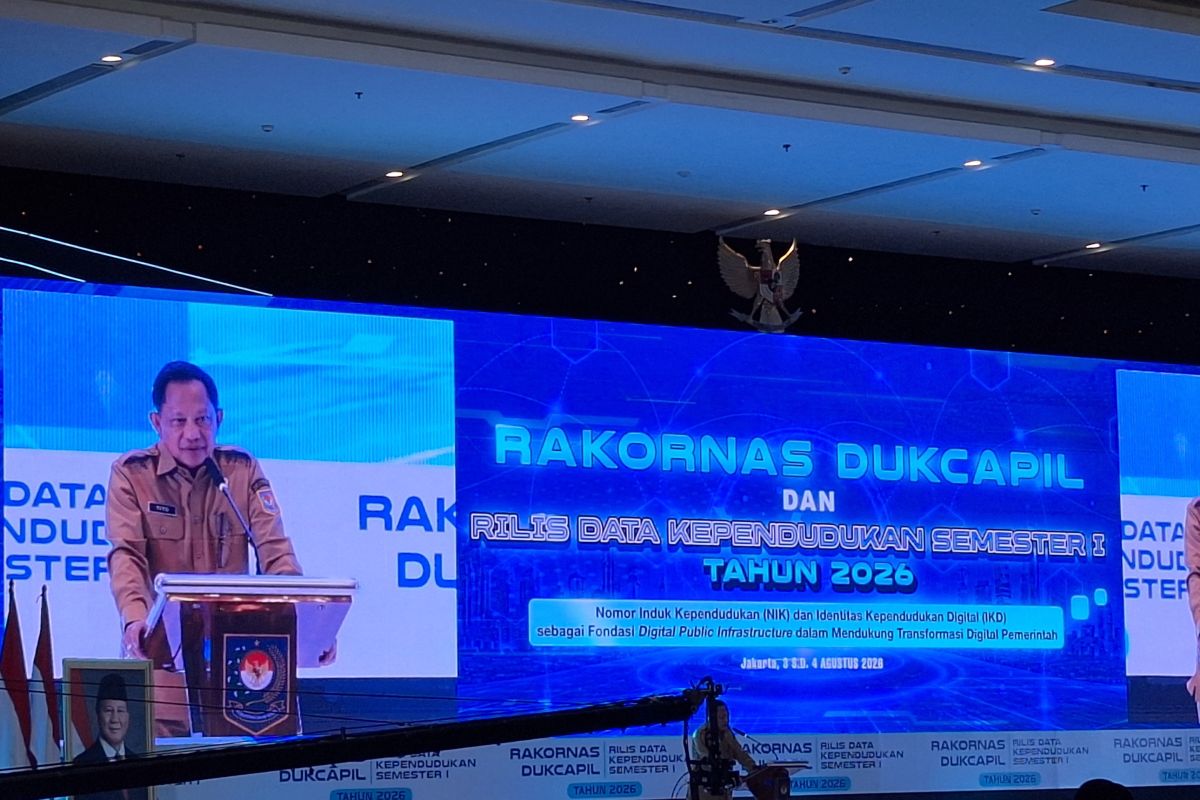
Jakarta (ANTARA) - Minister of Home Affairs Muhammad Tito Karnavian has assured that accurate population and civil registration (dukcapil) data will serve as the primary foundation for delivering properly targeted social assistance (bansos) in Biak Numfor Regency, Papua.
The Minister stressed that the problem of mistargeted social aid can be resolved through the integration of accurate and verified population data.
“With that system, it can read more precisely and more accurately who is eligible to receive social assistance and who is not,” the Minister said in a statement in Jakarta on Tuesday.
He made the remarks while giving directives to officials of the Biak Numfor Regency Government at the Regent’s Office Complex in Brambaken, Samofa District.
The visit was not merely ceremonial, but part of government efforts to accelerate the implementation of the Electronic-Based Government System (SPBE) whilst strengthening the use of biometric population data as the basis for determining social aid recipients.
The Minister explained that the data update will focus on people in the first to fourth income deciles, as the priority group for recipients of various government social protection programmes.
According to him, the use of biometric data will improve the accuracy of beneficiary determination whilst minimising the potential for distribution errors.
Biak Numfor is one of the national priority regions for the expansion of SPBE implementation, which is targeted to be operational before mid-August 2026.
For this reason, the Minister asked all regional apparatus, village officials and Posyandu cadres to play an active role in safeguarding the data update process to be carried out by technical teams in the field.
On that occasion, he emphasised the importance of regional governments preparing companion agents who will spearhead the data collection process for prospective social aid recipients.
“The success of social assistance digitalisation depends not only on the applications or technology used, but above all on the quality of the population data that underpins it,” he said.
He reminded all companion agents to ensure that every piece of data gathered from the community is accurate, up to date and has gone through a validation process.
According to him, the population data managed by the Directorate General of Civil Registration (Ditjen Dukcapil) constitutes the single identity reference that forms the foundation of SPBE as well as the main reference for various public services, including social aid distribution.
The use of the National Identity Number (NIK) combined with biometric verification allows the beneficiary validation process to be carried out with greater precision, thereby minimising duplicate data, fictitious identities and recipients who no longer meet the criteria.
Furthermore, he affirmed that Ditjen Dukcapil will continue to strengthen collaboration with regional governments through the provision of secure data, technical assistance and the use of the Population Administration Information System (SIAK) Dashboard to support continuous data updates.
“The digitalisation of social assistance is not merely about changing manual processes into digital ones, but about building a public service ecosystem based on a single set of population data,” he said.
According to him, the uniform use of population data as a reference across agencies will produce public services that are faster, more precise, efficient, transparent and accountable.
As a follow-up to the visit, Ditjen Dukcapil together with the Biak Numfor Regency Government organised a technical class for officials from the Civil Registration Office, the Social Affairs Office, and the Communications and Informatics Office.
Dozens of participants were designated as social assistance digitalisation agents and received direct guidance in operating the smartphone application for registering prospective aid recipients.
In addition to the training, Ditjen Dukcapil also handed over technical support to the Biak Numfor Regency Government, including low Earth orbit satellite-based VSAT Starlink devices and encrypted name-by-name, address-by-address (BNBA) data along with decryption guidelines.
It also provided access to the SIAK Dashboard to support real-time monitoring and updating of population data.