
Home Affairs Ministry Ensures Weak Fiscal Regions and Disaster Areas Become TKD Priorities
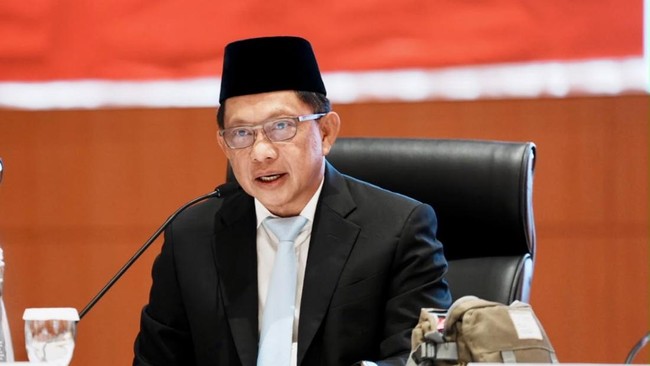
Jakarta, CNBC Indonesia - The Ministry of Home Affairs (Kemendagri) continues to monitor regional financial conditions amid government efforts to maintain economic growth momentum and the quality of state spending. As of the end of July 2026, regional revenue realisation was recorded as having slowed compared with the same period last year, while regional spending showed an increasing trend.
Minister of Home Affairs Muhammad Tito Karnavian said Kemendagri continues to carry out its guidance and supervisory functions over regional governments, including in the management of Regional Revenue and Expenditure Budgets (APBD).
Based on data from the Directorate General of Regional Financial Development (Ditjen Keuda) of Kemendagri as of 31 July 2026, APBD revenue realisation for provincial and district/city governments reached Rp606.8 trillion, or 51.05 per cent of the target. This figure is lower than the same period last year, which reached Rp691.8 trillion, or 51.93 per cent.
On the other hand, regional spending realisation reached Rp538.6 trillion, or around 42.5 per cent of the budget ceiling. In percentage terms, this achievement is higher than the same period in 2025, which stood at 41.7 per cent.
“Kemendagri will continue to evaluate developments in regional revenue and spending,” Tito said during a press conference on the 2027 State Budget Plan and Financial Note at the Mar’ie Muhammad Building, headquarters of the Directorate General of Taxes at the Ministry of Finance, Jakarta, as quoted on Wednesday (19/8/2026).
To strengthen regional fiscal capacity, the government has disbursed an additional Rp18.9 trillion in Regional Transfer Funds (TKD) on 5 August 2026. The funds are used, among other things, to assist regions experiencing difficulties in financing personnel expenditure, particularly payments for Government Employees with Work Agreements (PPPK), as well as to support regions with still-low fiscal capacity.
“And I think part of this problem, namely the payment of personnel expenditure, can almost entirely be resolved,” Tito said.
According to him, the government is still evaluating a number of regions that require continued support. In addition, the central government is also giving special attention to disaster-affected regions through strengthened fiscal support.
Tito said disaster-affected regions are one of the priorities for receiving additional TKD after regions with low Regional Own-Source Revenue (PAD).
“Our suggestion is to accelerate the recovery and improvement of these regions by providing them with fiscal strength through TKD, additional TKD for them as a priority. So if there is additional TKD nationally, besides regions with low PAD, the next priority is disaster-affected regions,” he said.
Furthermore, Tito reminded regional governments to continue maintaining economic growth and controlling inflation. Kemendagri routinely coordinates with regional governments to monitor inflation developments and economic conditions in each region.
He also assessed that various central government programmes will help strengthen regional capacity, especially in the public services sector. These programmes include school revitalisation, construction and improvement of community health centre facilities, and strengthening of Regional General Hospitals (RSUD).
“We see there is intervention from the central government to improve tens of thousands of schools. Then also tens of thousands of community health centres, all sub-districts, as well as RSUD. I think this will greatly help the regions, in addition to other central programmes,” Tito said.
Source: jawawa.id (https://jawawa.id/newsitem/home-affairs-ministry-ensures-weak-fiscal-regions-and-disaster-areas-become-tkd-priorities-1787111475)
Originally published by CNBC Indonesia (https://www.cnbcindonesia.com/news/20260819090954-4-760492/mendagri-pastikan-daerah-fiskal-lemah-bencana-jadi-prioritas-tkd), translated from Indonesian