
Home Affairs Ministry and KPK Map Regional Corruption Hotspots
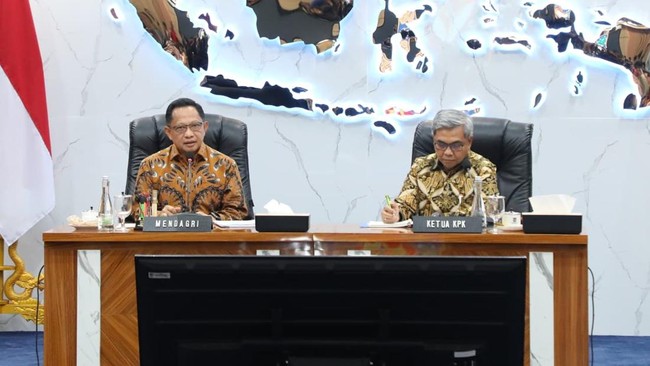
Minister of Home Affairs Muhammad Tito Karnavian has affirmed that his ministry has mapped corruption-prone points in the regions in order to strengthen prevention efforts. According to data from the ministry’s Inspectorate General, these hotspots are spread across several areas, including planning, budgeting, goods and services procurement, implementation, payments and civil servant management.
Other vulnerable areas include licensing, revenue, Regional Government Assets (BMD), regionally owned enterprises (BUMD) and regional public service agencies (BLUD), as well as grants and social assistance (bansos).
Based on these hotspots, Tito underlined the continued existence of commissioned programmes and unsolicited proposals (pokir) that are not aligned at the planning stage, mark-ups in budgeting, the manipulation of winning bidders in goods and services procurement, and invalid recipients of grants or social assistance.
“The main corruption hotspots have been clearly mapped. Therefore, there are eight corruption prevention areas that are our primary focus,” he explained during a joint press conference with KPK Chairman Setyo Budiyanto at the Main Session Room of the Home Affairs Ministry office in Jakarta on Friday (24/7/2026).
Tito ensured that the ministry has taken various steps to narrow the opportunities for corruption in the regions. These efforts began with retreats for regional heads and deputy regional heads after their inauguration, covering materials on national insight, corruption prevention and other topics.
Then, together with the KPK, the ministry developed the Monitoring Center for Prevention (MCP) system. In addition, there is the Regional Government Information System (SIPD), developed internally by the ministry to oversee regional finances, from the drafting through to the implementation of regional budgets, monitored digitally.
The ministry has also involved the Ombudsman and the Ministry of State Apparatus Utilisation and Bureaucratic Reform (Kemenpan-RB) through the “BerAKHLAK” programme.
“With the seriousness of the Home Affairs Ministry, the central government, on the orders of President Prabowo, is collaborating with the KPK to prevent corruption as much as possible. This is a warning for our colleagues in the regions because all the problems have already been mapped — they are all classic problems, and uncovering them will not be too difficult,” he said.
Meanwhile, KPK Chairman Setyo Budiyanto said regional heads caught in sting operations (OTT) generally come from areas with low or vulnerable MCP scores and Integrity Assessment Survey (SPI) results.
“These scores are not merely numbers, but indications that corrupt behaviour or abuse of authority still exists,” Setyo explained.
The KPK Chairman therefore appreciated the Home Affairs Ministry’s steps to strengthen prevention through field activities in a number of regions. Notably, the KPK together with Deputy Home Affairs Minister Ribka Haluk had previously gathered all regional heads in Papua for joint activities to remind those holding regional authority.
“We express our gratitude for the invitation extended in preparation for coordination and supervision activities, including planned field activities in several provinces, cities and regencies,” Setyo concluded.