
Home Affairs Minister Urges Regional Governments to Facilitate Private Sector in Public Housing Programme
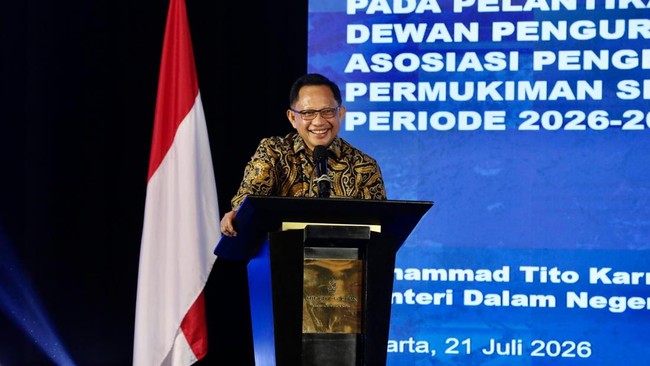
Minister of Home Affairs (Mendagri) Muhammad Tito Karnavian has emphasised that private sector involvement is a crucial factor in optimising the realisation of the Public Housing Programme. The Ministry of Home Affairs (Kemendagri) will therefore continue to encourage regional governments (Pemda) to provide various facilities for developers, so that housing construction for the public, particularly low-income communities (MBR), can proceed more rapidly.
“What must be done is to encourage the private sector to work. Their engine is actually much larger than the government’s,” Tito stated in a written release on Wednesday (22/7/2026).
According to Tito, efforts to resolve the housing backlog cannot rely solely on the State Budget (APBN) and Regional Budgets (APBD). He argued that the business ecosystem must be spurred to ensure the provision of housing for the public can be properly executed.
He explained that the government has introduced various policies to provide convenience to developers. These include the exemption of Building Approval (PBG) levies and Land and Building Acquisition Duty (BPHTB) for low-income communities, as well as simplifying licensing through the Public Service Mall (MPP). However, the implementation of these policies is not yet uniform across all regions.
Consequently, Tito requested the active role of developers to report regions that have not optimally implemented these policies. He also confirmed that the Ministry of Home Affairs would conduct a special evaluation of regions deemed to be hindering the acceleration of housing development.
“I want to get data from fellow developers regarding which regions are making things difficult, which regions are sluggish. I will hold a separate zoom meeting with them and, if necessary, I will issue a letter of reprimand to those regions,” he asserted.
Tito assessed that regional concerns regarding a potential reduction in Regional Original Revenue (PAD) due to the exemption of PBG and BPHTB for MBR are unfounded. According to him, the economic and social benefits generated by housing development are far greater. He explained that the more people who have access to liveable homes, the more poverty rates will decrease. Furthermore, housing construction activities will create jobs, increase transactions in the building materials sector, and expand the tax base for Land and Building Tax (PBB) in subsequent years.
To strengthen this policy, the Ministry of Home Affairs will also coordinate with the Development Finance Comptroller (BPKP) to ensure that the implementation of PBG and BPHTB exemptions for MBR is included as an aspect of regional supervision. Additionally, the Ministry will give appreciation to regions that support the public housing programme.
Concluding his remarks, the Minister invited the Association of Housing Developers (APERSI) to continue strengthening communication with regional heads. He noted that collaboration between regional heads and developer associations is a vital part of accelerating the resolution of housing issues in Indonesia.
Also present at the event were Coordinating Minister for Food Zulkifli Hasan, Minister of Housing and Settlement Maruarar Sirait, and Head of the Central Statistics Agency Amalia Adininggar Widyasanti.