
Home Affairs Minister Tito Suddenly Asks Regional Heads to Oversee Free Nutritious Meals Programme, What's Happening?
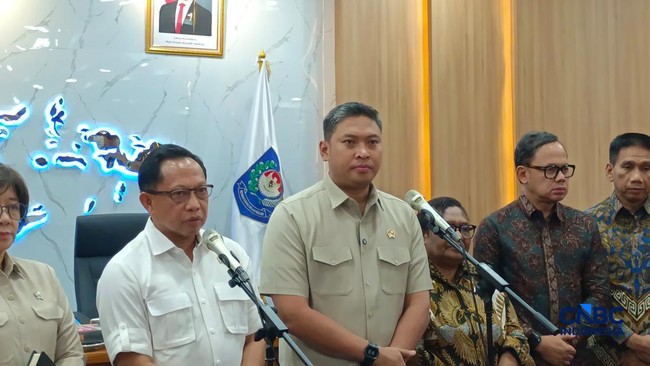
Home Affairs Minister Tito Karnavian has asked all regional heads to utilise the Free Nutritious Meals (MBG) programme to help improve the performance of local governments. According to him, the programme, which is a central government agenda, can help regions improve a number of development indicators without having to burden the Regional Revenue and Expenditure Budget (APBD).
This was conveyed by Tito in a coordination meeting between the National Nutrition Agency (BGN) and local governments throughout Indonesia together with the Head of BGN, Sudaryono.
Tito said that MBG is not only related to fulfilling community nutrition, but also has the potential to help regional heads achieve a number of indicators that measure the success of their administration.
“Because this programme is not only to improve nutrition, prevent stunting… regional heads have their own indicators, to be assessed as successful or not by the community, to increase popularity, electability, and also assessed by the public, assessed by the media, assessed by us as well. The indicators include handling stunting, whether it goes up or down,” said Tito in a press conference at his office, Jakarta, Thursday (13/8/2026).
“Then secondly, poverty, including extreme poverty must be reduced. Then the Human Development Index figure must also increase,” he continued.
In addition to stunting, Tito said MBG can help local governments tackle unemployment, open job opportunities, encourage economic growth and control inflation.
“Then handling unemployment, some time ago I even held a competition among local governments that succeeded in handling unemployment, reducing unemployment, opening job opportunities. Then also the issue of economic growth and inflation control. Well, actually the MBG programme will help all these indicators through the MBG programmes,” he explained.
According to Tito, one of the advantages for local governments is that the programme does not use the APBD. Therefore, he encouraged regional heads to make maximum use of MBG to support their respective development targets.
“Regional head performance indicators can be helped without the APBD. So, ride this programme for the interest of improving good indicators, regional head performance, without having to spend the APBD, free. So the APBD can work for other things,” Tito explained.
Tito also asked local governments to be actively involved in the implementation of MBG, starting from coordination between regional apparatus to the supply of food ingredients.
In a circular issued by the Ministry of Home Affairs, regional heads were asked to provide support for the implementation of MBG as well as coordinate relevant regional apparatus.
The Health Office, for example, was asked to be involved in issuing Hygiene and Sanitation Eligibility Certificates (SLHS), as well as supervising the hygiene of the Nutrition Fulfilment Service Units (SPPG) or MBG kitchens. Meanwhile, the Education Office can help with data collection of beneficiaries, while the Agriculture Office and Fisheries Office can support the supply of food ingredients to MBG kitchens.
“The Education Office in each region plays a role in collecting data on beneficiaries. Then the Health Office also participates in supervising hygiene issues in the existing SPPG. And then we can also utilise the Agriculture Office, then perhaps the Fisheries Office, in each region to supply ingredients to the SPPG,” he said.
Tito assessed that collaboration between the central and local governments is needed because the challenges of implementing MBG differ in each region. For this reason, BGN will have a coordinator in each province and possibly up to the district/city level as a liaison with local governments.
“This collaboration will also be more real in the field with local governments, because later there will be a person in charge or coordinator from each province, and later perhaps in districts/cities. Well, that will later become BGN’s point of contact to discuss the MBG programme, because each region may not have the same challenges, they have specific characteristics,” he said.
On the same occasion, the Head of the National Nutrition Agency (BGN), Sudaryono, also emphasised the importance of local government support to improve MBG governance, especially after food safety issues were still found.
He said his agency applies a zero-tolerance principle towards poisoning cases in the implementation of MBG.
“Our desire is zero tolerance for poisoning cases in the future. And we are currently improving this from the governance side, how to ensure, first, that no one gets poisoned, and also that the quality of MBG food as a nutritional intervention for our children meets our expectations,” said Sudaryono.