
Home Affairs Minister Signs Joint Decree with Housing Minister to Support 3 Million Homes Programme
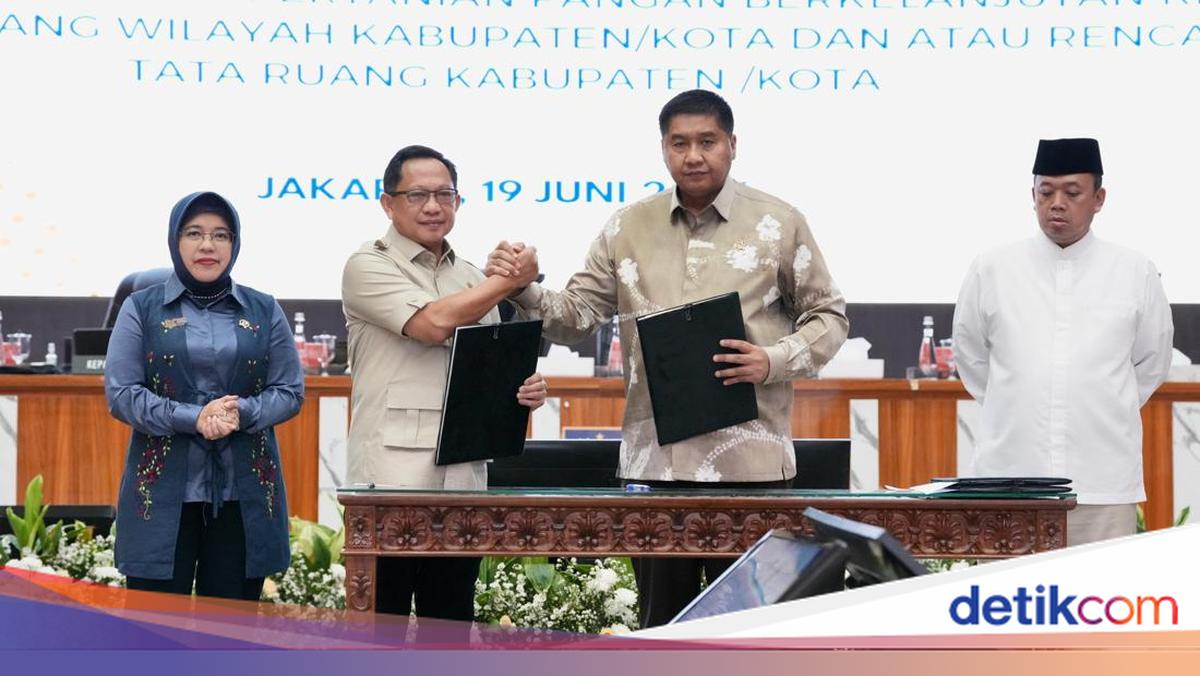
Minister of Home Affairs Muhammad Tito Karnavian and Minister of Housing and Settlements Maruarar Sirait have signed a Joint Ministerial Decree (SKB) to support the acceleration of the 3 Million Homes Development Programme. The signing took place at the Sasana Bhakti Praja Building, the Ministry of Home Affairs headquarters in Jakarta, on Friday.
Tito explained that the SKB aims to strengthen the legal foundation for local governments in supporting the provision of housing for low-income communities (MBR). The 3 Million Homes Programme is one of President Prabowo Subianto’s flagship initiatives.
Since the beginning of the administration, his party, together with the Ministry of Housing and Settlements and the Ministry of Public Works, has moved swiftly to prepare various policies to make house prices more affordable for MBR. These include the exemption of Building Approval (PBG) retribution and Land and Building Rights Acquisition Duty (BPHTB). The policy also adjusts the expanded definition of MBR set by the government.
“This decision has been made and implemented since 25 November 2024. The goal, once again, is to make it easier for the people to obtain and build houses, as well as for developers to build houses for low-income communities at more affordable prices,” Tito said in a written statement on Friday (19/6/2026).
Tito elaborated that through the SKB, the government has expanded the MBR coverage by changing the classification of zones from two to four. This step was taken to adjust the beneficiary criteria to the economic conditions of each region while expanding public access to the 3 Million Homes Programme.
“For example, in Zone 1, the income limit for unmarried individuals has been raised from 7 million to 8.5 million rupiah. For married couples, it has increased from 8 million to 10 million rupiah. In Zone 4, specifically for Jakarta, Bogor, Depok, Tangerang, and Bekasi, where land is scarce and expensive, the MBR definition for unmarried individuals is 12 million rupiah and 14 million rupiah for married couples,” he stated.
Furthermore, Tito highlighted the issue of domicile, which has often been an obstacle for people seeking PBG and BPHTB exemption facilities. He cited the example of people who work in Jakarta but buy houses in buffer cities like Bekasi, Tangerang, or Depok due to more affordable prices. Through the SKB, the government affirms that these incentives for MBR are not restricted by the domicile listed on the local electronic ID card.
“The goal is to make it easier for low-income people, wherever they are, to obtain these facilities in the form of PBG and BPHTB exemptions—5 percent of the NJOP—without having to use a local ID card or local domicile,” he said.
He explained that the policy also benefits local governments. Besides helping to reduce the housing backlog, which is a concern for regional heads, the policy demonstrates the government’s alignment with low-income communities while encouraging the growth of a housing development ecosystem involving the government and developers.
From a regional fiscal perspective, the existence of new houses also has the potential to increase Land and Building Tax (PBB) revenue, as previously unproductive land becomes residential areas with economic value.
“With the construction of buildings, what was once vacant, idle land taxed only on the land itself will subsequently be subject to land and building tax. So they will benefit in the years to come,” he concluded.
The event was also attended by Minister of Agrarian Affairs and Spatial Planning/Head of the National Land Agency Nusron Wahid, Head of the Central Statistics Agency Amalia Adininggar Widyasanti, as well as governors, regents, and mayors who participated virtually.