
Home Affairs Minister Says Dukcapil Data is the Foundation of One Data Indonesia and SPBE
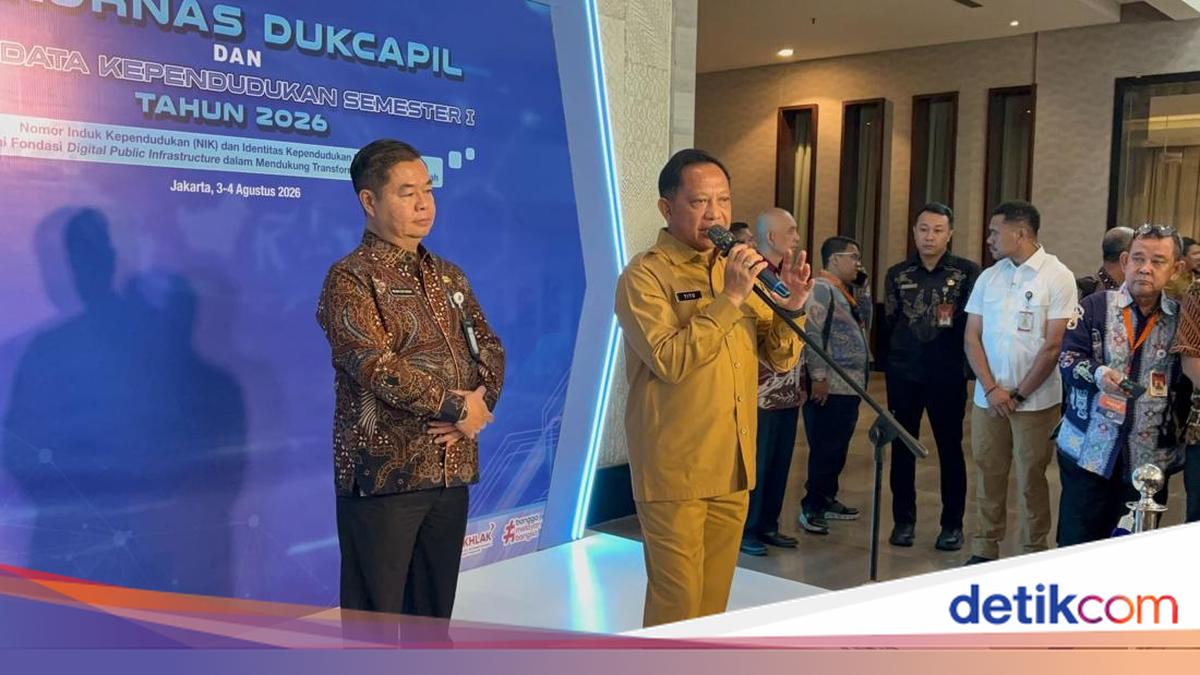
Minister of Home Affairs (Mendagri), Muhammad Tito Karnavian, has stated that population data managed by the Directorate General of Population and Civil Registration (Dukcapil) at the Ministry of Home Affairs is an important foundation for realising One Data Indonesia and the digital transformation of government.
According to Tito, Dukcapil data is one of the most complete population databases because it contains information on Indonesian citizens that is continuously updated through civil registration services in the regions.
“In my view, Dukcapil data is the most complete population data in all of Indonesia,” Tito told reporters after the opening of the 2026 Dukcapil National Coordination Meeting and the Release of First Semester 2026 Population Data at the Bidakara Hotel, Jakarta, on Monday (3/8/2026).
Tito explained that Dukcapil data originates from various civil registration services, from birth and death registration, population movement, to identity changes. The data is also complemented by biometric features such as fingerprints, retinal scans, and facial recognition.
According to him, the completeness of the data allows Dukcapil to serve as a basis for the government in formulating policy, reading the conditions of a region, and determining programmes that match the needs of the population.
“This data is extremely useful. For policy-making, for reading a problem, a map, if you will. How many men there are in one area, how many women, how many are aged, say, 15 to 30, 30 to 50 — all of that can be done using that database,” Tito said.
Dukcapil data supports government data-driven programmes
Beyond supporting policy formulation, Tito said Dukcapil data has also been used in various government programmes, one of which is the digitalisation of social assistance (bansos).
He cited the trial digitalisation of social assistance in Banyuwangi Regency. Tito noted that before data integration was carried out, nearly 70 per cent of recipient data in the area was deemed poorly targeted. After updating and integrating the data, the distribution of assistance became more accurate.
“In Banyuwangi, it was trialled, and nearly 70 per cent was not on target. Now it is well targeted,” Tito said.
Following that success, the government expanded the digitalisation of social assistance to a number of other regions. Tito said data integration allows the government to see the circumstances of assistance recipients based on various supporting information.
Besides government programmes, Tito said Dukcapil data has also been used by various other sectors, including elections and private services.
“This data is also used, including for elections, and also by the private sector. The private sector, for instance, for online transactions, banking for knowing their customers — know your customer,” Tito explained.
Dukcapil as the main platform of One Data Indonesia
Furthermore, Tito said population data integration is also an important part of developing the Electronic-Based Government System (SPBE). According to him, the existence of accurate, interconnected data across agencies will make it easier for the government to formulate policy, implement programmes, and deliver digital-based public services.
“If all the data of ministries and agencies, their programmes and budgets, are combined into one data set, and then all regional governments are combined, perhaps adding the private sector and state-owned enterprises, you can imagine — we would only need to click,” Tito said.
According to Tito, this integration will make it easier for the government to read the needs of each region, from the conditions of the population to the programmes that need to be carried out. In this way, decision-making can be done more quickly and on a data-driven basis.
“The main platform is Dukcapil. We will be able to very quickly find out which regions, for example, need water pumps because of a drought. This can then be fed to the Minister of Agriculture, Public Works, and others,” Tito said.
IKD drives the integration of government services
In addition to strengthening data utilisation, Dukcapil continues to promote the use of the Digital Population Identity (IKD) as part of the transformation of public services.
Director General of Dukcapil at the Ministry of Home Affairs, Teguh Setyabudi, said that people who have activated their IKD can now access a number of Dukcapil services digitally.
“In fact, for IKD users who have activated it, there are now 11 Dukcapil services that can be accessed directly through IKD. They no longer have to go through the Dukcapil office,” Teguh said.
Teguh explained that going forward, IKD will also be developed to support the integration of government services through digital verification and validation systems.
“Once again, IKD will later be used for, let’s say, verification, validation, and also single sign-on with the various portals owned by ministries and agencies. One example is the digitalisation of social assistance,” Teguh explained.
Through the use of the National Identity Number (NIK), IKD, and data integration across agencies, the government is encouraging the formation of a more integrated digital service ecosystem and supporting data-driven policy-making.
For information, the 2026 Dukcapil National Coordination Meeting carries the theme ‘NIK and IKD as the Foundation of Digital Public Infrastructure in Supporting the Digital Transformation of Government’. The forum serves as a vehicle for strengthening coordination between central and regional governments in supporting the government’s digital transformation agenda.
Source: jawawa.id (https://jawawa.id/newsitem/home-affairs-minister-says-dukcapil-data-is-the-foundation-of-one-data-indonesia-and-spbe-1785743599)
Originally published by detikcom (https://news.detik.com/berita/d-8602180/mendagri-sebut-data-dukcapil-jadi-fondasi-satu-data-indonesia-spbe), translated from Indonesian