
Home Affairs Minister Reveals Government Prioritises Post-Earthquake Handling in NTT
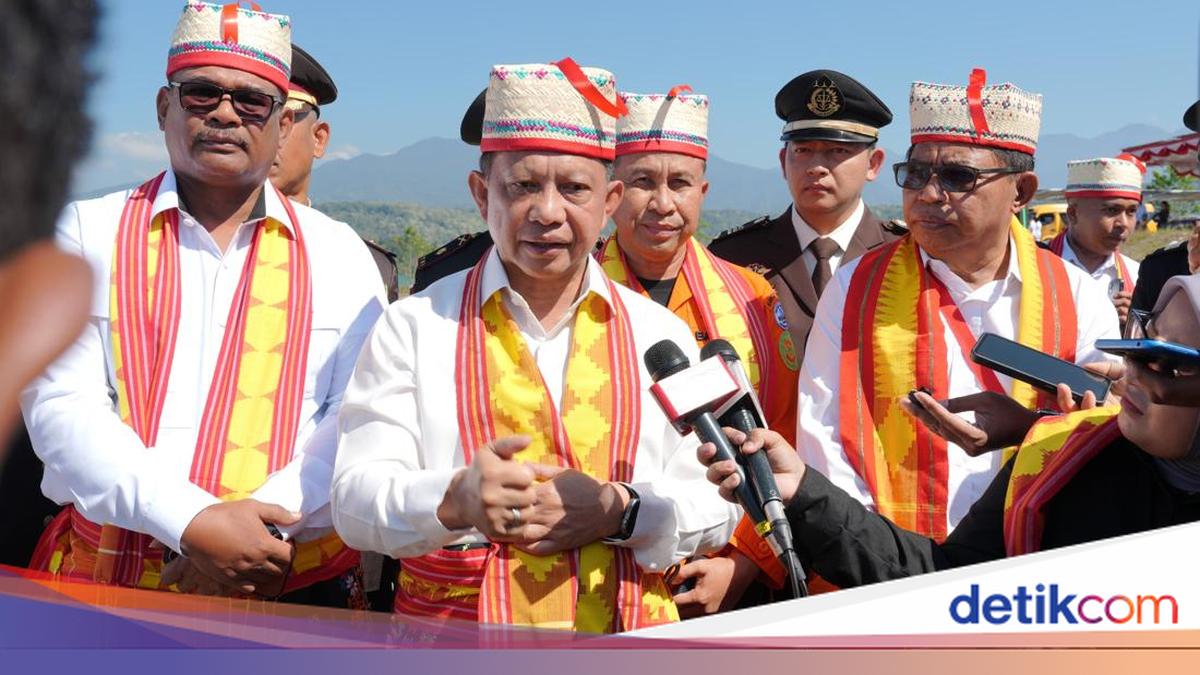
Home Affairs Minister Muhammad Tito Karnavian has affirmed that the central government is prioritising post-earthquake response efforts in East Nusa Tenggara Province, particularly to ensure that the basic needs of affected communities can be met promptly.
This commitment was demonstrated by Tito’s direct presence in East Manggarai Regency. He had initially prepared to attend the 81st Independence Day ceremony at the State Palace.
However, Tito subsequently decided to inspect the conditions of disaster-affected communities in NTT firsthand, in line with President Prabowo Subianto’s directive requesting a number of ministers, agency heads, and deputy ministers to go directly to disaster locations.
“I had already prepared with my wife to attend the Palace; my wife had also prepared clothing, including Toraja attire she had readied. Because the President assigned a number of ministers and agency heads to go directly to NTT, Flores in particular, to assist the region and the central government must be present, so here we are,” Tito said in a written statement on Monday (17/8/2026).
He conveyed this to journalists after leading the 81st Independence Day ceremony at Natas Lehong Field, East Manggarai Regency, NTT, on Monday (17/8).
In the post-earthquake response, Tito emphasised the importance of comprehensive data collection and verification. This step is necessary so that government assistance can be provided accurately according to the level of damage and the condition of affected communities.
Tito explained that the central government is currently prioritising the fulfilment of basic community needs, ranging from evacuation, rescue, and victim handling to the restoration of basic services and mobility access.
Meanwhile, for affected houses, the government will conduct data collection based on the level of damage.
“Damaged houses will need to be categorised as lightly, moderately, or heavily damaged. There are criteria for earthquakes, and assistance will come from BNPB,” Tito said.
According to Tito, the data collection process will be carried out through verification involving regional governments, which will then be validated by the Central Statistics Agency (BPS).
This approach is considered important so that post-disaster handling can be tailored to the characteristics of damage in each region.
For houses that can still be rebuilt at their original location, the government can apply an on-site reconstruction approach.
“It seems that nothing here has been completely destroyed. So the existing houses can be rebuilt, which is called in situ, on-site,” Tito explained.
In addition to ensuring damage assessment, the government is also continuously monitoring the restoration of basic services in affected areas. One of these is the electricity sector, which is showing positive progress.
Tito said that based on information he received from the President Director of the State Electricity Company (PLN), electricity network restoration in affected areas has reached 88%.
“From the PLN President Director, 88% is already on. No power plants were damaged, unlike in cases in several other regions,” Tito said.
“Some damaged substations have been repaired and are back on,” he concluded.