
Home Affairs Minister Opens Dukcapil National Coordination Meeting, Urges Data to Become Foundation of Digitalisation
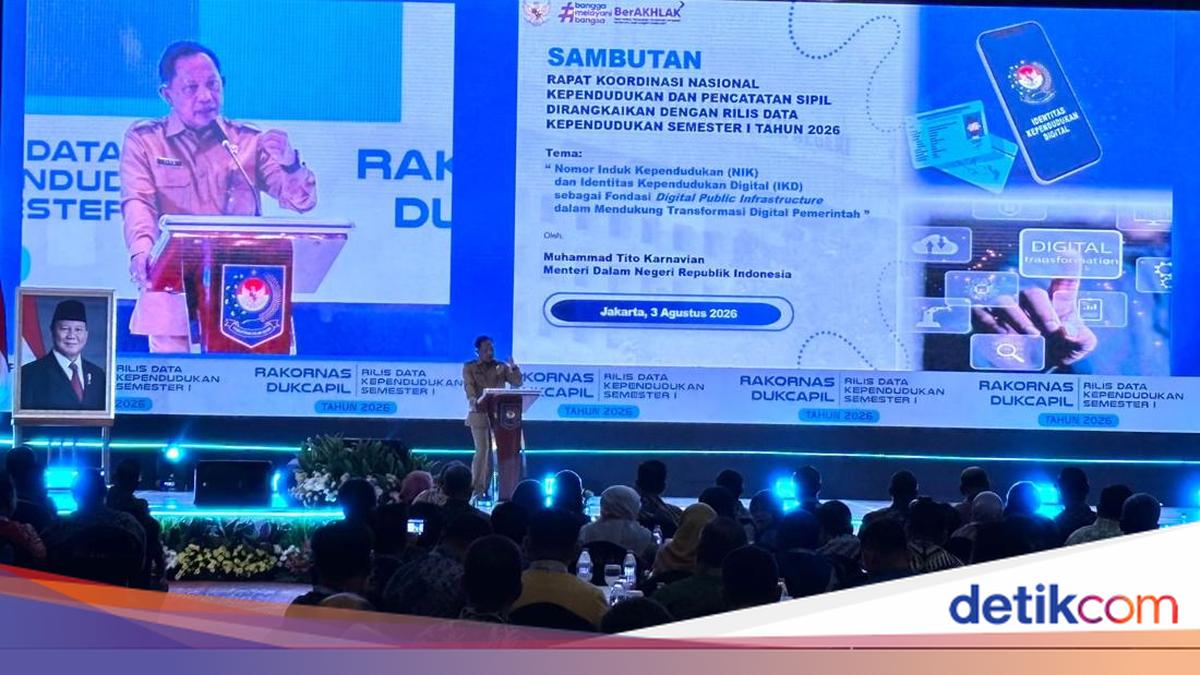
Minister of Home Affairs (Mendagri) Muhammad Tito Karnavian has opened the 2026 Dukcapil National Coordination Meeting (Rakornas). On the occasion, Tito emphasised the importance of strengthening population data as the foundation for digital government transformation and improved public services.
Tito said the civil administration data (Adminduk) managed by the Directorate General of Population and Civil Registration (Dukcapil) of the Ministry of Home Affairs is a crucial foundation because it covers all Indonesian citizens and residents.
“The issue of Dukcapil or civil registration is extremely important as a platform for everything. Because this is the only data that truly covers all citizens and residents in Indonesia,” Tito said when opening the 2026 Dukcapil Rakornas at the Bidakara Hotel, Jakarta (3/8/2026).
He noted that Dukcapil data currently covers nearly 99 per cent of Indonesia’s population. The data is also complemented by various population information, ranging from identity and biometrics to basic community data.
“The most complete data on Indonesia’s population lies with Dukcapil. Roughly 270 million Indonesian residents, soon to be released, are registered with Dukcapil. That is close to 99 per cent,” Tito said.
According to Tito, the strength of Dukcapil data lies in its real-time updates. Data on births, deaths, population movement and marriages is continuously updated through the ministry’s system.
“This data moves — its calculation is not in days, but hours, minutes, seconds. Because almost every second, at least every minute, someone is born and needs a birth certificate,” he explained.
Furthermore, Tito argued that digital transformation requires strong system support, not only in terms of data but also supporting infrastructure. Therefore, the Ministry of Home Affairs, together with Bappenas and the World Bank, will strengthen Dukcapil’s information technology infrastructure through a multi-year programme.
The strengthening covers data storage capacity, networks and cyber security systems. The programme has been prepared to ensure that Dukcapil’s digital services continue to run optimally.
“Once we are playing in digitalisation, we must not be careless. If the system goes down or has a problem, it will cause far more chaos than the manual system,” Tito said.
He added that strengthening the Dukcapil system will be carried out through three main aspects: data storage capacity, data traffic (bandwidth) and system security (cyber security).
“We must not allow a data breach once we are working with data. That would cause chaos — that is our risk with digitalisation,” he said.
In addition to strengthening digital infrastructure, Tito also encouraged the integration of population data with various public services. One example is cooperation with the Ministry of Health so that birth certificates can be issued automatically after a child is born at a health facility.
“Later, every child born at a Ministry of Health facility — whether at central hospitals, regional hospitals or community health centres (Puskesmas) — we will connect. As soon as the child is born, Dukcapil will issue the birth certificate online directly,” Tito said.
Tito added that Dukcapil data will also serve as the foundation for developing the Electronic-Based Government System (SPBE) and the One Data Indonesia programme. According to him, data integration across ministries and agencies will help the government make policy decisions more quickly and precisely.
“If One Data Indonesia can be achieved, it will be amazing. Truly extraordinary. Why? Because data held by ministries and agencies will be merged into one,” Tito said.
He explained that integrated data can help the government understand people’s needs more accurately, while also improving the effectiveness of various public service programmes.
Dukcapil Records 2.57 Billion Data Accesses, Strengthens Digital Infrastructure
Echoing Tito’s directives, Director General of Dukcapil at the Ministry of Home Affairs, Teguh Setyabudi, presented the achievements in population data utilisation throughout 2025. Teguh said Dukcapil data continues to be used by various agencies to support digital-based public services.
Currently, population data is being used by more than 7,693 institutions. In 2025, the number of active user institutions reached 2,283, with total access to Dukcapil data reaching 2.57 billion times.
“Data matching, including the utilisation of population data, now involves more than 7,693 institutions. Positively, in 2025 there were 2,283 active user institutions, with total hits in 2025 of 2.57 billion,” Teguh said.
He said the high level of data utilisation demonstrates Dukcapil’s important role in supporting various service processes and public identity verification.
Beyond expanding data utilisation, Teguh said Dukcapil is also continuing to strengthen its digital infrastructure, from networks and data backup systems to system security.
“Thanks to the support of the Minister, the Secretary General and all the leadership, in 2025 we were able to strengthen infrastructure in various areas, as well as strengthening networks, backup systems and the security system,” Teguh explained.
For information, the 2026 Dukcapil Rakornas, held on 2-4 August, carries the theme ‘NIK and IKD as the Foundation of Digital Public Infrastructure in Supporting Government Digital Transformation’.
The forum serves as a vehicle for strengthening coordination across regional Dukcapil offices in support of national strategic programmes. In addition to the opening of the Rakornas, the Ministry of Home Affairs also launched the Clean Population Data for Semester I of 2026.
Following the launch, Teguh was also scheduled to present the profile of that data in a session titled ‘A Portrait of Indonesia’s Diverse Face in National Population Data’. The Rakornas also serves as a forum for conveying the policy direction for civil administration in the 2027 fiscal year, including strengthening digital-based services and expanding the utilisation of population data.
Source: jawawa.id (https://jawawa.id/newsitem/home-affairs-minister-opens-dukcapil-national-coordination-meeting-urges-data-to-become-foundation-of-1785740056)
Originally published by detikcom (https://news.detik.com/berita/d-8602080/mendagri-buka-rakornas-dukcapil-dorong-data-jadi-fondasi-digitalisasi), translated from Indonesian