
Home Affairs Minister: Only 79 Regions to Receive Additional TKD for Civil Servant Salaries
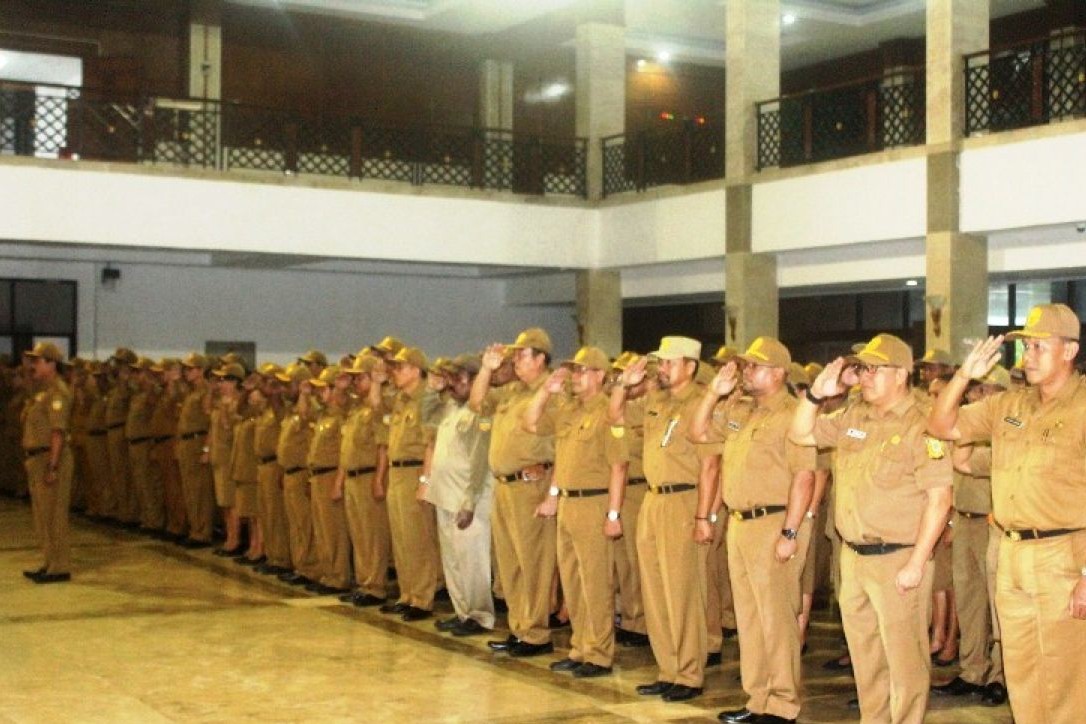
Minister of Home Affairs Tito Karnavian has affirmed that the government will not immediately disburse additional Transfer to Regions (TKD) funds for regional governments claiming difficulty in paying personnel expenditure. Based on the Ministry of Home Affairs’ provisional mapping, only around 79 regions are estimated to require additional budgets after undergoing a series of evaluations.
Tito made the remarks at the Government Communication Agency office in Jakarta on Wednesday (5/8), responding to Finance Minister Purbaya Yudhi Sadewa’s earlier statement that some 490 regions were estimated to be experiencing budgetary problems.
According to Tito, the government has prepared three steps before deciding to provide additional funds to the regions. The first stage is ensuring that regional governments have carried out maximum budget efficiency.
“We will send down a team to check whether efficiency measures have been carried out. Efficiency first,” Tito told reporters.
He explained that a number of regions had previously claimed they lacked sufficient budget to pay personnel expenditure, including after the addition of contractual government employees (PPPK). However, upon inspection, the problem actually stemmed from expenditure deemed inefficient.
Tito cited examples of spending that could still be curbed, such as meeting costs, official travel, and various other operational activities. Once these items were reduced, the regions’ capacity to pay staff salaries proved sufficient.
He also mentioned steps taken by the Lahat Regency Government as an example of budget efficiency. According to him, the region managed to save around Rp400 billion from personnel operational support spending.
“That is what I am asking for — do that first. Don’t just immediately ask for an increase in the General Allocation Fund (DAU). No. Carry out efficiency first,” he said.
If the evaluation shows that a region has indeed made savings but still faces a budget shortfall, the government will move to the second stage, namely examining the region’s entitlement to Revenue Sharing Funds (DBH) that have not yet been disbursed.
According to Tito, the government will coordinate with the Ministry of Finance so that any outstanding DBH is paid promptly. If those funds are sufficient to cover personnel expenditure needs, the matter is considered resolved without the need for new additional budget.
Only in the final stage will the government consider providing a top-up from the Ministry of Finance. This step is taken if the region has carried out efficiency measures, has no unpaid DBH, or the DBH received remains insufficient to pay personnel expenditure.
“Once we dissect it — still not enough. DBH? There is none. Or there is DBH, but it is not enough to pay personnel expenditure. There is no other way. This must be topped up by the Ministry of Finance. And our calculation is roughly at least 79 regions,” Tito said.
Tito also clarified the difference between the figures presented by the Ministry of Home Affairs and the Ministry of Finance. According to him, the figure of 490 regions cited by the Finance Minister refers to regions whose DBH has not yet been paid, not all of which are confirmed to be unable to pay personnel expenditure.
“The 490 are those whose DBH has not been paid. So not those who cannot pay. As for those who cannot pay personnel expenditure, we see a minimum of 79,” he said.
He added that if the Ministry of Finance later decides to assist more regions through DBH payments or additional General Allocation Fund (DAU), the Ministry of Home Affairs would not object.
According to the ministry’s calculation, the additional budget needed to cover personnel expenditure in the roughly 79 regions reaches around Rp3.7 trillion. Meanwhile, if accompanied by strengthening other budgetary needs, the total requirement approaches Rp14 trillion.
Tito revealed that this calculation differs from the Ministry of Finance’s estimate of nearly Rp20 trillion. Nevertheless, he stressed that the government will first ensure all regional financing instruments are optimally utilised before deciding to provide additional funds from the central government.
Deputy Home Affairs Minister Bima Arya has urged regional governments not to rush to dismiss employees despite fiscal pressure resulting from cuts to the Transfer to Regions (TKD).
The entire disbursement process is carried out without additional withdrawal conditions, so regional governments can immediately use the funds for their needs.
The TKD increase is a realisation of the Interior Minister’s proposal to President Prabowo Subianto and the House of Representatives (DPR RI).
The government is adding Rp10.6 trillion in TKD for flood and landslide recovery in Aceh, North Sumatra, and West Sumatra. The funds will be disbursed in stages from February to April 2026.
The KPPOD has assessed that 25 years of regional autonomy have shown progress in poverty reduction and improvements in the Human Development Index, but trends towards recentralisation and fiscal dependence on the centre are strengthening.