
Home Affairs Minister Applauds Open Tender Scheme in Bandung Housing Programme
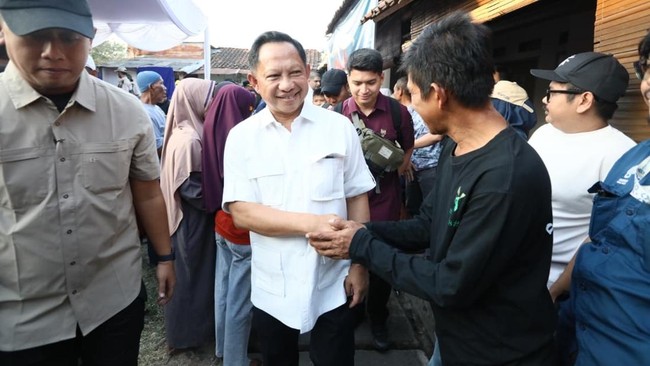
Minister of Home Affairs Muhammad Tito Karnavian, alongside Minister of Housing and Settlement Areas Maruarar Sirait, inspected a public housing programme in Cilampeni Village, Ketapang District, Bandung Regency, West Java, on Saturday. During the visit, the Home Affairs Minister observed a simulation of the Open Shop Selection (PTT), described as a ‘people’s tender’, for the implementation of the Self-Help Housing Stimulant Assistance (BSPS) programme. He commended the mechanism for its openness and transparency, noting that shop owners can openly display the types of building materials offered along with their prices. ‘I have often accompanied him (the Housing Minister). This is a very good programme, because there is this people’s tender, the money is all completely open. Everything is transparent,’ he stated. The Home Affairs Minister also engaged in dialogue with building shop owners, checking and verifying the data on building materials and prices displayed. He welcomed the mechanism as it enables the public to obtain quality building materials at lower prices. ‘This means whoever is cheapest will win. And then the remaining money is returned to the people. They can discuss what to use it for,’ he added. He further said that the government, under the direction of President Prabowo Subianto, continues to strive to make it easier for low-income communities to obtain decent housing, including through the exemption of Building Approval retribution and Land and Building Rights Acquisition Duty for low-income citizens. ‘Now, specifically for low-income communities, it is reduced to zero. And the definition of low-income communities has also been somewhat expanded by the Housing Minister,’ he added. The Home Affairs Minister expressed hope that these facilities would further boost regional economic turnover, particularly in the housing sector. He also urged regional heads not to worry about the policy, as increased house construction would have an economic impact that ultimately increases locally-generated revenue. ‘With a house, previously empty land only generated land tax. But if there is a house, next year there will be land and building tax. So locally-generated revenue will increase,’ he concluded.