
HNW States That Indonesia's Halalbihalal Tradition Is Inseparable from Muhammadiyah's Role
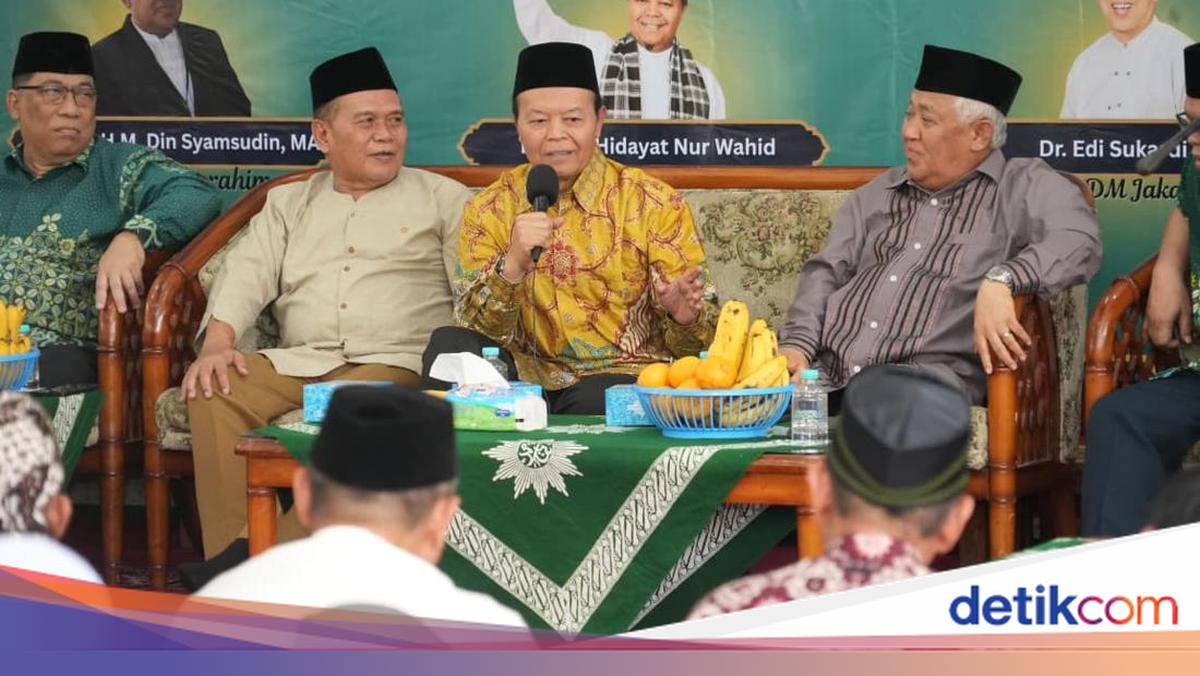
Deputy Chairman of the MPR RI and Member of Commission VIII of the DPR RI, Hidayat Nur Wahid (HNW), has stated that the halalbihalal tradition has become an accepted and inseparable part of Indonesian society. This is due to its strong historical roots and beneficial social practices.
HNW noted that the term is one of the legacies of ijtihad from Muhammadiyah circles. It was initially popularised by Rahmad, a Muhammadiyah resident from Gombong, Central Java, through his writing in the 5th edition of Majalah Soeara Moehammadijah in 1924, in a special column that facilitated readers in expressing apologies and building silaturahmi through the mass media, using the term ‘Alal Bihalal’. Ahead of Eid al-Fitr in 1926, Majalah Soeara Moehammadijah then featured an advertisement with the term now more widely known, namely ‘Halal bil Halal’.
“Thus, the tradition known today as ‘Halal bi Halal’ is inseparable from the role of (Muhammadiyah members) in popularising the term in the life of the ummah, as part of efforts to present an enlightening Islam and strengthen brotherhood,” said HNW in his statement on Sunday (29/3/2026).
He made these remarks during the Eid al-Fitr Silaturahim event 1447H with the PD Muhammadiyah South Jakarta.
HNW, who is also an Advisor to PD Muhammadiyah South Jakarta, added that in its historical journey, specifically in 1948, the term halalbihalal was then adopted in a national context. KH Wahab Hasbullah in 1948 responded to President Soekarno’s request to hold an event that would attract the presence of national figures beyond the term ‘Silaturahim’.
He proposed to President Soekarno to use the term halalbihalal to bring together and reconcile national figures who were then experiencing political tensions. President Soekarno accepted it, and it became a tradition practised in the state palace in particular and in Indonesia in general.
“The Halal bi Halal momentum in the early days of independence became a strategic means to strengthen unity against the colonial Dutch’s divide et impera politics. This shows that Islamic traditions can be accepted, continued, and make a significant contribution to maintaining national integrity and strengthening the bonds of brotherhood among national leaders and fellow citizens,” he explained.
According to HNW, this year’s halalbihalal momentum has a broader meaning, not only as a socio-religious tradition but also as a means to strengthen collective commitment in facing global problems, including the major annual agenda of the Muslim ummah post-Ramadan, namely the Hajj pilgrimage.
“This year, for the first time, the Hajj pilgrimage in Indonesia is organised by the Ministry of Hajj and Umrah. As a result of our struggle in Commission VIII, it is certainly hoped to bring better, professional organisation, free from legal cases, and oriented towards the welfare of the pilgrims, and all that must be based on ‘halal’ principles and carried out ‘bil halal’. So that there will be no more cases of the Minister of Religious Affairs having issues with the KPK,” HNW emphasised.
“The commitment to improving Hajj organisation was actually also initiated by Muhammadiyah. When KH A Dahlan demanded improvements in Hajj organisation with the Hajj Ordinance and then formed the Hajj Assistance Section in 1922, which was directly led by his student KH M Sudja,” he continued.
In addition, HNW also invited Muslims to make the halalbihalal momentum a means to strengthen solidarity with the struggle of the Palestinian people, as well as to save Masjid Al-Aqsa. This stance, in the Indonesian context, was actually pioneered by young Muhammadiyah cadres who later became the Father of the Nation and National Hero, namely Abdul Kahar Mudzakkir.
At that time in 1931, said HNW, he was only 24 years old, but he was trusted by the Mufti of Jerusalem as-Sayyid M Al Amin al-Husaini to fight for Palestine and Masjid Al-Aqsa at the World Islamic Conference in Al-Quds, where Kahar Mudzakkir was even trusted to be the ‘Katib’/Secretary.
“Nowadays, the fate of Palestine (Gaza, West Bank) is not getting more peaceful, better, but even with the Israel & US war against Iran, their condition is getting worse. Peace is getting further away,” HNW revealed.
Moreover, continued HNW, when the Israeli military closed Masjid Al-Aqsa since the beginning of the Israel & US war with Iran. This incident is the first time since the occupation of the Al-Quds area in 1967 by Israel, for the first time Tarawih prayers, I’tikaf, Friday prayers, and Eid al-Fitr prayers were prohibited from being held at Masjid Al-Aqsa. And this closure is still ongoing until the month of Shawwal, until 15 April 2026.
If there is no strong global solidarity and effective pressure from international institutions, said HNW, then the closure of Masjid Al-Aqsa could become permanent, even the first qibla mosque of the Muslim ummah could be demolished and replaced with the Solomon Temple, in line with the Zionist programme to realise the claim of Greater Israel. And if that happens, the aspiration to establish a Palestinian state will be dashed because it cannot be realised.
“Therefore, Halal bi Halal must also become a momentum for the Muslim ummah to return to its fitrah by strengthening solidarity for Masjid Al-Aqsa and Indonesia’s support for saving Masjid Al-Aqsa and Palestinian independence, continuing what was previously fought for by Prof Dr. KH Abdul Kahar Mudzakkir, a young Muhammadiyah cadre, who became a member of BPUPKI, the Committee of Nine, and later became the Father of the Nation and National Hero,” he concluded.
Source: jawawa.id (https://jawawa.id/newsitem/hnw-states-that-indonesias-halalbihalal-tradition-is-inseparable-from-muhammadiyahs-role-1774792277)
Originally published by detikcom (https://news.detik.com/berita/d-8420767/hnw-sebut-tradisi-halalbihalal-di-ri-tak-lepas-dari-peran-muhammadiyah), translated from Indonesian