
HKTI Agribusiness Investment Partnerships Aim to Boost Indonesia’s Food Self-Sufficiency
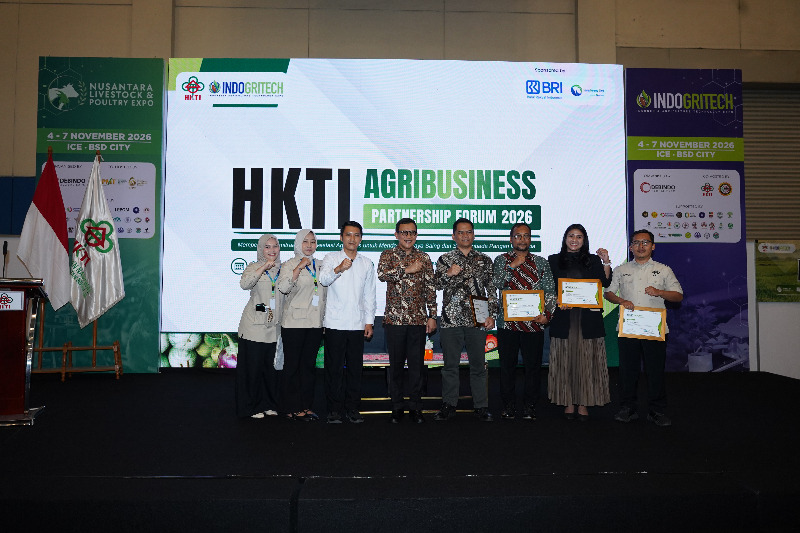
The Indonesian Farmers’ Harmony Association (HKTI) held the 2026 HKTI Agribusiness Partnership Forum on Saturday, 7 November 2026, at the Business Programme Area of Indogritech, Indonesia Convention Exhibition (ICE) BSD City, South Tangerang. The forum was a step towards strengthening HKTI agribusiness investment partnerships to support Indonesia’s food self-sufficiency.
The event’s theme was “Strengthening Agribusiness Partnerships and Investment to Boost Indonesia’s Competitiveness and Food Self-Sufficiency”. It brought together government, banks, state-owned food companies, investors, academics and farmers’ economic organisations to discuss stronger collaboration and faster transformation of the national agricultural sector through investment, financing and agribusiness value-chain development.
The event, hosted by Akhmad Fathoni, drew participants from various groups, including students from Sultan Ageng Tirtayasa University (Untirta) and UIN Jakarta, HKTI members and farmers from Pontang in Serang Regency.
Self-sufficiency must be competitive
HKTI’s National Board Secretary-General, H. Abdul Kadir Karding, said the gains in food self-sufficiency must be sustained and extended to other strategic commodities. Agricultural development, he said, should not be measured solely by higher production, but must also ensure national food security and sovereignty.
“If we remain dependent on rice imports while our source countries are in conflict, that is a problem. Food is the foundation of national sovereignty,” Abdul Kadir Karding said.
He said agricultural development required four interconnected elements: self-sufficiency as the goal, competitiveness as a prerequisite, agribusiness investment as the driving force, and partnerships as the means of achieving it.
“Self-sufficiency without competitiveness will be costly for consumers and the state budget, and will not improve farmers’ welfare. Robust self-sufficiency must therefore be efficient and high-quality, and able to compete in domestic and global markets,” he said.
He also stressed the importance of making supply chains more efficient and ensuring that farmers’ organisations are actively involved in investment projects in the regions.
“Investment that marginalises farmers will be fragile; investment that includes them will endure. HKTI serves as a bridge connecting farmers, investors and markets through a pentahelix partnership model and practical work focused on resolving problems at the farm level,” Abdul Kadir Karding said.
Banking’s role: three pillars of agribusiness growth
Representing the banking sector, Farina, a senior vice-president at state-owned PT Bank Rakyat Indonesia (Persero) Tbk (BRI), said the bank was committed to supporting the three pillars of agribusiness growth: investment, financing and business development.
BRI is the largest provider of People’s Business Credit (KUR) to the agricultural sector, accounting for 81.22% of national agricultural KUR disbursements. It encourages farmers to use financing facilities in line with their business cycles and join its supported clusters to strengthen their operations and build sound financial track records.
Seed self-sufficiency through grower partnerships
Agustinus Budi S., vice-president of research at state-owned PT Sang Hyang Seri (Persero), outlined fundamental business restructuring and the transformation roadmap for Tropical Precision Genetics. To strengthen national seed self-sufficiency, the company plans to reactivate 33 Seed Production Units (UPB) across Indonesia.
“Seed self-sufficiency is built through partnerships, starting with seed growers in the field,” Agustinus Budi S. said.
He also described benefits for partner growers, including guaranteed purchases of their produce (offtake), agronomic assistance and a one-day payment system.
Government support: KUR, machinery and insurance
Concluding the presentations, Agriculture Ministry Director of Agricultural Financing Dr Drh Purwanta said the government was continuing to improve access to agricultural financing and ensure it reached the right recipients. By November 2026, agricultural-sector KUR disbursements had reached Rp104.03 trillion, with agriculture consistently among the largest recipients of national productive financing.
“The closed-loop model connects farmers, farmers’ economic organisations, offtakers, financing institutions and the government in an integrated supply and value chain from upstream to downstream,” Purwanta said.
In addition to KUR, the Agriculture Ministry is expanding access to subsidised credit for agricultural machinery and equipment (Alsintan), with a ceiling of up to Rp2 billion, and providing farm protection through Rice Farming Insurance (AUTP).
HKTI calls for practical partnerships, not ceremony
HKTI and other stakeholders hope to establish concrete, sustainable agribusiness partnerships that go beyond discussion forums and ceremonies. Proposed arrangements include contract farming, closed-loop partnerships and joint processing of agricultural products to strengthen the national agribusiness ecosystem.
Source: jawawa.id (https://jawawa.id/newsitem/hkti-agribusiness-investment-partnerships-aim-to-boost-indonesias-food-self-sufficiency-1794271825)
Originally published by trubus.id (https://trubus.id/kemitraan-investasi-agribisnis-hkti/), translated from Indonesian