
History Speaks! The Struggle for the Strait of Hormuz is Only Temporary and Ephemeral
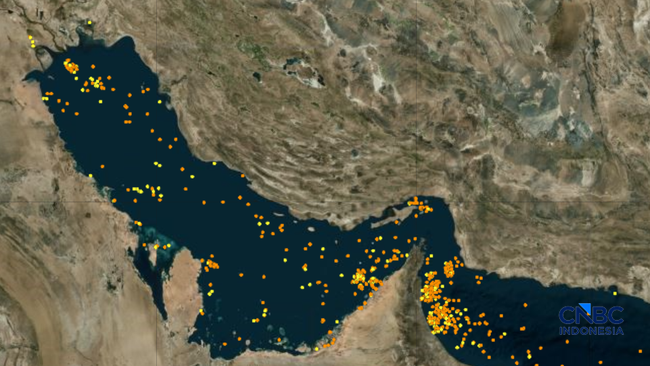
The Strait of Hormuz and Bab el-Mandeb have become synonymous with geopolitical competition in recent months. Whoever controls these narrow waterways holds command over the maritime traffic flowing from the Arabian Sea and the Red Sea towards the Indian Ocean and beyond—a vital component of global trade.
However, the conflict over these straits has existed almost since the very beginning of modern maritime trade itself. “The feud between the US and Iran regarding these strategic points is merely the latest chapter in a long history—spanning centuries—in which extra-regional powers have sought to influence or dominate the Middle East through sea routes,” wrote Ibrahim Al-楽しMarashi in The Conversation, as cited on Saturday (26/9/2026).
According to Ibrahim, although maritime hegemony from extra-regional powers may occur, its nature is merely temporary. “The historical lesson is that while maritime hegemony from extra-regional powers may occur, it is only temporary and ephemeral, much like the waves that carry it,” he asserted.
History has proven this. After World War II, the balance of power shifted again. The US replaced Britain by establishing military bases, aircraft carrier task forces, and conducting arms sales in exchange for access to Gulf oil. In 1980, US President Jimmy Carter stated that any Soviet attempt to control the Gulf region would be considered an attack on American interests and would be met with military force.
Forty-five years later, Trump effectively (though perhaps unintentionally) dismantled the Carter Doctrine. Although US naval ships are now in the Strait of Hormuz to protect freedom of navigation, it was actually the war ignited by Trump in February 2026 that initially endangered shipping, as it prompted Iran to disrupt trade in the Gulf as a retaliatory measure.
It began with China. China withdrew its naval fleet, Portugal lost control of Hormuz, the Netherlands focused on Java, and Britain abandoned Aden. Power dominance shifts when hegemonic powers exceed their capabilities, technology changes, and local alliances undergo restructuring.
Iran and the Houthis—who recently seized Mocha—do not require aircraft carrier fleets. Instead, their missiles, mines, and drones have turned maritime insurance costs into a weapon. Despite its immense naval strength, the US cannot eliminate the active role of local communities around the Strait of Hormuz and Bab el-Mandeb. Every empire of the past has realised that controlling a chokepoint does not necessarily mean controlling the political dynamics and the will of the surrounding populations.
China during the Ming Dynasty provides one of the earliest examples of an extra-regional power projecting power through naval strength and diplomacy. In 1405, Zheng He—a Chinese Muslim admiral, explorer, and diplomat—embarked on the first of seven expeditions across the Indian Ocean. Leading a fleet of over 300 ships, he reached the city of Hormuz around 1414, then Aden in Yemen, and crossed Bab el-Mandeb to enter the Red Sea.
This ‘Pax Sincia’ did not aim to conquer these straits. Instead, this presence built a strong trading position through naval displays of force, diplomatic missions, and high-value gift exchanges. Unlike the colonial powers of later eras, Zheng He did not establish colonies in Hormuz or along the Arabian coast. Rather, he integrated into the existing trading system built by Arab, Persian, Indian, and East African traders in the region.
“These voyages also demonstrated the limits of maritime power that exceeds its capacity,” he noted. After Zheng He’s final expeditions in the 1430s, a change in priorities within the Ming Dynasty ended the series of voyages. The state was no longer willing to invest in the navy or its maintenance costs.
Currently, China refers to Zheng He’s voyages to provide historical legitimacy for China-Middle East relations. Beijing presents its modern investments in infrastructure, energy, and ports—such as Gwadar in Pakistan—as a revival of ancient peaceful relations, the traces of which have existed since the pre-modern Silk Road era.
However, in the 1500s, the increase in global shipping traffic and the arrival of European colonial powers marked a shift towards more forceful and aggressive attempts to control the straits. The Portuguese were innovators in naval warfare; they introduced a more coercive form of maritime power using heavy cannons on ocean-going vessels.
In 1513, Afonso de Albuquerque attacked Aden in an attempt to control access to the Red Sea. He failed to capture the fortified city on the mainland, which was surrounded by rugged mountainous terrain. As the United States learned centuries later, naval superiority does not necessarily result in victory on land.
“Portuguese warships were indeed capable of destroying enemy ships and bombarding ports, but controlling the waters outside the port is not the same as controlling the land territory behind it,” said Ibrahim.
Nevertheless, in 1515, Albuquerque successfully captured the city of Hormuz. There, he imposed the cartaz, a paid permit for merchants to traverse the gulf and the Indian Ocean. Essentially, this type of trade regulation is what Iran is now attempting to implement through its toll system.
Source: jawawa.id (https://jawawa.id/newsitem/history-speaks-the-struggle-for-the-strait-of-hormuz-is-only-temporary-and-ephemeral-1790416325)
Originally published by CNBC Indonesia (https://www.cnbcindonesia.com/research/20260926112937-128-771143/sejarah-berbicara-perebutan-di-selat-hormuz-hanya-sementara-fana), translated from Indonesian