
History Is More Than a Parade Through the Streets
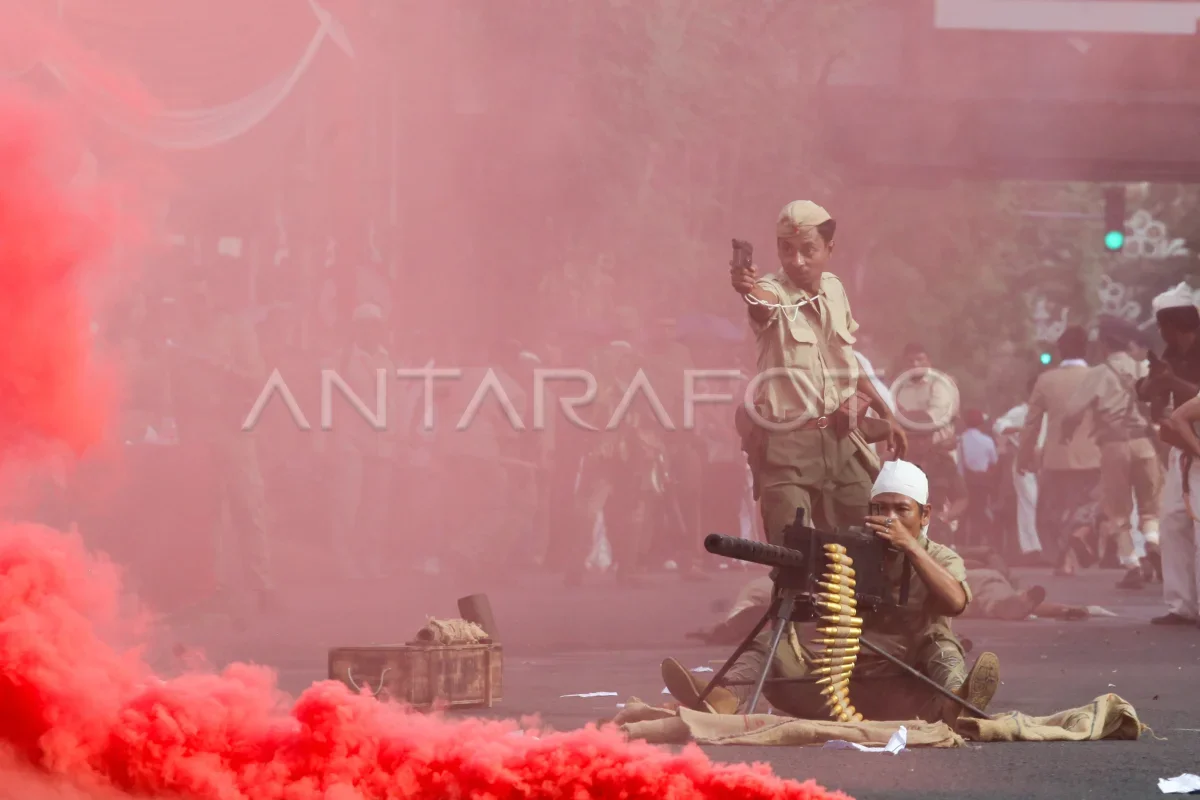
Surabaya has a strong historical legacy. But pride in the past must go hand in hand with the courage to address the problems of the present. The Parade Juang has provided a platform for preserving collective memory.
SURABAYA (ANTARA) – Sirens blared, sharpened bamboo spears were raised, and ranks of popular militias moved through the streets. Scenes from the struggle for independence were brought to life once again at Surabaya’s 2026 Parade Juang.
However, the parade’s significance must not end with the spectacle. The challenge is to turn historical memory into knowledge, concern and concrete action.
Held on 1 November 2026 under the theme “Suroboyo Wani”, the parade was watched by around 170,000 people and involved 2,150 participants, including 375 historical re-enactors from various regions.
Veterans, the Indonesian Military (TNI), the National Police (Polri), the flag-raising troop (Paskibraka), history communities, young people and other groups travelled from the Tugu Pahlawan area to Balai Pemuda along a route of about 2.5 kilometres. Participation from different groups showed that Surabaya’s history is a shared memory.
Collective memory
One of the parade’s most compelling elements this year was the story of Soegiharto, a Persebaya player in the 1930s who was portrayed leaving the football field to join the defence of independence.
His story brought together the history of the independence struggle and the world of sport. Persebaya, which brought the President’s Cup trophy, and the Bintang Timur Surabaya futsal team extended the message of national unity to the sporting arena.
Soegiharto’s story also serves as a reminder that the struggle was not carried out only by prominent figures or people bearing arms. Indonesians from different backgrounds could take responsibility when the nation faced a threat.
Scenes depicting the Student Genie Troops, fighting in the Tunjungan area, and the raising of the Red and White flag in front of the Majapahit Hotel also introduced locations that hold significance in Surabaya’s history. The city itself thus becomes a learning resource about the events that shaped the identity of the City of Heroes.
Theatrical presentations can complement the teaching of history in schools. Children can do more than memorise dates and names; they can also understand the atmosphere and sacrifices of the independence struggle.
Even so, an engaging performance does not automatically foster understanding. Audiences may remember the costumes and spectacle more than the historical context behind them.
For this reason, re-enactments should be accompanied by accurate information about the time, place, figures and background of the events. Information could be provided through display boards, QR codes, guides or digital materials.
Historians, museums, teachers and history communities should be involved to ensure that dramatisation does not obscure the facts. The parade will be more meaningful if the enjoyment of watching it also inspires people to read, ask questions and visit historical sites.
Supporting materials should also remain available after the event, so that schools and families can use them as a basis for discussion. In this way, a momentary experience can develop into an ongoing learning process.
Source: jawawa.id (https://jawawa.id/newsitem/history-is-more-than-a-parade-through-the-streets-1793584331)
Originally published by Antara (Indonesian) (https://www.antaranews.com/berita/5825515/sejarah-tak-sekadar-berarak-di-jalanan), translated from Indonesian