
Historic Value of Denpasar’s Heritage District Said to Be Increasingly Eroded
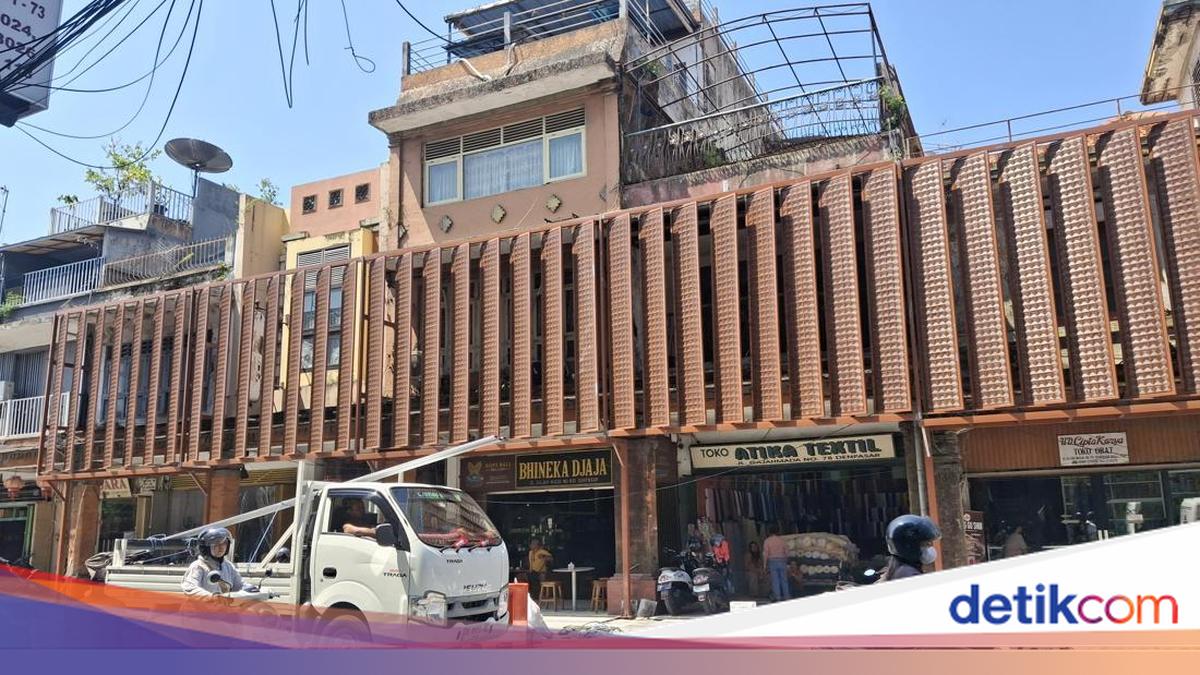
The bustle of traditional markets, colonial-style buildings, rows of Chinese-influenced shop houses, temples and modern cafés converge in the heart of Denpasar. Chinese, Balinese and Dutch cultural influences blend into a distinctive identity in the heritage district along Jalan Gajah Mada. This diversity is more than a visual attraction: it also tells the story of the area’s history and the economic life of the community that has grown there.
The district has been given repeated makeovers. This year, it is being redeveloped again, with a striking visual change: secondary skins are being installed over the façades of buildings on both sides of the street. Large brown windows decorated with carvings are lined up uniformly in front of the shops, obscuring the upper portions of the buildings.
Although work on the secondary-skin façades is still under way, the project has already attracted criticism from architecture professionals. The effort to beautify the district’s appearance is seen as potentially obscuring its historic value and threatening the identity for which Gajah Mada has long been known.
Bayu Krisna, an architect and principal architect at Atelier 5758, who has worked in the design and construction field for more than a decade, said a heritage district comprises more than old buildings; it is also shaped by other elements of identity.
“A heritage district does not consist solely of historic buildings. It has economic networks, social practices, trading patterns, intergenerational relationships and the collective memories of the community, all of which shape its identity,” he told detikBali on Friday (13 November 2026).
Applying a single design language to buildings with different characteristics could make the district’s architectural diversity and layers of history harder to recognise. The Jalan Gajah Mada corridor in Denpasar has developed organically, shaped by distinct historical layers from different periods.
“From an architectural perspective, standardising façades could obscure the diverse character of buildings that has developed over time,” Bayu added.
He explained that the identity of a historic district is formed through layers of time, including buildings from different periods, changes in function and materials, variations in proportions, and the relationship between buildings and surrounding community activity.
“When these different façades are covered by one uniform design language, there is a risk that this diverse history will become even more difficult to read,” Bayu said.
Beyond the question of historic value, the use of secondary skins must also take account of each building’s function and needs. Architecturally, a secondary skin is an additional layer on a building’s envelope that can reduce sun exposure, control heat and glare, provide privacy and create a more comfortable indoor environment.
However, its suitability depends on factors including the building’s orientation, materials, degree of openness, distance from the façade and the needs of its interior spaces. A secondary skin is therefore not automatically an appropriate solution for every type of building.
In the context of Gajah Mada, Bayu questioned whether all the buildings had the same environmental needs and whether their façades and the spaces behind them had been thoroughly assessed. He also raised concerns about the effect of the added layer on natural light, air circulation and the ease of maintaining the buildings in the future.
“If the main aim is visual uniformity, we should also ask whether that is the right priority for revitalising a heritage district. An architectural intervention should be justified by its needs and benefits, not just its appearance,” said Bayu, who was born and raised in Denpasar.
Bayu also raised safety concerns. Without access to technical documents or an on-site inspection, he said he could not draw conclusions about the safety of the construction.
However, he outlined several matters that should be checked when installing secondary skins, including the structural system and connections, resistance to wind loads, the risk of corrosion and the condition of the existing buildings.
“It must be ensured that the installation does not obstruct lighting, ventilation, maintenance access or access for rescue and fire evacuation, especially if the building is also used as a residence,” he said.
Bayu said he hoped the project to beautify and preserve the old city would be carried out with a more comprehensive understanding of the district. This should include the history of its buildings, architectural value, trading patterns, socio-economic conditions, mobility, and the needs of people who live and work there.
“From a conservation perspective, we need to know what has historical value and how that value can be carried forward. From an economic perspective, revitalisation needs to consider the sustainability of local traders and businesses, rather than focusing only on the potential for new commercial activity,” Bayu said.
From an urban-planning perspective, he said, priorities should include the quality of pedestrian routes, traffic safety, accessibility, climate comfort and the relationship between buildings and public spaces. In terms of governance, the process should involve affected communities and professionals from different disciplines, and be supported by assessments that are accessible and accountable to the public.
He said Denpasar’s character should not always be expressed solely through traditional ornaments or architectural symbols. A city’s identity is far more complex, shaped by its history, people, activities, environment and the everyday use of its spaces.
“Revitalisation should not be about making a district look more historic, but about ensuring that the history and life that shaped it still have a place in the future. Ultimately, the success of revitalisation is not only about what is built, but also about what is preserved, improved and carried forward,” Bayu concluded.
Source: jawawa.id (https://jawawa.id/newsitem/historic-value-of-denpasars-heritage-district-said-to-be-increasingly-eroded-1794585062)
Originally published by detikBali (https://www.detik.com/bali/wisata/d-8752270/nilai-historis-kawasan-heritage-denpasar-dinilai-makin-terkikis), translated from Indonesian