
Hino: From the Driver's Seat, Delivering Love, to Driving the Nation's Economy
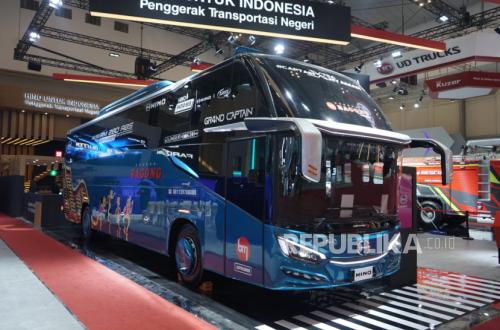
REPUBLIKA.CO.ID, TANGERANG – Let us call him Sarib. This middle-aged man from Pemalang is a driver for an intercity and interprovincial bus service operating the Jakarta-Kendal route. When Republika met him at Pulo Gebang Terminal in East Jakarta on Thursday (6/8/2026), Sarib was cleaning the interior of his bus. He said he has been with his current bus company for 11 years, a firm whose fleet predominantly uses Hino chassis.
“Every year there is always a new Hino bus. Our company usually uses Laksana bodywork,” he said.
Sarib drives a bus that is quite old, built on an RG1JN chassis, which in its time was known for its ability to travel fast with a fairly supple leaf spring suspension. Despite the vehicle’s age, Sarib claims he encounters no significant issues while driving the bus, which is over two decades old.
According to him, his company has a mandatory inspection procedure that drivers must perform before the bus departs. Mechanics and drivers both play a role in maintaining the vehicle’s condition.
“Before we depart, we definitely check everything, including the engine. Usually, if there is a problem, it is because the parts are old and need replacing. That is why inspections are necessary to anticipate that. Besides maintaining the bus’s condition, the driver’s factor is also important for passenger safety. I try to drive safely,” he said.
Decades of experience driving buses have made Sarib understand why his company entrusts most of its fleet to Hino. “Every Hino bus chassis that has come out from the past until now definitely has its own advantages and distinct characteristics. Some are strong on inclines, some are agile on the roads. But one thing that is definitely the same is that all Hino models are very easy to maintain,” he revealed.
For passengers, the presence of a Hino bus might not always be visible as part of a larger transportation system. However, Mainazlah Arundita’s experience shows how the reputation of a commercial vehicle can influence people’s mobility choices.
Hino has an image as a tough, fuel-efficient commercial vehicle and is the backbone of public transport. Bus companies that use these vehicles as their fleet are certain to apply affordable fares.
This is what Mainazlah Arundita felt during her years in a long-distance relationship with her husband. At the beginning of their marriage, she spent almost half a year apart from him. Arundita worked for a mobile operator in Tasikmalaya, while her husband was in the capital. They later reunited in Jakarta.
Not long after, Arundita resigned from her job. However, as a housewife, she felt bored and wanted to work again. Fortunately, she was accepted at a company in Banten. The consequence was that she was once again separated from her husband.
“When I was commuting Tasik-Jakarta, I could use PO Budiman. Meanwhile, for the Banten-Jakarta route, I used Laju Prima and Primajasa buses. These bus companies mostly use Hino buses,” said Arundita, who found the buses she rode comfortable enough for long-distance travel to see her beloved.
Source: jawawa.id (https://jawawa.id/newsitem/hino-from-the-drivers-seat-delivering-love-to-driving-the-nations-economy-1786294262)
Originally published by Republika (https://ekonomi.republika.co.id/berita/tjiftp348/hino-dari-kursi-pengemudi-mengantar-cinta-hingga-menggerakkan-ekonomi-negeri), translated from Indonesian