
Hillsborough Meteorite Holds Key Compounds for the Origin of Life
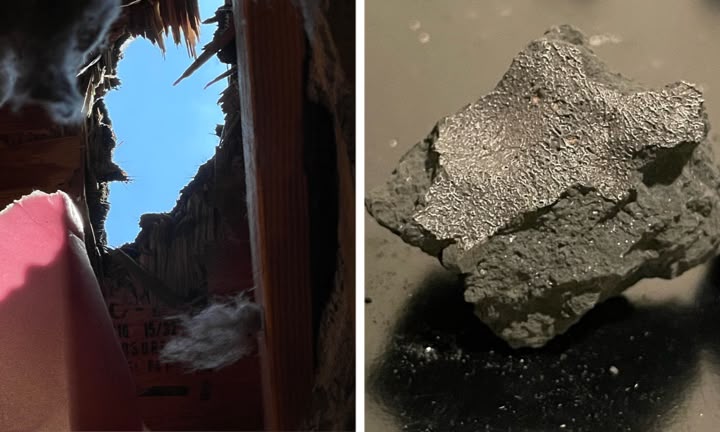
A space object known as the Hillsborough meteorite has been revealed to contain complex organic compounds that are the building blocks of life. The finding indicates that the 1.3-kilogram rock is an extremely rare and primitive class of meteorite. The presence of this exceptional rock on Earth is the result of an unexpected event. On the morning of 16 July 2024, a super-bright meteor streaked across the sky over New York City and exploded in the atmosphere. One of its fragments hurtled downwards and struck the roof of a house in Hillsborough, New Jersey, penetrating the ceiling of the main bedroom. “I heard a very loud bang and felt the house shake,” recounted the homeowner, who wished to remain anonymous, while recalling the moment the space object fell. “I opened the door and saw a hole in the ceiling above my bed.” Thanks to the homeowner’s quick response, researchers have been able to study the Hillsborough meteorite in a very pure state, providing a valuable contribution to our understanding of the origins of the universe. The Hillsborough meteorite is classified as a CM1/2 carbonaceous chondrite. This type of rock is rich in carbon and is believed to have played a role in delivering water to the early Earth. The uniqueness of the find, published in the journal Science Advances on 15 July, lies in the purity of the sample, which was preserved thanks to the homeowner’s swift action in securing the fragment from environmental contamination. Microscopic analysis of the meteorite revealed traces of sodium-rich material. This indicates that the parent asteroid from which the meteorite originated once contained salty water. Furthermore, the research team detected the presence of amino acids, the protein building blocks that are fundamental to life. Uniquely, most of the amino acids found do not occur naturally on Earth, confirming their extraterrestrial origin. Based on video footage from cameras across New Jersey that captured the meteor’s trajectory, it is strongly suspected that the rock was once part of the asteroid 163 Erigone, which is approximately 72 kilometres wide and located in the inner asteroid belt. Around 155 million years ago, a massive collision shattered this asteroid, and millions of years later, a smaller fragment was propelled into a near-Earth orbit. This rock then travelled for another 200,000 years before finally entering Earth’s atmosphere at a speed of 51,500 kilometres per hour. Although most of it was destroyed by heat, the remaining fragment that landed in New Jersey has provided a golden opportunity for science. The homeowners expressed pride in being able to contribute to scientific knowledge, stating, “We knew almost immediately that what happened to us was very rare and we felt a responsibility to preserve the meteorite for the scientific community.” The Hillsborough meteorite fragment is now housed at the American Museum of Natural History in New York City, awaiting further study to unlock the deepest secrets of how the ingredients for life may have been delivered to our young planet billions of years ago.