
Highlighting the Medical Workforce Gap in Indonesia, Abidin Fikri Reveals Its Impact
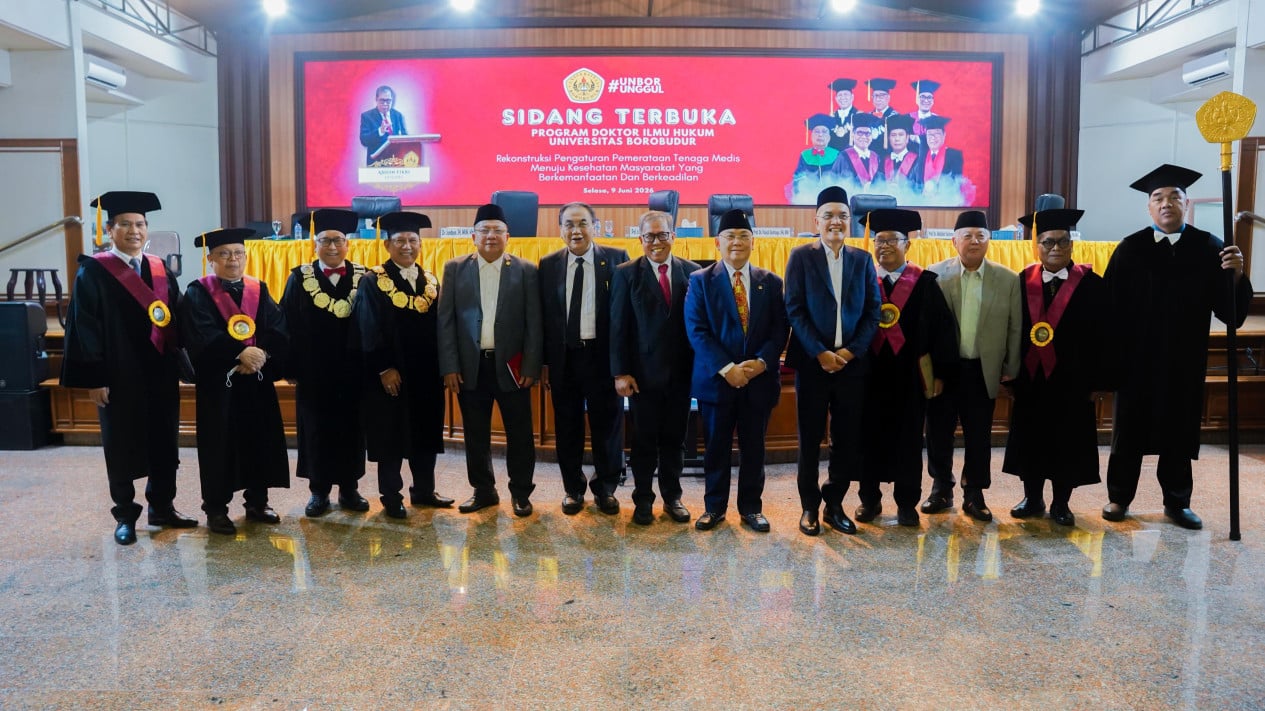
Jakarta – The Doctoral Programme in Law at Borobudur University in Jakarta has announced the graduation of Abidin Fikri during an open doctoral examination. The Deputy Chair of Commission VIII of the Indonesian House of Representatives (DPR RI) was recorded as the 399th graduate, achieving a Cumlaude distinction with a Grade Point Average of 3.97.
The solemn open session was attended by several national figures, including Deputy Speaker of the People’s Consultative Assembly (MPR RI) Bambang Wuryanto and the Chair of the PDI Perjuangan Faction in the DPR RI, Utut Adianto, along with other members of parliament who attended to commend the legal contributions proposed for the fulfilment of public health rights.
During the session, Abidin Fikri successfully defended his scientific dissertation entitled “Reconstruction of Regulations for the Equitable Distribution of Medical Personnel Towards a Beneficial and Just Public Health System.”
Through in-depth research, Abidin highlighted fundamental issues regarding the gap in the distribution of medical personnel between regions in Indonesia, which he assesses as still experiencing serious problems.
“Based on 2024 data, out of a total of 10,195 community health centres (Puskesmas), there are still 345 Puskesmas operating without a doctor, while Puskesmas meeting the standard of nine types of health workers have only been realised in 6,133 locations,” he stated on Wednesday.
He said that the condition of distribution inequality between urban areas and remote, border, and outermost island regions continues to occur massively, even though the health budget allocation increases every year.
According to him, this situation creates real injustice in access to health services and has the potential to contradict the principles of social justice as well as the constitutional mandate guaranteeing the right to health.
To address this crucial issue, Abidin Fikri offered a concrete solution in the form of a legal reconstruction of Article 231 of Law No. 17 of 2023 on Health by proposing the addition of a new paragraph, specifically Paragraph (1a).
Through the structuring of norms, institutions, governance, and health human resources, this new regulation is expected to reinforce the central government’s pivotal role in managing the distribution of medical personnel.
The proposed legal reconstruction encompasses four main pillars: centralised recruitment based on digital data, the provision of affirmative incentives, and guarantees of legal protection and welfare for medical personnel serving in remote areas.