
High Volatility and Thin Market, IHSG Rises 0.84% in First Session
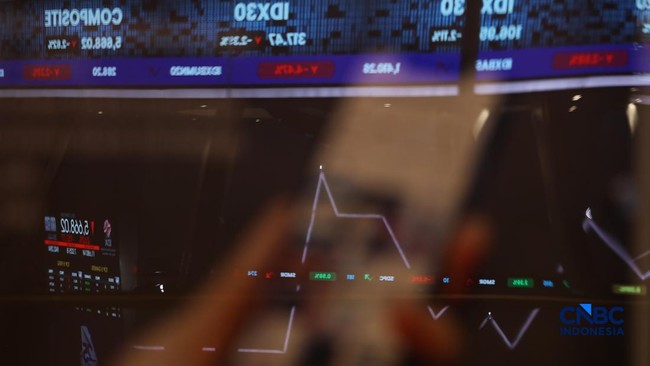
The Jakarta Composite Index (JCI) closed the first trading session on Wednesday (1/6/2026) with an increase of 47.39 points or 0.84%, reaching the level of 5,690.58. During the session, 376 stocks advanced, 270 declined, and 313 remained stagnant.
In the first trading session of this month, the market remained relatively quiet. Transaction value reached Rp 5.86 trillion with a volume of 9.89 billion shares conducted across 876,700 transactions.
Volatility in the JCI remains high. After initially opening up by 1%, the index dipped into the red zone before eventually surging to its daily high of 5,728.22. According to Refinitiv, three sectors dominated the JCI’s gains today: materials (3.52%), utilities (2.17%), and energy (1.31%).
In detail, BBCA acted as the primary driver of the JCI, rebounding from the 5,500 level and contributing 11.71 points, following an 11.26% decline in the previous two trading days. Additionally, Prajogo Pangestu’s company, BRPT, provided significant support, rising 10.12% to contribute 7.31 points. Other top movers included TLKM, BREN, AMMN, and MBMA.
Previously, the Financial Services Authority (OJK) noted that current Indonesian stock market conditions require improvement. The JCI has been stuck in the red zone and has struggled to recover to the green zone like other regional exchanges. Hasan Fawzi, Executive Head of Capital Market Supervision, Financial Derivatives, and Carbon Exchange at OJK, stated that there is something unusual behind the recent sustained weakness in the Indonesian capital market.
“If it remains in the red continuously, there must be something wrong, and that is what we must address,” he said at the Indonesia Stock Exchange (BEI) building in Jakarta on Tuesday (30/6/2026). For context, the JCI has declined by 34.95% year-to-date, with a monthly decline of 7.9% last month.
As the market enters the second half of 2026, Indonesia’s financial market is expected to face numerous challenges from both domestic and international factors. Globally, Iran reaffirmed on Tuesday that it would not meet with high-level US envoys, leaving the long-term peace prospects uncertain. Tehran stated its current focus is resolving the details of the ceasefire agreed upon two weeks ago before discussing more complex issues, including its nuclear programme.
Iran also emphasised it will continue to control traffic in the Strait of Hormuz alongside Oman and plans to begin imposing shipping tariffs in mid-August. Despite high tensions, oil prices continue to weaken, though the UN warned that the impact of war could potentially drive up food and energy prices in vulnerable nations.
On Wednesday, S&P Global is scheduled to release the China Manufacturing PMI data. As a reference, in May 2026, Chinese manufacturing activity moderated, with the index easing to 51.8 from a five-year high of 52.2 in April. Despite the slowdown, this remains above market projections of 51.4.
Recently, the Indonesian Central Statistics Agency (BPS) announced that Indonesia’s trade balance in May 2026 recorded a deficit of US$ 1.61 billion. This marks the first deficit in six years. The deficit was caused by import values exceeding exports, with imports at US$ 24.81 billion and exports at US$ 23.20 billion. This is the first Indonesian deficit since a 72-month consecutive surplus period that began in May 2020.
Ateng Hartono, Deputy for Distribution and Services Statistics at BPS, explained that the May 2026 deficit was driven by the oil and gas commodity sector, which saw a deficit of US$ 3.76 billion, primarily due to petroleum products and crude oil. According to BPS records, imports increased by 22.16% compared to May 2025. Oil and gas imports reached US$ 4.51 billion, a 70.78% year-on-year increase, while non-oil and gas imports reached US$ 20.30 billion, up 14.69%.