
High Hopes from Merauke's Rice Fields: New Planting Method Boosts Productivity
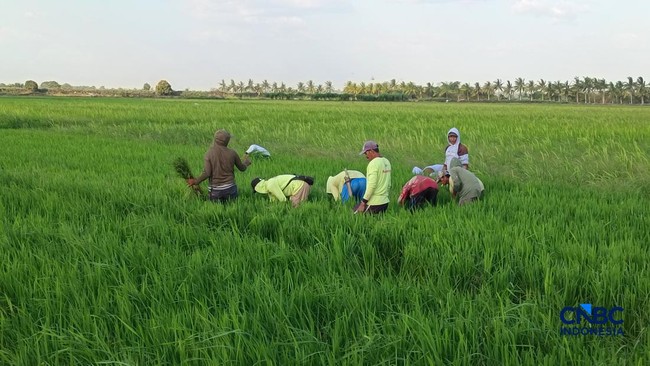
There is a noticeable change in the rice planting methods in Candra Jaya Village, Kurik District, Merauke Regency, South Papua. Moving away from the traditional broadcasting method, some farmers in this region have begun adopting a new technique using a drum seeder, locally referred to as the ‘pipe method’.
This shift is more than just about new equipment. For farmers, the impact is already visible in the field, with crops appearing neater, healthier, and possessing the potential for higher yields compared to previous patterns.
Abdul Rokhim, a farmer from Candra Jaya Village, stated that the pipe method is being implemented as part of a Ministry of Agriculture programme. He noted that the differences from previous methods are evident even before the harvest arrives.
“This is a new programme from the Ministry of Agriculture, using a drum seeler or pipe method. The advantage is that maintenance is easier and the planting is neater. It is already clear that production looks set to be higher based on the current growth,” said Abdul Rokhim when interviewed at his field in Merauke on Sunday (5/7/2026).
He added that the plants grown with this new method appear healthier and produce more tillers.
Another farmer in the same area, Angga Dwi Hardianto, observed similar results. He admitted that farmers in his area previously relied on the broadcasting method (tabela hambur). However, since the introduction of the pipe method, he believes the plant growth is more promising.
“The results so far are better than the broadcasting method. We were instructed to use this pipe method programme. So far, it is working well because it saves both labour and time. We even used drones for spraying and fertilising, which significantly reduces manual labour,” said Angga.
The pipe method essentially maintains the principle of direct seeding. The difference lies in the preparation: seeds are soaked, drained, and then placed into a tube-shaped tool equipped with wheels and small holes, which is pulled across the paddy field. This allows the seeds to emerge at regular intervals.
This method ensures a neater seed distribution, providing plants with better growing space. This improved spacing enhances air and sunlight circulation, which can help prevent fungal infections and other diseases.
Farmers in Merauante are optimistic about hitting their target yields. Angga mentioned that productivity in his area currently averages between 4.5 to 5.5 tonnes per hectare, but with the new method, potential yields could reach 10 tonnes per hectare.
This modernisation effort in Merauke is part of the Ministry of Agriculture’s Advanced Agriculture System (PMAAS) programme. Fadjry Djufry, Head of the Agency for Agricultural Assembly and Modernisation (BRMP) at the Ministry, stated that the concept was developed two years ago after the Minister of Agriculture, Amran Sulaiman, studied productivity increases in countries such as the USA, Vietnam, and China.
According to Fadjry, the method has been tested in several areas with promising results. “Starting from 20-hectare plots to 40-hectare plots, it proved promising, yielding 10.4 tonnes per hectare. Last year, we tested 300 hectares in Sukamandi and achieved 8-9 tonnes. During the dry season, the potential is above 10 tonnes,” he explained.
Fadjry explained that the core of this new method is the regulation of planting distance and increasing the plant population per hectare. By creating a neater planting pattern, the plant population can be significantly higher than with old methods, while simultaneously reducing seed requirements.
“We are teaching neater planting distances. Planting costs can be reduced from Rp3 million to just Rp500,000–600,000, which is a significant saving. Our hope is that if the plant population and nutrient needs are met, production could double. We have already proven this over the last two planting seasons,” said Fadjry.
For the farmers in Merauke, this change is currently being tested in the field. Amidst the tidal paddy fields of South Papua, this once-foreign method is gradually being embraced as a new hope: higher harvests, lighter workloads, and reduced costs.