
High Economic Growth, but the Lower Classes Have Not Felt It
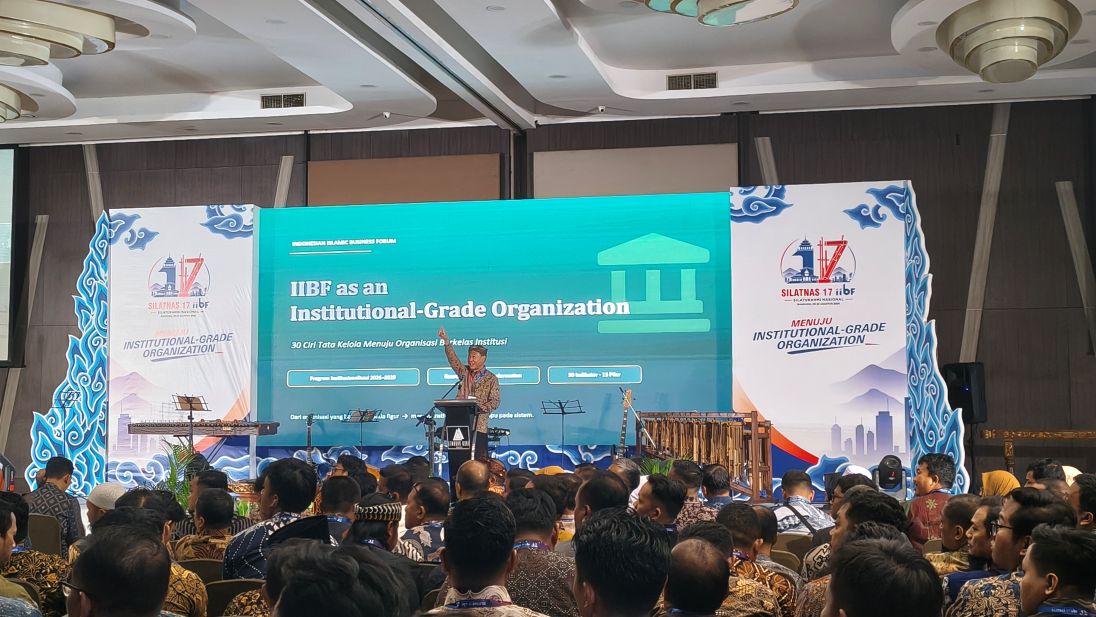
The Indonesian Islamic Business Forum (IIBF) held its 17th National Gathering (Silatnas) in West Bandung Regency from 20 to 22 August 2026. The gathering coincided with the organisation’s 17th anniversary. IIBF is determined to develop into an institution of institutional standing, not merely a gathering place for entrepreneurs, but a strategic partner in national development that is sensitive to economic inequality and produces entrepreneurs who are not only materially wealthy but also devout.
Chairman and President of IIBF, Heppy Trenggono, stated on Thursday (20/8) that the transformation towards an institutional-grade organisation is driven by two main pillars: better governance and a clear, measurable methodology. Over its 17-year journey, IIBF has become a platform for education and the revival of entrepreneurial cadres with an approach not found elsewhere. The organisation now aims to deliver a broader and more sustainable impact.
“IIBF is a place for educating cadres, a place for the revival of cadres. We have a methodology that may not be seen elsewhere. So we are creating better governance and a clearer methodology,” he said.
More than just a business community, Heppy explained, IIBF positions itself as an economic sensor and a thinking partner for the government. He also highlighted a phenomenon rarely discussed openly: national economic growth above 5 percent that has not been felt by the lower classes. “Bank credit has soared for corporations, while lending to MSMEs is only 0.12 percent. Consumption has increased, yet public savings have actually declined,” he stressed.
Heppy said this divergence is IIBF’s main concern, to be conveyed as honest input to policymakers. IIBF will never become a volunteer for anyone competing in politics, but it will always be a development partner for the government by providing honest input.
“The ‘Buy Indonesian’ movement initiated by IIBF is not merely a campaign to shop for domestic products. It is a tangible form of defending the national economy. IIBF entrepreneurs are encouraged to also become consumers who prioritise products made by their fellow countrymen, so that the economic wheel turns domestically and welfare is distributed more evenly,” he said.
Chairman of the Organising Committee for the 17th IIBF National Gathering, Hanum Sujana, said IIBF’s uniqueness compared to other business organisations lies in building the character of entrepreneurs, not just business skills. The main focus is developing entrepreneurs who are wealthy and devout, conducting business to world standards and ethically in accordance with Islamic values.
“We focus on building the entrepreneur. Because a business will not grow beyond the growth of its businessperson. If the businessperson grows, the business will also grow,” she explained.
Hanum said that with members and alumni spread from Aceh to Sulawesi, with the largest and most active bases in East Java and Lampung, IIBF nurtures its members through five support systems: family, business mentors, spiritual mentors, fellow strugglers, and mastermind groups. “Many members who started with huge debt burdens, even hundreds of billions of rupiah, have successfully restructured and paid off their obligations after joining, changing from mindset to support network,” she said.
At the regional level, Chairman of the IIBF West Java Regional Board, Jaja Mujahid, acknowledged an increase in the number of people wanting to join, especially amid economic pressure and waves of layoffs hitting many sectors. The main obstacles faced by members vary, from marketing and capital to production efficiency.
“I invite entrepreneurs not only to complain, but to move and complement each other. When the economy is slowing down, do not stay idle. Gathering becomes a solution, because there is a transfer of energy and ideas. Step out of your comfort zone, let us discuss the way out,” he said.
Jaja added that the coaching programme in West Java runs quarterly, covering topics from how to be delivery, financial literacy, to mastering business without membership fees, entirely voluntary and community-based. “Towards the vision of an Institutional Great Organisation, IIBF hopes to strengthen its role not only as a place to learn business, but as a socio-economic movement that lifts the nation’s welfare from the grassroots,” he concluded.