
Hidden Cameras in Hotel Rooms: How to Detect Them
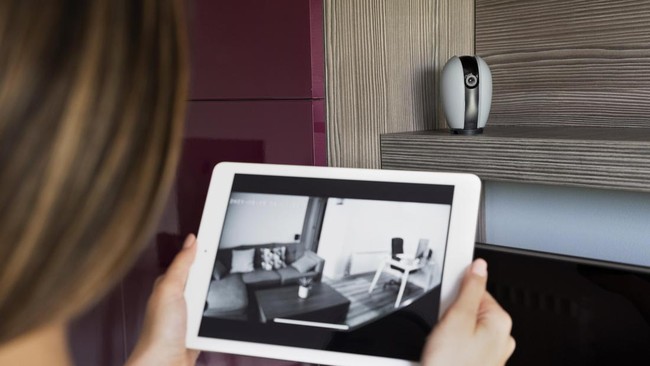
Jakarta, CNBC Indonesia - Hidden cameras are one of the things that most concern travellers when they are on the go. This is because the devices have been found installed in hotels, bathrooms, and other unexpected areas.
Spycam technology is now increasingly modern and difficult to recognise. With its small shape, the camera can be tucked away in almost any place without the victim realising it.
The CEO of Singapore-based technology services company OMG Solutions, Pieter Tjia, said that many people are selling recordings taken from these cameras to porn sites, so that they can be viewed thousands of times. Therefore, it is important to know how to detect hidden cameras around you to protect yourself and your privacy.
To find out, Tjia and his team hid 27 cameras in a house, then gave CNBC the devices that are usually recommended to find them.
In total, CNBC conducted five rounds of testing to see which method was most effective.
Test 1: Using the ‘naked eye’
First, examine the room using the easiest and cheapest method, namely testing using the naked eye.
One of the CNBC teams, Victor Loh, went from one room to another, paying attention to whether there was anything that looked strange or suspicious. After searching for 20 minutes, he found one camera embedded in a wall clock because the time on the clock looked wrong.
“I found one. But the room was very well camouflaged,” he said.
Test 2: Using a mobile phone
For this test, Victor downloaded a popular application called Fing, which scans the Wi-Fi network to look for cameras. He also used his mobile phone’s flashlight to make it easier to see the camera lens.
The application showed that there were 22 devices connected to the house’s Wi-Fi but no cameras.
Tjia explained that when his team installed the cameras in the house, they also installed a second wireless network. They then connected the hidden cameras to that network, bypassing the main network of the house.
“Even if we didn’t do this, the application would show that there were cameras in the house, but not where they were located,” he said.
Victor was more fortunate using his mobile phone’s flashlight. With the flashlight, he found three more cameras, namely in a Wi-Fi repeater, a button on a shirt, and a teddy bear.
Tjia said that most of the hidden cameras are made in China, which ironically is also banned in that country.
Test 3: Using a radio frequency detector
With only four of the 27 cameras found, it was now time to switch to devices designed to find hidden cameras, such as a radio frequency detector that beeps when it is close to a surveillance camera.
It works when the camera is turned on and connected to Wi-Fi, meaning they will not find cameras that use an SD card to store data, said Tjia.
The detector is also prone to false alarms.
This device also has an internal lens detector, but the beeping sound proved to be so annoying that Victor did not find a single camera with this device. In fact, the device beeped even when it was in a part of the house where there were no cameras at all.
Test 4: Using a lens detector
Next, with a cheap, portable, and easy-to-use lens detector. This device emits infrared light, which is reflected back from the camera lens as a red dot.
However, you have to be close to the camera for it to work.
Although popular, Victor only found two cameras with this device, namely one inside an essential oil diffuser, and the other on a Wi-Fi mesh device.
Test 5: Using an advanced lens detector
For the last test, Victor used a more advanced lens detector.
Shaped like binoculars, this detector also highlights the light reflected from the camera lens. However, this device is able to work from a distance so that it allows Victor to see the camera from across the room. It can also be in a bright or dark room.
Victor found cameras in a tissue box and a leather bag, and one more buried among the files under the table. However, he had to look directly at the lens to find them.
In total, he found 11 cameras with this device.
The final result
In total, Victor managed to find 17 of the 27 cameras. This is not a bad result, nor is it a good one, given the time he spent finding them was not easy.
“When you are travelling, you are definitely very tired. The last thing you want to do is spend an hour looking at every nook and cranny just to find a camera,” he said.
Social media posts about hidden cameras have increased by almost 400% in the last two years, according to data company Sprout Social. Not surprisingly, many articles are dedicated to finding quick and easy solutions to this growing problem.
“But in this cat-and-mouse game, hidden cameras are superior. The detection tools are getting better, as are the hidden cameras,” said Tjia.
(fab/fab) Add as a preferred source on Google [Gambas:Video CNBC]”