
Here's Why the Government Is Accelerating the Merah Putih Fishermen's Village Programme
Jakarta, CNBC Indonesia - The government is accelerating the construction of Merah Putih Fishermen’s Villages (KNMP) across various regions as part of efforts to achieve national protein self-sufficiency. This move is also driven by the fact that many fishermen are still trapped in detrimental trade chains, meaning abundant catches do not always lead to improved welfare.
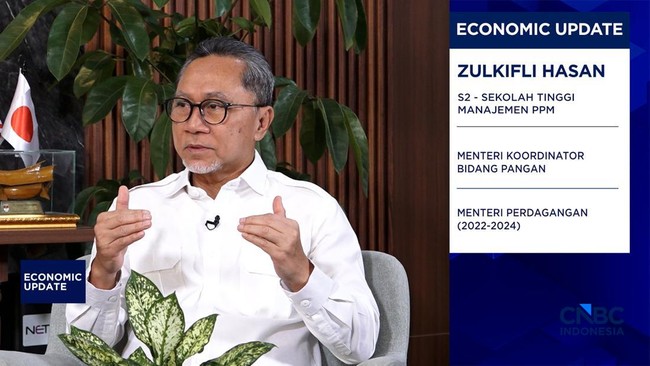
Coordinating Minister for Food Zulkifli Hasan (Zulhas) stated that after successfully pushing for self-sufficiency in carbohydrate commodities such as rice and animal feed corn, the government is now shifting its focus to protein self-sufficiency, particularly from the fisheries and poultry sectors.
“Food is broad. We have carbohydrates and protein. Now we have just finished with carbohydrates, namely rice and corn for animal feed are already self-sufficient. Industry still has a small amount of imports,” Zulhas said during CNBC Indonesia’s Economic Update 2026 on Tuesday (23/6/2026). “This year, we are focusing on protein self-sufficiency: fish, shrimp, chicken eggs, and chicken meat. We are indeed entering milk and beef, but this is not easy. We are focusing on chicken and fish first,” he continued.
According to Zulhas, one of the main problems faced by fishermen is their low bargaining position when selling their catch. This situation often forces fishermen to sell fish at low prices because they lack storage facilities. “Now, regarding these fishermen, we are siding with the fishermen first. That is the basic principle of President Prabowo Subianto’s policy,” he said.
He cited conditions he found during a visit to Kupang, East Nusa Tenggara (NTT), where the price of fishermen’s catch was extremely low. “Yesterday I was in Kupang, NTT, there was fish sold in a large bucket for Rp25,000. How much is that? 3 kilogrammes (kg), 4 kg for only Rp25,000. It cannot be exchanged for 1 litre of oil,” Zulhas revealed.
According to him, the problem occurs because fishermen must sell their fish immediately after arriving on land. If not sold quickly, the fish risks rotting, leaving fishermen with no choice but to accept the price offered by middlemen. “Why? Because when our fishermen come ashore, bringing their catch, they sell it, meet a middleman, and get haggled down. They cannot hold out, otherwise the fish will rot. So they sell it,” he said.
This condition, Zulhas noted, traps many fishermen in a cycle of poverty and debt to loan sharks. “What happens in the end? The fishermen gradually lose money. Eventually, they get entangled in debt to loan sharks, borrowing here and there, Rp50 million, Rp100 million. Forever, when they go to sea, they have to hand over their catch to the lender continuously, but they have no choice, they cannot do other work. He remains a fisherman, he remains poor,” he said.
To overcome this problem, the government is building Merah Putih Fishermen’s Villages equipped with various supporting facilities. “Therefore, this year approximately 20,000 Fishermen’s Villages will be built. There, Merah Putih Fishermen’s Cooperatives will be established,” he stated.
He explained that these fishermen’s villages will be equipped with auction halls, ice plants, cold storage, and fishermen’s cooperatives connected to a wider marketing network. “Where many fishermen go to sea, an auction hall will be built there, an ice plant will be built, cold storage will be built, and a fishermen’s cooperative will be established so they have a broad network,” he said.
With storage facilities, fishermen are no longer forced to sell fish when prices are low. The catch can be temporarily stored while waiting for better prices. “So if fishermen come bringing a lot of fish and it does not sell, they can store it first. It can be stored in the cold storage while being offered. If it still does not sell at a profitable price, then it will be bought by the Merah Putih Fishermen’s Cooperative,” Zulhas explained.
Furthermore, the cooperative will also become a supplier of fish raw materials for the Free Nutritious Meal (MBG) programme through the Nutrition Fulfilment Service Units (SPPG) under the National Nutrition Agency (BGN).
Zulhas acknowledged that building a new ecosystem is not an easy task. However, the government is optimistic that the protein self-sufficiency target can be achieved if all parties perform their roles properly. “That is what is being built. Indeed, it is not easy. Building something new is not easy. But the design has been laid out in such a way that there is already a solution,” he said. “If we can execute this well, each party disciplined, not playing around, I think we can accelerate it, just like rice self-sufficiency which we achieved in a year. This too, if all parties work well, I think it can be achieved in a year as well,” Zulhas concluded.