
Here Are the Major Challenges Facing the 2027 Consumer Sugar Self-Sufficiency Programme
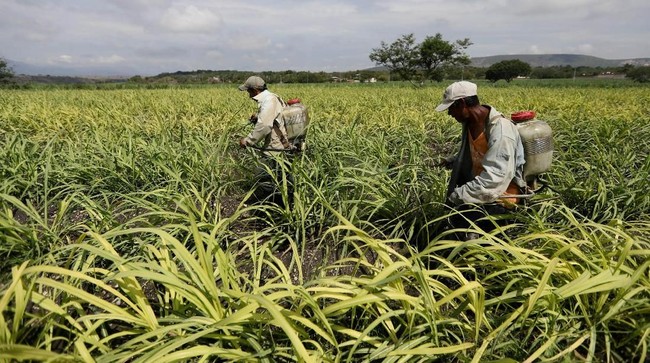
Jakarta, CNBC Indonesia - Deputy Minister of Agriculture (Wamentan) and Chairman of the Indonesian Farmers Harmony Association (HKTI), Sudaryono, has outlined the challenges behind the government’s intensified ratoon dismantling programme aimed at boosting sugarcane productivity. One of the main obstacles lies in the process of finding farmers and lands willing to participate in the programme.
Sudaryono emphasised that the Ministry of Agriculture is not working alone in implementing this programme. Various parties are involved as the government’s extensions in the field.
“HKTI is not the only one, of course; the Ministry of Agriculture has eyes and ears, and many extensions, including the Agricultural Services in each region and city, as well as Agricultural Extension Workers, which are now under the Ministry of Agriculture’s domain. HKTI wants to play a role in that,” Sudaryono said during a press conference at the Ministry of Agriculture Auditorium, Jakarta, on Monday (27/4/2026).
He explained that the core of the ratoon dismantling programme is to find farmers and sugarcane lands ready for rejuvenation. However, in practice, this is not always easy.
“So, it’s like this: the essence of ratoon dismantling is finding farmers and fields or locations that are willing to be dismantled. Sometimes finding them is not easy, so we want all parties involved, even the Ministry of Agriculture. As Deputy Minister, we are involving Babinsa and Babinkamtibmas to find potential beneficiaries,” he clarified.
Regarding the reasons for the difficulties, Sudaryono revealed that farmers’ psychological factors are one of the main constraints. Many farmers are reluctant to dismantle their grown sugarcane plants.
“It’s like this: it’s difficult because, for example, the farmer already has sugarcane; they feel attached if it’s dismantled, meaning it will be replaced. Meanwhile, if it’s already tall, they want to harvest it, so these are just technical issues,” he explained.
In addition, the issue of information dissemination is also a barrier. Although the government has utilised various communication channels, the information about the ratoon dismantling programme has not fully reached farmers in the field.
“Besides that, sometimes the information—we’ve used social media, disseminated news everywhere—but sometimes, apologies, in reality, it doesn’t reach everywhere,” Sudaryono said.
Therefore, the government is now strengthening field-based communication networks, including through extension workers and farmer organisations like HKTI.
“So, this information doesn’t just rely on social media and official news like yours, TV and official news, but also uses networks—extension worker networks, service networks, including HKTI; we want to involve them in that,” he stressed.
Sudaryono emphasised that HKTI is present as a strategic partner to the government, not a replacement for the state’s role.
“HKTI does not replace the government, but HKTI is now in the midst of the government, becoming a strategic partner to the government, so that together we become eyes, ears, mouthpiece, and hands, extensions of the government,” he said.
He also stressed that the Ministry of Agriculture needs support from various parties, including HKTI, to help find potential farmers and programme locations.
“The Ministry of Agriculture wants to help with sugarcane farmers’ ratoon dismantling. Finding potential farmers and locations is also challenging. Therefore, HKTI must be ready to assist,” he asserted.
For information, the ratoon dismantling programme is an important part of the government’s strategy in pursuing the target of consumer sugar self-sufficiency by 2027 at the latest.
Agriculture Minister Amran Sulaiman previously revealed that the national sugar needs currently reach 6.7 million tonnes, while white crystal sugar production is only around 2.67 million tonnes. This means there is still a shortfall of about 4.03 million tonnes.
He stated that one of the main problems in the sugar sector is the dominance of old and unproductive ratoon sugarcane plants.
“Actually, this is just 2025; the President asked to increase productivity. The main problem in the sugar sector is the ratoon. It’s 80% ratoon 10 or 7, meaning age 7 years, 10, even 20 years, but back to ratoon 4,” Amran said some time ago.
In fact, checks show that 70%-80% of sugarcane plants are no longer viable.
“After checking, 70%-80% are damaged, so not viable,” he said.
To address this, the government targets sugarcane rejuvenation through the ratoon dismantling programme covering 100,000 hectares per year with a total budget of Rp1.7 trillion per year for three years.
“If this is dismantled, production will surely increase, God willing. That’s 80% we fix, people’s sugarcane,” Amran said.
The government is optimistic that with the consistency of the programme, the consumer sugar self-sufficiency target can be achieved by 2027 at the latest.