
Henan Asset: Taking a Clear-Eyed View of MSCI
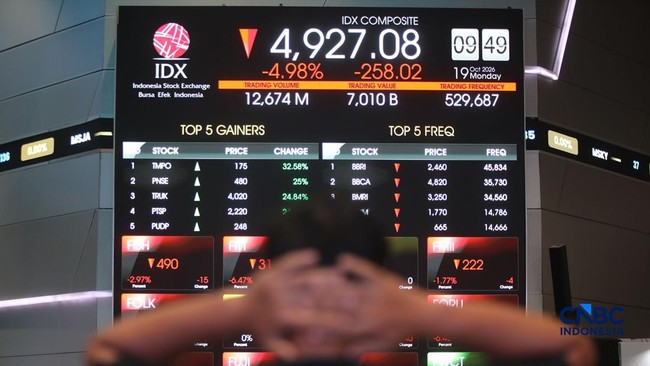
Jakarta, CNBC Indonesia – The past three days have felt like three years, as the Jakarta Composite Index (JCI) fell to a new low. On 16 October, the JCI closed down about 10.6% at 5,240, and trading was halted again.
On the next trading day, 19 October 2026, the JCI fell further, closing at a record low of 4,997. From its January 2026 market peak of 9,135, the eighth correction cycle has now reached 45.3%.
It is understandable to feel concerned at these figures. But amid market turbulence, it is important not to rush into decisions.
In its research, Henan Asset urges investors to consider what is known and what remains uncertain, how each may affect the market, and how to navigate the situation through investment discipline and process before deciding what to do next.
What triggered the volatility
The main trigger for the JCI’s movements over the past three days was MSCI’s announcement on 15 October 2026. The global index provider opened a public consultation on the possibility of changing Indonesia’s status from Emerging Market to Standalone Market.
The key word is “consultation”. The announcement is not a decision to reclassify Indonesia’s market; it is an invitation for market participants to provide feedback by 30 April 2027, with a final decision due no later than 30 June 2027.
More than eight months remain before a decision is made, and much could change in that time. MSCI has also not set an implementation date.
If reclassification is approved, passive fund outflows generally occur on the effective date, which would likely fall after June 2027. This could bring renewed pressure at that point.
In its consultation document, MSCI cited concerns centred on three issues: share-ownership transparency, alleged coordinated trading, and market-governance reform.
MSCI said it would proceed with reclassification unless there is evidence of material improvement during the consultation period. In other words, its current base case is to proceed with reclassification.
This leaves three possible outcomes before the deadline: Indonesia retains Emerging Market status, is downgraded to Frontier Market, or is moved to Standalone Market.
Lessons from other countries
For context, Henan Asset reviewed 12 MSCI market consultations and reclassifications since 2006: Venezuela (2006), Argentina (2009), Greece (2012), Morocco (2012), Ukraine (2015), Peru (2015–2016), Nigeria (2016–2017), Argentina (2019–2021), Lebanon (2020), Pakistan (2021), Russia (2022), and Nigeria (2022–2023).
The cases varied. Greece was downgraded from Developed to Emerging Market; Ukraine, Lebanon and Nigeria moved from Frontier to Standalone Market; while Russia was reclassified because of accessibility and investability issues.
Of the 12 cases, 10 ended in a downgrade. The other two – Peru (2015–2016) and Nigeria (2016–2017) – avoided downgrades after making verifiable, tangible improvements.
These consultations were generally prompted by capital controls, shrinking liquidity or sanctions related to geopolitical events. Indonesia’s case is different: MSCI has opened a consultation not because of those systemic factors, but because of concerns over transparency and market governance.
The historical record offers lessons not only about which markets were eventually downgraded, but also about when the greatest pressure occurred. In many cases that ended in a downgrade, the heaviest pressure came before MSCI’s formal decision, rather than afterwards.
However, outcomes and recovery periods have varied widely between countries, depending on the destination classification, the reason for reclassification and each country’s economic conditions. Cases ending in Standalone Market status generally faced greater pressure than those downgraded to Frontier Market.
Indonesia’s circumstances also differ because the country is not facing an economic or currency crisis. These comparisons should therefore be treated as context, not as a forecast of what will happen.
Assessing fundamentals amid uncertainty
Another important point is that this correction has been triggered by market-governance concerns, not by a collapse in economic activity.
Unlike the 2008 Global Financial Crisis, which hit the global financial system, or the 2020 COVID-19 crisis, which halted business operations, the current episode is a shock to confidence in and accessibility of the domestic market. Businesses have not stopped operating, and listed companies’ earnings are still growing by about 7% year on year, based on trailing 12-month earnings – the four quarters through September 2026.
The banking, telecommunications and consumer sectors, which account for a large share of the JCI, have yet to show systemic earnings pressure.
Valuations are now at levels rarely seen. The LQ45 is trading at about 8.9 times forward earnings, below its COVID-19 low and well under its historical average of 15.4 times. But fundamentals cannot be assessed separately from the market’s reaction. Governance concerns, thinning liquidity and the possibility of lower earnings forecasts could continue to weigh on share prices, even while businesses remain in good health.
Investors should therefore look beyond earnings and valuations to consider the quality of governance, liquidity and the direction of each company’s earnings forecasts.
“This does not mean that we know exactly when the market will reach its bottom. We continue to monitor downside risks to the exchange rate, potential outflows and shrinking market liquidity. However, we believe many assets still have sound underlying value, and we have not seen signs of systemic risk of the kind seen in previous cycles,” Henan Asset said, as quoted on Wednesday (21 October 2026).
Noise and signal: what could change the assessment
In these conditions, it is important to distinguish information worth paying attention to from what can be disregarded. The test is simple: does the information genuinely change the assessment of fundamentals, risk or market liquidity?
Henan Asset said investors should set aside noise such as unsupported predictions of JCI levels, claims that investors have already “exited”, direct comparisons with Greece, Argentina or Russia despite their very different circumstances, overreactions to MSCI news that is not final, and speculation about when the market will bottom.
Daily market movements still warrant attention when accompanied by changes in liquidity, fund flows or new fundamental information.
“The signals we are monitoring are the direction and resilience of listed companies’ earnings forecasts amid global pressure; tangible progress in market-governance reform; developments in the MSCI consultation ahead of April 2027, including the removal from indices of shares with overly concentrated ownership; rupiah movements; and foreign fund flows and market liquidity,” Henan Asset said.
What has changed – and what has not
At the close on 19 October, the JCI stood at 4,997, its lowest closing level so far in the eighth cycle and below its previous low of 5,324 on 8 June. The correction has therefore retested and broken through the previous floor, meaning the bottom of this cycle cannot yet be determined.
Even so, Henan Asset’s assessment of the foundations of Indonesia’s economy has not changed: economic activity continues and corporate earnings are still growing. The firm acknowledges, however, that governance, liquidity and the direction of earnings revisions will determine how quickly market confidence recovers.
Since 2000, the JCI has gone through seven correction cycles before this eighth one, from the Global Financial Crisis to the Trump tariff storm. In every cycle, there has been a compelling reason to believe that “this time is different”.
All seven previous cycles eventually ended in a recovery, although the time taken varied considerably. Past performance does not guarantee the same result in the future.
What investors can do
There is no single answer for every investor. The appropriate course depends on individual objectives, time horizon, liquidity needs and risk profile.
Near-term funding needs: Set allocations according to liquidity requirements, rather than forecasts of market direction.
Long-term investors: Consider investing in stages in line with risk profile, rather than making a single all-at-once decision.
Concentrated share portfolios: Review the liquidity of each holding. Lower-risk instruments may also be considered.
Institutional investors: Make decisions within the limits of their respective mandates and investment policies.
Positions using margin facilities: Review these early, as in volatile conditions margin calls and forced selling can compel decisions outside the investment plan.
“More than eight months remain before MSCI’s decision. Whatever the outcome – whether Indonesia retains Emerging Market status or is reclassified – we will apply the same process: read the signals, not the noise; review positions in line with mandates and investment objectives; and provide regular updates as the situation develops,” Henan Asset concluded.
Source: jawawa.id (https://jawawa.id/newsitem/henan-asset-taking-a-clear-eyed-view-of-msci-1792587087)
Originally published by CNBC Indonesia (https://www.cnbcindonesia.com/market/20261021181106-17-778359/henan-asset-membaca-msci-dengan-kepala-dingin), translated from Indonesian