
Help, Mr. Trump! Wall Street in Flames, Europe Collapses
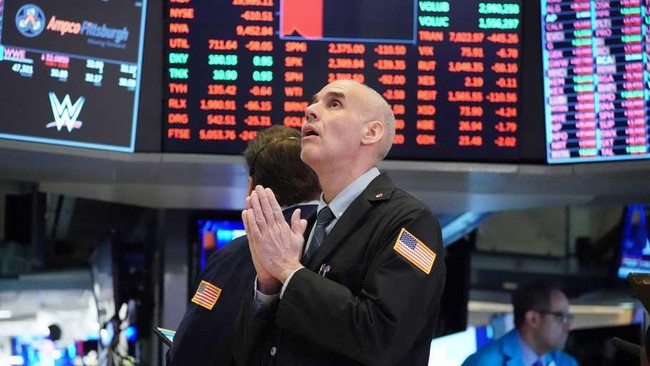
Jakarta, CNBC Indonesia - The United States (US) stock market, Wall Street, and European stock markets were battered during the latest trading session this week, on Friday (27/3/2026).
Indices plunged after Brent oil prices broke through US$110 due to an incident in the Strait of Hormuz, exacerbating investor concerns over energy supplies. The latest comments from US President Donald Trump also failed to encourage market participants to return to buying shares.
The Dow Jones index fell 793.47 points, or 1.73%, closing at 45,166.64. The S&P 500 tumbled 1.67% and ended at a seven-month low of 6,368.85. Meanwhile, the Nasdaq Composite plunged 2.15% to 20,948.36.
Over the past week, the S&P index declined 2.1%. The Nasdaq, dominated by technology stocks, dropped 3.2%, while the Dow Jones weakened 0.9%.
The Nasdaq’s movement has now entered correction territory, nearly 13% below its all-time high reached in October 2025. The Dow also briefly entered correction territory intraday and closed down 10% from its previous closing peak. The S&P 500 is now down 8.7% from its all-time closing high.
Wall Street’s collapse was triggered again by the renewed surge in oil prices.
The international Brent crude oil price rose 4.22% to $112.57 per barrel. Meanwhile, US West Texas Intermediate (WTI) crude oil climbed 5.46% to $99.64 per barrel. This marks the highest closing for both benchmarks since July 2022.
US President Donald Trump extended the deadline for attacking Iranian energy infrastructure until 6 April, just over a week after the initial target set on Friday.
“Based on a request from the Iranian Government, this statement is to affirm that I am postponing the period of destruction of energy facilities,” Trump wrote on Truth Social.
“Talks are ongoing and, despite misleading statements from ‘fake news’ media and others, everything is going very well,” he added.
This announcement is the latest signal that the Trump administration is working towards an end to the US-Iran war. The war has driven a spike in oil prices, burdening consumers and potentially harming the Republican Party in the midterm elections.
However, uncertainty still looms over investors. Iran’s foreign minister stated that Tehran has no intention of holding talks with the US, although its leaders are reviewing the American proposal to end the war.
The Pentagon is also considering deploying an additional 10,000 troops to the Middle East.
The Strait of Hormuz was declared closed by Iran’s Revolutionary Guard, with warnings that any movement in the strategic sea lane would face a harsh response. Two Chinese ships were denied passage on Friday morning, and a Thai-flagged cargo ship that had previously been attacked in the route was reported aground.
Jay Hatfield, founder and CEO of Infrastructure Capital Advisors, explained that although Trump has extended the deadline, investors now want to see a genuine resolution to the conflict, not just a possibility.
A conflict resolution would be a positive catalyst for the stock market, which has been falling since the US and Israel attacked Iranian energy infrastructure on 28 February.
“The longer the Strait of Hormuz remains closed, the worse the oil market conditions will be,” Hatfield told CNBC International.
“Oil prices may fall quite deeply, but there will still be inventory issues when the strait reopens. If it takes another month to reopen, oil prices could hold around $80 for a while until stocks recover,” he added.
Foreign Secretary Marco Rubio stated that the US can achieve its goals in Iran without the use of ground troops and estimated the operation would be completed in a matter of weeks, despite the troop additions to the region.
“Clearly, overall market sentiment has turned very negative and we have now entered correction territory,” said Ken Polcari, partner and head of market strategy at SlateStone Wealth, quoted from Reuters.
“In the end, I see this as a great opportunity, but I wouldn’t be surprised if we see a deeper drop of around 15% to 20% before it’s all over,” he added.
The CBOE Volatility Index (VIX), often referred to as the fear gauge on Wall Street, reached its highest level since 9 March.
Megacap stocks were the main drag on the S&P 500 index, with Nvidia down around 2% as the largest contributor, while Amazon fell around 4%.
Software sector stocks also came under selling pressure again, with the S&P 500 software and services index dropping to its lowest level since 7 April.
The surge in oil prices and other commodities like fertilisers due to the Iran war has reignited inflation concerns and reduced expectations that the Federal Reserve and other central banks have room to cut interest rates.
Money market participants now no longer expect any rate cuts by the Fed this year, compared to previous anticipations of two cuts before the conflict erupted.
The CME FedWatch Tool now estimates around a 25% chance of at least a 25 basis point rate hike at the Fed’s October meeting.
Philadelphia Fed President Anna Paulson acknowledged risks to the economy due to the war but did not detail its implications for short-term monetary policy.
The latest data also shows US consumer sentiment fell to a three-month low in March, heightening concerns about economic conditions due to the war in the Middle East.
Europe Follows Suit in Collapse
Selling pressure in European stock markets continued on Friday after Trump extended the delay in attacking Iranian energy infrastructure.
The pan-European Stoxx 600 index closed provisionally down 0.9%, with almost all sectors in the red. The FTSE 100 index closed near stagnant, while the CAC 40 fell 0.9% and the DAX weakened 1.3%.
European markets continued the decline from the previous session after closing lower on Thursday. Investors