
Help! Gen Z Find It Harder to Travel as the IHSG Falls and Portfolios Burn
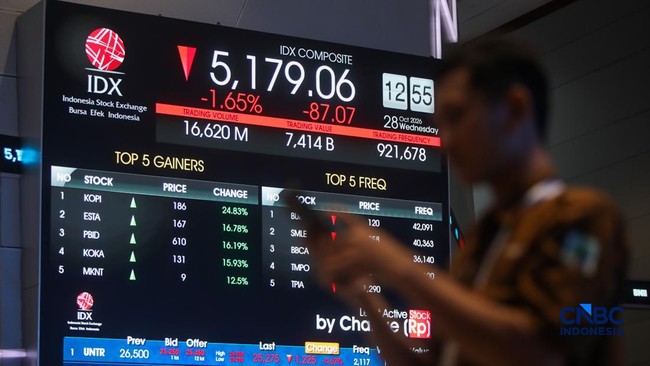
Jakarta, CNBC Indonesia — The stock market has continued to face turbulence this year, with the Indonesia Stock Exchange Composite Index (IHSG) suffering a sharp fall.
The IHSG has plunged 41% so far in 2026, its steepest decline since the 2008 crisis. The fall is affecting not only the benchmark index but could also put further pressure on people’s purchasing power.
This connection becomes more plausible when examined through the lens of the wealth effect, particularly given the changing demographics of Indonesia’s capital-market investors, who are now dominated by younger people.
The psychology of the ‘wealth effect’
The IHSG’s decline does not merely erode investors’ portfolio values; it could also shake the financial security of young people who are still building their wealth. When the value of investments falls, they may rein in spending, postpone major purchases or redirect money towards savings.
This phenomenon is known as the wealth effect: as wealth rises, consumption tends to increase. Conversely, when asset values fall, the willingness to spend may weaken. If market pressure persists, its effects could spread from portfolio screens to young people’s everyday financial decisions.
In theory, the wealth effect describes how fluctuations in the value of a person’s assets affect their spending. Consider an investor named Martya.
Martya invests in a share priced at 1,000.
When the share rises to 1,500, Martya has an unrealised gain. Psychologically, Martya feels wealthier and may be more inclined to spend.
Conversely, if the stock market corrects and Martya’s portfolio falls in value to Rp750, an unrealised loss arises.
Although the loss has not been realised, this apparent decline in wealth can trigger a defensive psychological response. Martya may curb spending. Such psychological adjustments can, in aggregate, put pressure on purchasing power.
Young investors and the wealth gap
The psychological impact of unrealised losses becomes a significant macroeconomic issue because of the current demographic make-up of investors.
According to 2025 data from the Indonesia Central Securities Depository (KSEI), of approximately 27 million capital-market investors at the time, 54.33% were individual investors under 30 — members of Generation Z. Domestic investors accounted for more than 60% of the total.
This generation is expected to be one of the drivers of consumption, as its members are keen to travel and buy goods related to their hobbies.
By occupation, private-sector employees, civil servants and teachers made up 33–34% of investors, followed by young people and students at 24–27%.
More recently, the Financial Services Authority (OJK) reported that the number of capital-market investors reached 31.14 million in August 2026. The latest figures are said to put the total at more than 32 million.
By age, OJK’s Head of Securities Institutions Supervision, Edi Broto Suwarno, said that around 55.25% of individual investors were aged 30 or younger as of August. Including those aged 31 to 40, the proportion exceeded 80.64%.
Statistics Indonesia (BPS) data for May 2026 also underline the size of Indonesia’s young population. The country had 284.43 million people in total. Yet the widespread adoption of investing among Generation Z and under-30s contrasts with the value of the real assets they manage.
Investors in this age group held only around Rp42.54 trillion in assets in C-BEST. By contrast, wealth was concentrated among investors over 60, who controlled Rp905.94 trillion despite representing just 2.96% of all investors.
Implications for the real economy
The high participation of young people in the capital market creates a layered vulnerability. When the IHSG and most shares are in a bearish trend, unrealised losses shown on portfolio screens can directly reduce their willingness to consume.
This is more concerning because the incomes of younger people are less secure. High levels of gig-economy work and the risk of unemployment among people of working age mean they have less of a financial cushion than older generations.
Ultimately, falling portfolio values among such a large demographic are not merely a technical stock-market cycle. They could become a trigger that slows economic circulation and weakens purchasing power in the real economy.
Source: jawawa.id (https://jawawa.id/newsitem/help-gen-z-find-it-harder-to-travel-as-the-ihsg-falls-and-portfolios-burn-1793605857)
Originally published by CNBC Indonesia (https://www.cnbcindonesia.com/research/20260525164854-128-737919/tolong-gen-z-jadi-susah-jalan-jalan-karena-ihsg-jatuh-porto-terbakar), translated from Indonesian