
Helicopter Scheme to Modified Tanker Trucks Behind Subsidised Fuel Scandal
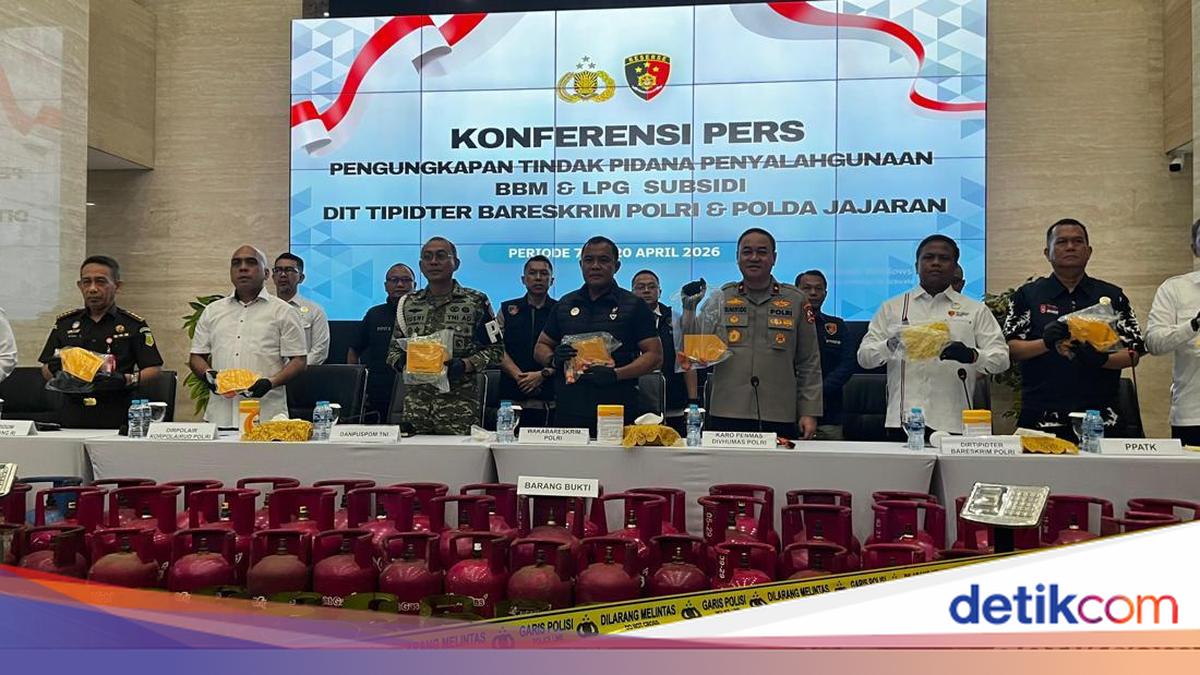
The Directorate of Specific Crimes (Dittipidter) of Bareskrim Polri has exposed the misuse of subsidised fuel oil (BBM) and subsidised LPG in various regions of Indonesia. The methods used by the perpetrators include the ‘helicopter’ scheme, fake number plates, and trucks with modified tanks.
Over a period of 13 days, the financial losses to the state from these energy crimes amounted to Rp 243 billion. Deputy Chief of Bareskrim Polri, Inspector General Nunung Syaifudin, stated that the revelations occurred during the period from 7 April to 20 April 2026.
“Criminal acts of misuse of BBM and LPG have caused financial losses to the state of approximately Rp 243,669,600,800 over 13 days,” said Inspector General Nunung during a press conference at the Bareskrim Polri building in South Jakarta on Tuesday (21/4).
The uncovering of these cases aligns with the directives of President Prabowo Subianto as outlined in Astacita. Following instructions from National Police Chief General Listyo Sigit Prabowo, Polri is committed to taking firm action against anyone involved in the misappropriation of subsidised BBM and LPG.
During that period, police processed 223 police reports (LP) with a total of 330 suspects. In addition to arresting the perpetrators, police also seized a number of items of evidence in these revelations.
“The evidence secured includes 403,158 litres of diesel, 58,656 litres of Pertalite, 13,346 LPG cylinders, and 161 four-wheeled and six-wheeled vehicles,” Nunung revealed.
Involvement of Petrol Stations
Nunung explained that based on data from 2025 to 2026, 65 public fuel filling stations (SPBU) were recorded as involved in criminal acts of misuse of subsidised BBM. Of that number, 46 cases have been declared complete (P21) and 19 others are still under investigation.
Polri will not compromise with anyone who plays around with the rights of the little people, including rogue officials. In this operation, Polri also received full support from the TNI Military Police Centre (Puspom).
“We have committed that whoever is involved, whether from TNI members or Polri members, we will take firm action. This is to give a deterrent effect to rogue elements and business actors,” Nunung emphasised.
Nunung assessed that the perpetrators not only harm the state materially but also torment the public who struggle to obtain BBM and LPG.
“These perpetrators are not only betraying the state but also betraying the people. I emphasise once again, models like that will face us,” he said.
Suspected Money Laundering
In addition to applying general criminal articles, Bareskrim will also ensnare the intellectual actors and capital owners with money laundering charges (TPPU).
“Whoever is involved, whether field perpetrators, capital owners, receivers, or actors behind the scenes, we will chase, act against, and process to completion. I have ordered investigators to charge them with TPPU articles,” Nunung clarified.
Not only that, if involvement of civil servants (ASN) is found, Polri will hand over the case to the Directorate of Corruption Crimes. Polri is also collaborating with PPATK to track the flow of funds of these mafias.
Nunung reiterated that there will be no room for energy mafias to operate. “Our commitment is zero tolerance for subsidised BBM and LPG mafias. The motto remains the same: if you remain reckless, I will crack down,” Nunung concluded.
Perpetrators’ Methods
On the same occasion, Dirtipidter Bareskrim Polri Brigadier General Mohammad Irhamni initially explained that this illegal practice is triggered by the high price disparity between subsidised and non-subsidised BBM. Currently, the price of non-subsidised BBM reaches Rp 31,000 per litre, while the subsidised price is only Rp 6,800 per litre.
“This disparity is what brings out perpetrators to commit crimes with very lucrative profits,” said Irhamni.
Irhamni revealed one of the most common methods used is the ‘helicopter’ or in Sumatra known as ‘ngoret’. This method involves repeatedly purchasing subsidised diesel fuel at several SPBUs using the same vehicle.
“Purchasing subsidised diesel fuel repeatedly at several SPBUs, then storing and hoarding it at depots, and then distributing it to industries in the surrounding areas. In Jakarta, it’s called ‘helicopter’, in Sumatra or Bangka Belitung it’s called ‘ngoret’,” Irhamni explained.
Not only that, the perpetrators also use fake number plates to circumvent Pertamina’s barcode monitoring system. By changing number plates and barcodes, one vehicle can refuel multiple times beyond the set quota.
“Purchasing subsidised BBM using fake number plates to avoid monitoring conducted by Pertamina. Thus, perpetrators can make purchases multiple times by switching vehicles or barcodes,” he clarified.
There is also the method of using modified trucks with larger storage tanks to siphon large amounts of diesel in one filling at the SPBU. “The next method is collaboration with rogue SPBU staff to obtain a larger BBM quota,” he revealed.
In addition to BBM, Bareskrim also highlighted the misuse of subsidised LPG gas. The method used is transferring the gas content from 3 kg cylinders (subsidised) to 12 kg and 50 kg cylinders (non-subsidised). This illegal practice is commonly found in areas surrounding the capital.
“This is very prevalent in the areas surrounding Jakarta, so their distribution is very easy to industrial areas or restaurants or hotels around Jakarta,” said Irhamni.
In this revelation, it was found that Central Java and East Java were the regions with the highest case revelations, with 44 and 41 police reports respectively.
“It appears that in East Java and Central Java, it is still rampant. Coincidentally, in East Java, there are approximately 1,000 operating SPBUs,” said Irhamni.
Appreciation for Polri
The Special Task Force for Upstream Oil and Gas Business Activities Implementation