
Heaven for Illegal Pills in Tanah Abang
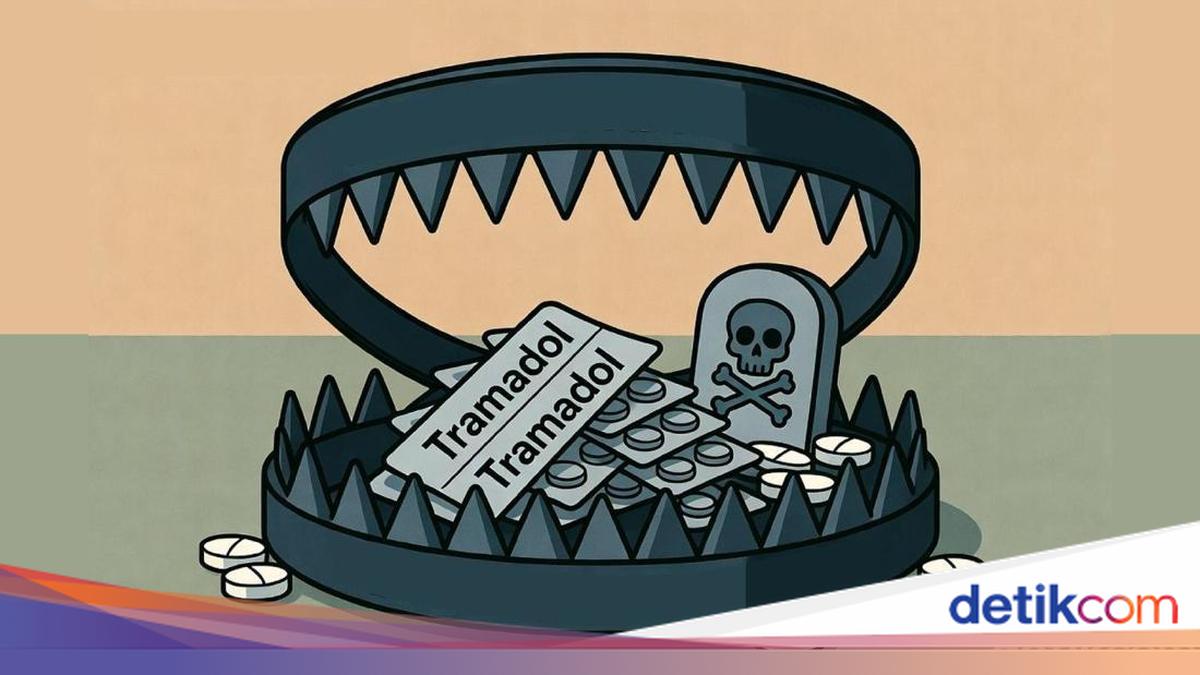
A middle-aged woman sat on the pavement of Jalan KS Tubun, Tanah Abang, Central Jakarta, on Friday, 24 July 2026. She watched every motorcycle that passed. When a motorcyclist slowed down and stopped in front of her, the woman immediately stood up. Without much talk, she handed several strips of pills to the two young men on the motorbike.
“How much, Ma’am?” asked one of them, who was part of the detikX team.
“Thirty,” the woman replied curtly, indicating the price was Rp 30,000 per strip containing 10 tablets.
“Is this Tramadol? No Hexymer?” he continued.
The woman shook her head slowly. However, besides showing the drug she called Tramadol, she also pulled out another strip of pills labelled Trihexyphenidyl. The terms are interchangeable. Other names for Trihexyphenidyl include Eksimer, Hexymer, Trihex, thp, double L (LL), cow pills, Yarindo pills, dog pills, yellow pills, double Y, Hexy, or Trihexyphenidyl. These definitions are listed in a booklet on preventing the misuse of certain drugs published by the Jakarta Food and Drug Supervisory Agency (BPOM). Tramadol and Trihexyphenidyl are prescription-only medicines classified as certain drugs (OOT) that are illegally traded without a doctor’s prescription and are frequently abused.
Two days earlier, the detikX team traced the road beyond Pasar Tanah Abang, looping around to the front of the Museum Tekstil. As evening approached, the pavements along the route were filled with activity that at first glance appeared ordinary. More than a dozen people were sitting or standing along the road, some spaced apart. They appeared to be offering something to motorcyclists who slowed down. They were selling Tramadol and Trihexyphenidyl like street vendors.
There were young men, middle-aged men, and women carrying black sling bags. Some stood almost at the edge of the road, even stepping slightly into the traffic lane. In their hands, they clutched several strips of pills, holding them up to show passing motorcyclists.
detikX attempted to walk slowly near them several times, but no one offered the drugs. However, the situation was different for motorcyclists. A transaction occurred near the team: a motorbike carrying two young men in their early twenties, both wearing black T-shirts and no helmets, suddenly pulled over to the side of the road. Before the engine was even switched off, a young man rushed over to them. The motorcyclist was heard mentioning the figure of Rp 20,000. A brief negotiation ensued and a deal was quickly struck.
A few minutes later, a man wearing a helmet and carrying a backpack, looking as though he had just finished work, conducted a similar transaction. No haggling was heard. The transaction went smoothly amidst the flow of pedestrians and motor vehicles that afternoon.
This scene was apparently nothing new for two security officers who guard the area daily. Both admitted to seeing sellers of Tramadol and Trihexyphenidyl taking turns at the same spot almost every day, with the practice spreading even wider.
“There are people around morning and night, 24 hours,” one of the security officers, who wished to remain anonymous, told detikX.
According to them, the presence of these individuals along the road never really disappears. As day turns to night, there is always someone standing or coming in shifts. However, they claimed they never knew exactly what drugs were being traded.
“When we’re on guard at night here, we hear sounds, but we don’t know if they’re chatting or dealing. We just know there are always people there,” he explained.
From their post, the two officers said they had witnessed police conducting raids in the area several times. Every time officers arrive, the people offering the drugs would quickly leave the location.
“When the police come, they run. A few hours later, they’re back,” one of the officers said.
They added that the faces they see are not new. After guarding the same location for some time, they have come to recognise some of the sellers who regularly operate along the street.
“Yes, it’s the same people,” he said.
Nevertheless, the two security officers claimed they almost never had any disputes with the sellers. As long as they are active, the sellers do not disturb the security post or the people on duty. Occasionally, if the sellers shift their position too close to the post, the officers simply remind them to move away. According to them, the warning is usually heeded without argument.
The Tramadol and Trihexyphenidyl traded on the streets around Tanah Abang are strongly suspected to be counterfeit or illegally produced. detikX analysed the two drug strips using the counterfeit drug identification guide from the Food and Drug Supervisory Agency (BPOM). From the external appearance alone, several irregularities were immediately visible.
The strip sold as Tramadol, for example, measured 11.8 x 5.8 centimetres. This size is slightly larger than the original packaging, which is recorded as 10.8 x 5.7 centimetres.
The irregularities did not stop there. The packaging lacked the manufacturer’s or registrant’s logo, the drug content grammage, the brand name, the generic drug logo, the registration number, the distribution permit number, and the expiry date.
The mandatory warning ‘Harus dengan resep dokter’ (Must be obtained with a doctor’s prescription) was also missing. Likewise, the prescription drug logo—a red circle with a black border containing the letter K—was absent.
Instead, the packaging only displayed three coloured lines designed to resemble the original product, complete with a hologram to give the impression of authenticity.
A similar pattern was found on the Trihexyphenidyl strip. Its packaging measured approximately 16 x 5.7 centimetres, differing from the original product size of around 11.4 x 8.1 centimetres. The manufacturer’s logo and the prescription drug logo were also missing.