
Heartbreaking Stories of Nepal Flash Flood Victims Who Lost Family Before Their Eyes
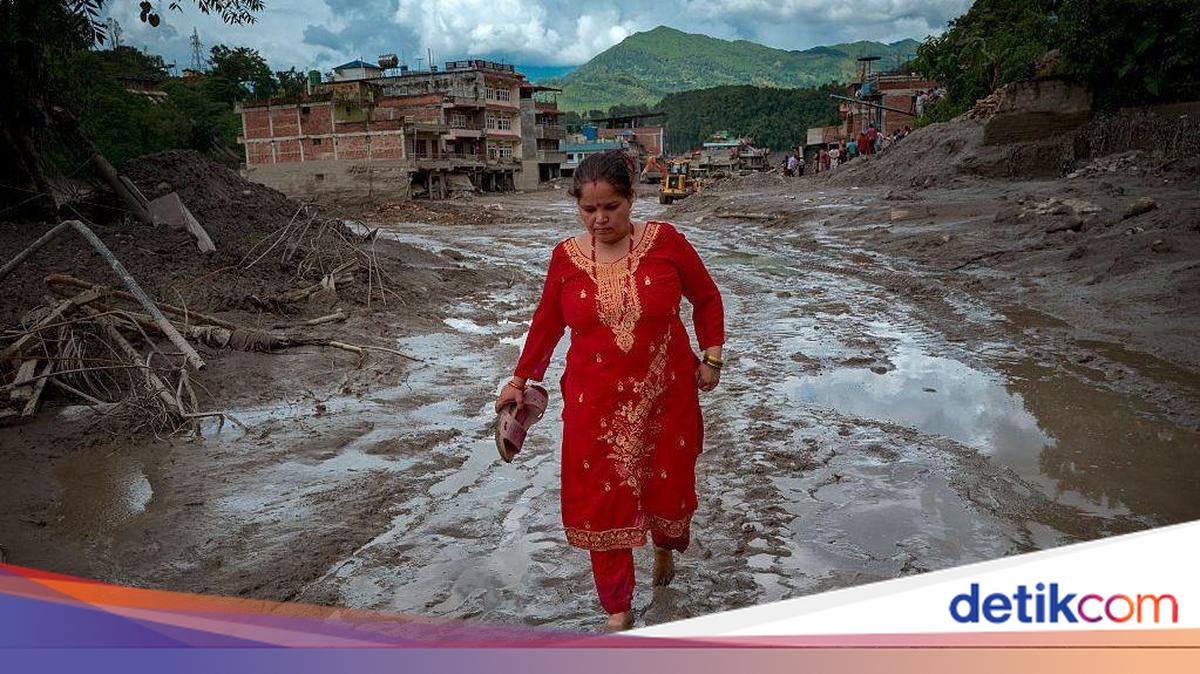
At least 389 people have been reported dead in Nepal as a result of flash floods and landslides that occurred on Wednesday (26/08).
The National Disaster Management Authority of Nepal also stated that 910 people remain missing and cannot be contacted following the floods that struck the region. The majority of those missing are foreign nationals, numbering 517 people, followed by 44 military personnel and 28 police officers.
Basanta Raj Adhikari, Director of the Centre for Disaster Studies at Tribhuvan University in Nepal, told the BBC Newsday programme that there is a risk of “second and third waves” of disaster occurring today or tomorrow.
“We do not know for certain yet,” he said, adding that he continues to discuss the situation with colleagues in China who are monitoring developments. “The rainfall is not heavy, but landslides could still occur.”
He added that his team has long been monitoring various threats in the Himalayan region. “Climate change is truly happening here,” he said. “We continue to carry out observations.”
This event is the most devastating disaster in Nepal since the 2015 earthquake, which killed around 9,000 people. Aerial footage shows widespread damage to homes, roads and bridges along the Bhotekoshi River in the Rasuwa region of Nepal.
“The entire nation is shocked and deeply grieving,” said Nepal’s Prime Minister Balendra Shah.
In addition to Nepal, floods and landslides also occurred in Gyirong District, Tibet. The series of events killed at least three people, according to a report by Chinese state television, CCTV. According to CCTV, at least 558 people are missing in Gyirong, including 260 foreign nationals.
The border at Gyirong is a major crossing point for tourists and traffic between China and Nepal. On Wednesday, state media reported “many casualties” shortly after landslides occurred along the shared border.
Several downstream districts along the Nepal-China border were affected by the floods and landslides. Local officials said the disaster caused significant losses, both in lives and property, but they do not yet have a clear estimate.
A number of residential settlements in the Rasuwa and Nuwakot districts along the banks of the Bhotekoshi River in Nepal were the hardest hit. The area is not densely populated and its roads serve as a vital main route for Nepal-China trade.
Critical infrastructure in the area, such as hydroelectric power plants, highways and bridges, has been destroyed. Thousands of tourists from various countries travel through this area to visit Kailash Mansarovar, located in Tibet. Each year during the Janai Purnima festival, hundreds of pilgrims visit Gosaikunda, located within a national park in the region, to worship.
‘There was no chance at all to save themselves’
“My family members were swept away by the flood before my eyes,” said Kalpana Malla, a resident of Nuwakot District, Nepal.
Kalpana said her father, mother, sister and her sister’s children were all swept away by the flood and landslide. “They could not escape the flood, there was no chance at all,” she said.
“This flood took everything. My son and I climbed onto the roof of the house and survived, but I cannot explain how we managed to survive,” she said.
Kalpana’s son, Sugam Malla, said he saved his mother by pulling her by the hand. “Earlier I had given my mobile phone to my sister so she could stay safe and contact people for help. But now she cannot be reached, her phone is off. I fear she must have been swept away by the flood,” said Sugam.
Another resident, Goma Pandit, lost all her livestock. “My farmland was also washed away. Ten sacks of mustard seeds, tonnes of maize and rice are all gone. Nothing is left,” she said.
Keshav Prasad Baral, a Nepali survivor of the event, described the flood at the border between Nepal and Tibet as looking like “a huge surge of mud coming straight towards us”. The 68-year-old man is now being treated in hospital. He said the water rose higher and higher before entering his home.
When the incident occurred, Keshav tried to grab his wife’s hand. But his wife was still swept away by the flood and landslide. “Four or five hours later, a helicopter came to rescue me. My wife is still somewhere beneath the mud. She is gone,” he said.
Many families are waiting for news at hospitals. Many families continue to search for their missing relatives. Shreejana Shrestha, a BBC Nepali journalist, visited a hospital in Kathmandu. Some survivors were flown by helicopter to receive treatment at the hospital. On the other hand, many families gathered outside the hospital, hoping to find their loved ones.
Source: jawawa.id (https://jawawa.id/newsitem/heartbreaking-stories-of-nepal-flash-flood-victims-who-lost-family-before-their-eyes-1787885515)
Originally published by detikcom (https://news.detik.com/bbc-world/d-8637613/kisah-pilu-korban-banjir-bandang-nepal-kehilangan-keluarga-di-depan-mata), translated from Indonesian