
Hearing Reports of Minyakita Shortages, Here is the Response from the Trade Minister and Zulhas
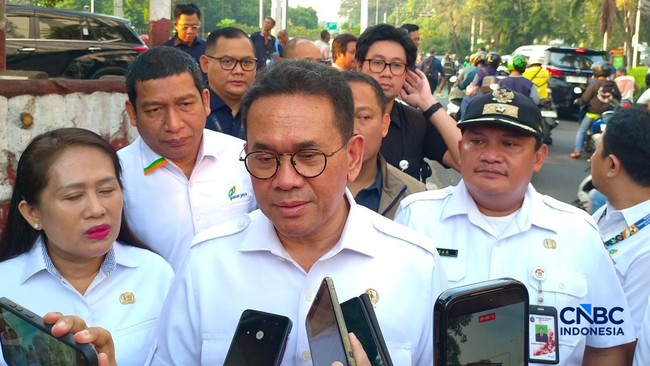
Jakarta, CNBC Indonesia - Trade Minister Budi Santoso has responded to complaints about Minyakita still being difficult to find in several markets in Jakarta, such as Pasar Senen where stocks are empty. The government assures that stocks of this public cooking oil are in a safe condition. According to Budi, the public needs to view Minyakita’s position as part of the domestic market obligation (DMO) policy, so its distribution volume is not as large as other commercial cooking oils. He explained that Minyakita is essentially a government instrument to maintain cooking oil price stability in the market, not to dominate the supply. “Minyakita is DMO oil. I always say that DMO oil is oil that is distributed or mandatory due to exports. So the amount is not like the amount of other oils,” said Budi when met at Pasar Palmerah, Central Jakarta, on Wednesday (13/5/2026). Budi stated that the existence of Minyakita serves as a balancer to prevent other cooking oil prices from rising too high. “But we have to maintain it. Because Minyakita is actually an instrument for price stabilisation. So its function is as a balancer. A balancer so that when prices rise, other (cooking oil) prices do not rise. That’s actually its function,” he clarified. Responding to the coordination meeting results on inflation control from the Ministry of Home Affairs, which showed average prices for bulk cooking oil, premium packaged cooking oil, and Minyakita already above Rp19,000 per litre, Budi said the situation is influenced by the rise in global crude palm oil (CPO) prices. “If we look at it, it’s indeed like that. Because premium cooking oil, and outside of Minyakita, will certainly adjust to the CPO price which has risen again now, as well as distribution prices and so on,” he said. He hopes that cooking oil prices can return to falling once distribution conditions and prices normalise. “Hopefully, if everything returns to normal, prices will start to fall too, because the situation is that oil prices are rising,” said Budi. Budi also assured that Minyakita stocks nationwide are still safe. According to him, the main issue currently is more related to distribution, especially in eastern Indonesia such as Papua and Maluku. “Stocks are safe, no problem, stocks are safe. For Papua and Maluku areas, it’s actually a distribution issue. That’s why we always ask Bulog,” he said. Therefore, the government is encouraging the distribution of Minyakita through state-owned food companies like Perum Bulog and ID Food to make distribution to eastern regions smoother. “Yes, one of the purposes of the minimum 35% to BUMN Pangan is actually for the eastern regions, because there aren’t many distributors there,” Budi explained. He added that so far, the distribution of Minyakita through BUMN pangan has even exceeded the minimum requirement. “So the minimum is 35%, in principle the producers have no issue. Meaning if the quota is more than 35% it’s also fine. Now it’s already more than 50% distributed by BUMN Pangan,” he said. Budi hopes distribution to Papua and Maluku can improve soon. “Hopefully all distribution to Papua and Maluku is smooth and quickly resolved,” he said. Meanwhile, Coordinating Minister for Food Affairs Zulkifli Hasan (Zulhas) said that Minyakita prices in Java and Sumatra regions are actually relatively in line with the highest retail price (HET) of Rp15,700 per litre. “From the information I have on cooking oil, we’ve been meeting about this for several days. For Java Island, Sumatra Island, you can check SP2KP, the nearby ones are blue. Blue-green means in line with HET,” said Zulhas on the same occasion. However, Zulhas acknowledged that Minyakita prices are still expensive in Papua and Maluku due to high distribution and transportation costs. “But the expensive ones are in Maluku and Papua. What does that mean? It means transportation,” he said. The government is asking Bulog to accelerate supplies to those areas, including through transport subsidies from the Ministry of Transportation (Kemenhub). “We ask that this can be handled by Bulog immediately supplying the areas including Papua and Maluku. Later also with the Ministry of Transportation. Because Kemenhub provides transportation subsidies so that transport gets subsidies, thus prices can be suppressed,” Zulhas concluded.