
Health Protection Key to Sustainability of 27.4 Million Creative Economy Workers, Minister Says
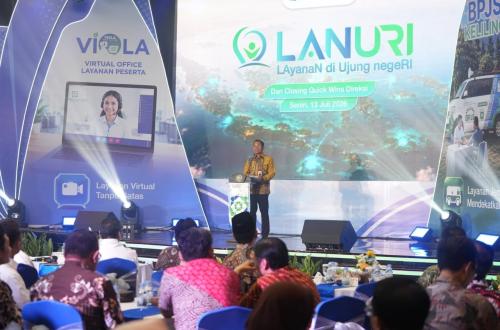
Minister of Creative Economy/Head of the Creative Economy Agency, Teuku Riefky Harsya, has affirmed that health protection is an essential foundation for the sustainability of the national creative economy sector. According to him, safeguarding the health of creative economy workers is tantamount to protecting one of the nation’s greatest assets on the road towards Golden Indonesia 2045.
“When we talk about health protection for creative workers, we are really talking about protecting one of this nation’s greatest assets, namely the 27.4 million creative economy actors in Indonesia,” said Riefky during the launch of the Remote Area Service (LANURI) and the closing of BPJS Kesehatan’s 100 Days of Work Quick Wins at the BPJS Kesehatan head office in Jakarta on Monday (13/7/2026).
Riefky revealed that the number of creative economy workers has now reached 27.4 million, surpassing the creative sector employment absorption target of 25.5 million set in the 2025 RPJMN. These creative workers are not only found in major cities but are spread across villages, coastal areas, mountainous regions, and the country’s outermost, foremost and least-developed (3T) regions.
“Many creative talents in the regions have extraordinary potential, yet they still face limited access to social and health protection services. That is why the presence of BPJS Kesehatan’s digital services is expected to broaden the reach of protection so that no creative economy worker is left behind,” he said.
Riefky explained that Indonesia’s creative economy is dominated by the younger generation. Around 63 per cent are Generation Z and millennials, while 58 per cent are women, who play a major role in strengthening family economies.
“Health protection and welfare for creative economy workers is not merely a social issue, but also an issue of productivity, competitiveness, and the sustainability of national economic development,” Riefky continued.
According to Riefky, Indonesia cannot build a strong creative economy if its creative talents remain vulnerable to health risks and lack adequate access to protection. He viewed the launch of LANURI as part of efforts to expand National Health Insurance (JKN) membership whilst raising creative workers’ awareness of the importance of health protection.
“The programme is also expected to strengthen collaboration between the government, BPJS Kesehatan, communities, and various stakeholders,” Riefky added.
Riefky said technological developments are opening up greater room for collaboration between the creative economy and the health sector. The Ministry of Creative Economy, he continued, has identified at least four subsectors that contribute directly to health services: applications, digital content, film, and music.
“We hope that collaboration between the Ministry of Creative Economy and BPJS Kesehatan can produce ever more creative content addressing health themes. A single piece of educational content can reach millions of people and serve as a highly effective instrument for behavioural change,” said Riefky.
He added that creative works can also serve as effective media for health education. In his view, film and music have proven capable of building public awareness of various health issues, including mental health. Thus, the creative economy contributes not only to economic growth but also to people’s quality of life.
Riefky said this commitment aligns with the Creative Economy Master Plan (Rindekraf) 2026-2045 recently issued by the government. In that document, human resource development and creative talent are the top priorities for developing the national creative economy ecosystem.
“At the Ministry of Creative Economy, we are committed to building an ecosystem that allows creative economy workers to create safely and comfortably, with access to social and health protection,” he said.
Riefky affirmed that the greatest investment for the future of Indonesia’s creative economy lies not only in technology or infrastructure, but in its people. In his view, health protection for creative workers must be a shared concern.
“We believe the best investment for the future of Indonesia’s creative economy is an investment in its people. By protecting creative economy workers today, we are safeguarding the sustainability of Indonesian creativity for the future, towards Golden Indonesia 2045,” said Riefky.
Source: jawawa.id (https://jawawa.id/newsitem/health-protection-key-to-sustainability-of-27-4-million-creative-economy-workers-minister-says-1783925593)
Originally published by Republika (https://ekonomi.republika.co.id/berita/ti3nkt423/menekraf-perlindungan-kesehatan-jadi-kunci-keberlanjutan-274-juta-pelaku-ekraf), translated from Indonesian