
Health Ministry Targets 3,000 Cataract Operations per Million People
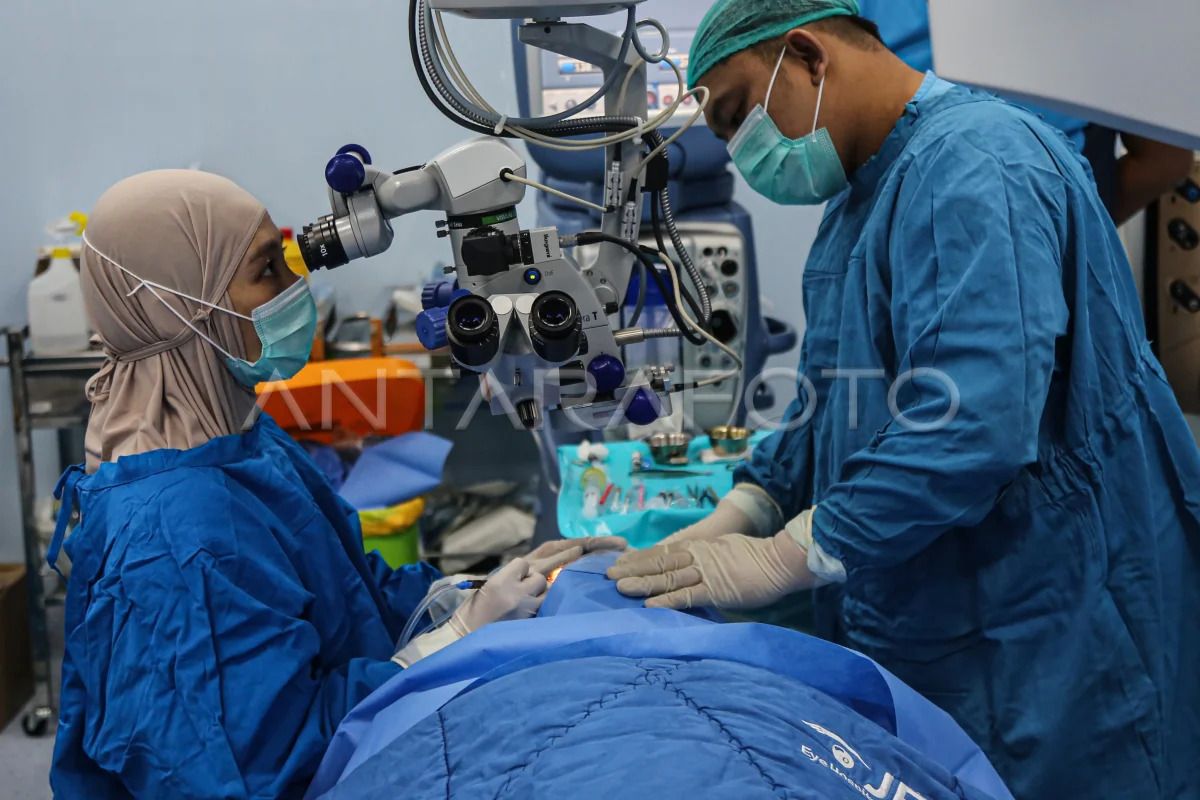
Jakarta (ANTARA) – The Ministry of Health is targeting a Cataract Surgical Rate (CSR) of at least 3,000 procedures a year nationally per one million BPJS Health members. The rate measures the number of cataract operations performed per one million people in a year.
Deputy Health Minister Dante Saksono Harbuwono said in Jakarta on Monday that tackling visual impairment was a crucial investment in improving Healthy Life Expectancy (Health-Adjusted Life Expectancy/HALE), an indicator of how long someone can live without poor health or disability.
“Visual impairment, including cataracts, does not directly cause death, but it significantly affects a person’s quality of life. The Government and Perdami are committed to reducing the backlog of cataract operations and accelerating the distribution of ophthalmologists, including to remote areas,” Dante said.
He said one-fifth of disability-causing illnesses in Indonesia stemmed from visual impairment. As the population ages, vision problems have a direct impact on people’s daily productivity. To address this, the Health Ministry is pushing forward the National Vision Health Roadmap through several strategic targets.
The Government aims to ensure that at least one million people at risk of visual impairment receive early eye-health screening at primary healthcare facilities. It also aims to provide surgery for 80 per cent of people with moderate to severe cataracts, and ensure that at least 80 per cent of patients achieve good visual acuity after surgery.
“If all general practitioners carry out fundoscopy examinations, more eye disorders will be detected. Likewise, if all endocrinologists, including myself, perform fundoscopy, more cases of diabetic retinopathy — damage to retinal blood vessels caused by diabetes complications — will be detected early,” he said.
Separately, Perdami Central Board chairman Professor Budu said cases of blindness in Indonesia were becoming more complex. In addition to cataracts, they include a rise in refractive errors such as short-sightedness and astigmatism, diabetic retinopathy, age-related macular degeneration — damage to the centre of the retina — and glaucoma, which involves damage to the optic nerve associated with high pressure inside the eye.
He said changes in lifestyle and Indonesia’s transition towards a developing-country profile had also contributed to shifts in eye-disease trends.
“Cataracts are the leading cause of blindness worldwide, and Indonesia has begun moving towards becoming the country with the second-highest level of blindness in the world. We must properly anticipate this,” Professor Budu said.
He welcomed stronger cooperation with the Health Ministry to address the country’s substantial eye-health burden.
Source: jawawa.id (https://jawawa.id/newsitem/health-ministry-targets-3-000-cataract-operations-per-million-people-1793015737)
Originally published by Antara (Indonesian) (https://www.antaranews.com/berita/5812691/kemenkes-targetkan-3000-operasi-katarak-per-sejuta-penduduk), translated from Indonesian