
Health Ministry Drafts 2026–2035 Health Workforce Blueprint to Strengthen Transformation
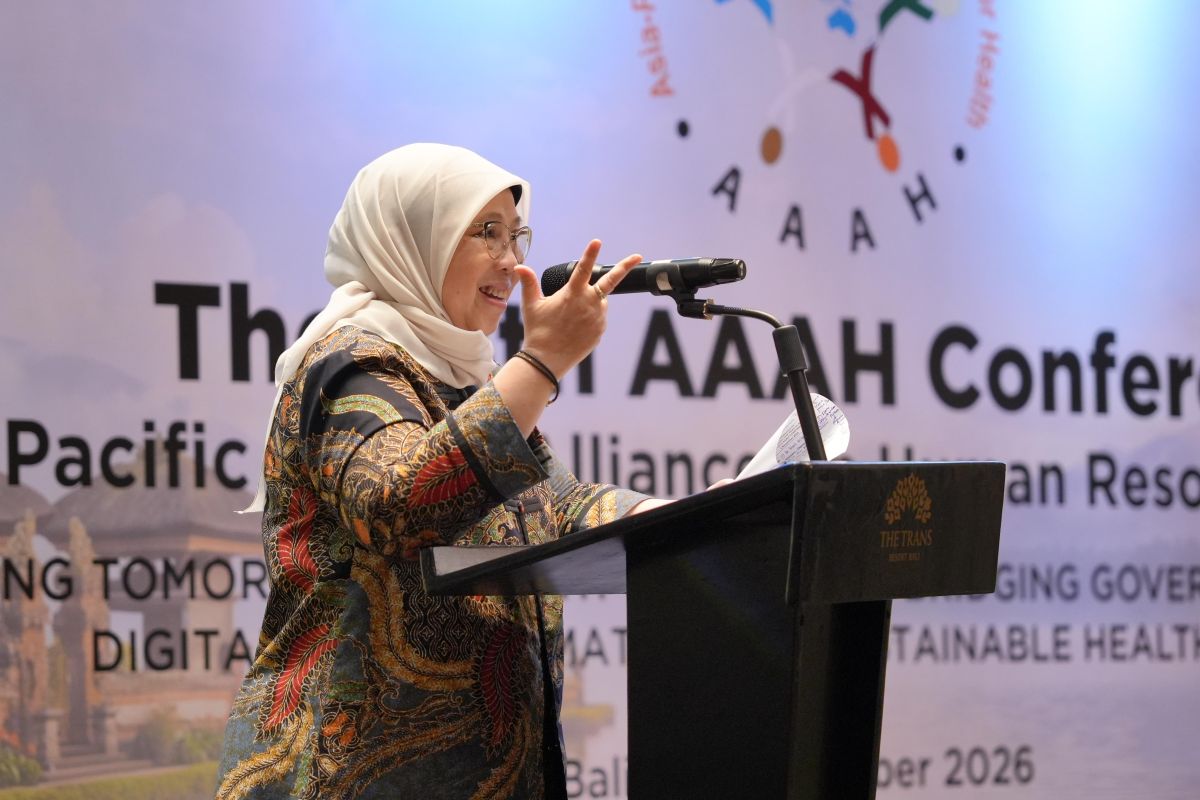
Jakarta (ANTARA) – The Ministry of Health is drafting the 2026–2035 Blueprint for Health Workforce Management, drawing on recommendations from the 14th Asia Pacific Action Alliance on Human Resources for Health conference to strengthen the health workforce as a foundation for transforming the health system.
Yuli Farianti, the ministry’s Director General of Health Human Resources, said a range of strategic challenges — from an ageing population and a rise in chronic diseases to climate change and the uneven distribution of medical personnel — required concrete, integrated responses. Indonesia’s doctor-to-population ratio currently stands at 0.62 per 1,000 people.
“Strengthening the health workforce is not just about producing more health workers. It is about having the right competencies, fair distribution, and a working environment in which health workers feel safe and valued, and want to stay. All of this is captured in the formula: Competence plus Commitment equals Resilience,” she said in a statement issued in Jakarta on Thursday.
To build this resilience, the conference agreed on three key pillars that should advance in tandem: governance; education and welfare; and digital transformation.
She said Indonesia had implemented these three pillars systematically under the leadership of the Minister of Health. Health workers were placed at the centre of the transformation, as the success of health-sector reform depended heavily on the capacity of its human resources.
Under the governance pillar, the ministry is strengthening data-based workforce planning through 2032 to map health workforce needs, particularly in remote, border and island regions.
For education and welfare, it is accelerating the supply of specialist doctors through hospital-based training, enabling trainees to take part directly in providing services to the public.
Under digital transformation, the ministry is streamlining bureaucracy by issuing lifetime Registration Certificates (STR) through the SATUSEHAT SDMK platform and providing access to online training through Plataran Sehat.
Delegates also saw the three pillars in practice during field visits to three health facilities in Bali.
On Monday (2 November), the delegates, divided into three groups, visited the facilities. The first group went to Prof. Dr I.G.N.G. Ngoerah Central General Hospital, a Class A referral hospital that trains 1,442 residents across 24 study programmes.
The second group visited the Denpasar Health Polytechnic, which applies global standards in learning simulations and has sent dozens of students on internships and graduates to work in Japan.
At primary-care level, the third group observed the life-cycle-based Primary Care Integration (ILP) programme at Kuta II Community Health Centre. The approach has helped control the conditions of 81 per cent of its patients with hypertension and 79 per cent of those with diabetes. The centre also recorded free health check-up coverage of 101.6 per cent, reaching 5,708 people.
The service results have also been supported by close personal relationships between health workers and the local community.
In addition to strengthening regional cooperation, the conference fostered a sense of togetherness through Menyama Braya, a local Balinese philosophy that teaches people to treat one another as family.
Yuli Farianti said delegates from 22 countries who attended the conference in Bali were returning home as one extended family, united by the shared mission of caring for those who care for others.
Anna Kurniati, chair of AAAH for 2024–2026 and Secretary of the Health Ministry’s Directorate General of Pharmaceuticals and Medical Devices, praised the strong support and solidarity among member countries, as well as contributions from international development partners including WHO, JICA, KOICA, ADB, UNFPA and the IHPP Foundation.
AAAH, she said, was a strategic alliance for strengthening collective action among member countries. No single country, she added, could address health workforce challenges on its own.
The recommendations from the 14th AAAH conference will serve as a strategic reference for Indonesia as it draws up the 2026–2035 Health Workforce Management Blueprint. The conference’s closing also marked the handover of the next conference to Thailand.
Source: jawawa.id (https://jawawa.id/newsitem/health-ministry-drafts-2026-2035-health-workforce-blueprint-to-strengthen-transformation-1793890481)
Originally published by Antara (Indonesian) (https://www.antaranews.com/berita/5835163/kemenkes-susun-blueprint-sdm-kesehatan-2026-2035-kuatkan-transformasi), translated from Indonesian