
Health Ministry Claims Companies Ready to Comply with Nutri-Level Labelling Obligations
Jakarta, CNBC Indonesia - The government is set to implement the Nutri-Level nutrition labelling system as an effort to curb the consumption of sugar, salt, and fat. This policy is said not to burden the industry unilaterally, as it has been discussed extensively with stakeholders for a long time.
Deputy Minister of Health Dante Saksono Harbuwono stated that businesses are fundamentally ready to follow the regulation. He emphasised that the policy formulation process involved not only the government but also the industry.
“The discussions have been ongoing for two years with the industry, and it seems they accept it. Many multinational companies have already implemented similar measures in other countries with positive results,” said Dante when met by the media in Jakarta on Thursday (23/4/2026).
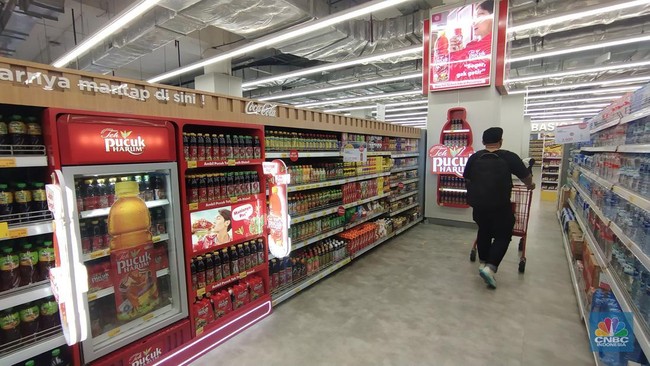
Nevertheless, implementation in the field is assessed as not straightforward, particularly for the category of sugary drinks, which are currently very popular among the public.
IPB University Professor Nuri Andarwulan explained that the Nutri-Level system is part of Front of Pack Labelling (FOPL), designed to simplify nutritional information for easier consumer understanding. Through this system, products will be assigned letter scores from A to D with colour indicators, ranging from dark green to red.
The aim is to help the public quickly select healthier products without needing to read complex nutritional details. However, field findings present a rather challenging picture.
From research on 100 ready-to-drink beverages in cafes and restaurants in the Jakarta and Bogor areas, only three drinks fell into the low-sugar category of level A and B. In contrast, 97 other drinks were in categories C and D, with some even exceeding the daily sugar intake limit in a single serving.
“This means that if this policy is widely applied, most products are likely to receive yellow or red labels,” said Nuri in her statement, quoted from the official IPB University website.
This situation could raise concerns among businesses, as such labels might affect consumer perceptions and product sales. Nuri said the industry might view the policy as unrealistic if implemented abruptly without supporting strategies.
Therefore, she encourages collaborative steps between the government and businesses, one of which is through product reformulation. However, reformulation is not without risks.
Reducing sugar levels could alter the familiar taste for consumers, so it needs to be done gradually to remain acceptable in the market. Additionally, there is a possibility that businesses might switch to artificial sweeteners as an alternative.
“While it can reduce sugar levels, this step may not necessarily place the product in the best category under the Nutri-Level system,” she said.
Supervision of packaged drinks falls under the National Agency of Drug and Food Control, while products in cafes and restaurants relate to the Ministry of Health. Without strong coordination, policy implementation could be inconsistent.
From the consumer side, the main issue is understanding. If the majority of products are labelled C and D, there is a risk that the public might ignore the information, deeming it insignificant.
Nuri stressed that Nutri-Level cannot stand alone. This policy needs to be accompanied by massive education, incentives for the industry, and broader nutritional interventions.
“The ultimate goal is public health. Its implementation must be gradual, evidence-based, and involve all parties,” she said.
Source: jawawa.id (https://jawawa.id/newsitem/health-ministry-claims-companies-ready-to-comply-with-nutri-level-labelling-obligations-1777013691)
Originally published by CNBC Indonesia (https://www.cnbcindonesia.com/lifestyle/20260423160154-33-729301/kemenkes-klaim-perusahaan-siap-ikuti-kewajiban-label-nutri-level), translated from Indonesian