
Health Ministry: CKG and CCEC Strengthen Early Detection of Vision Problems
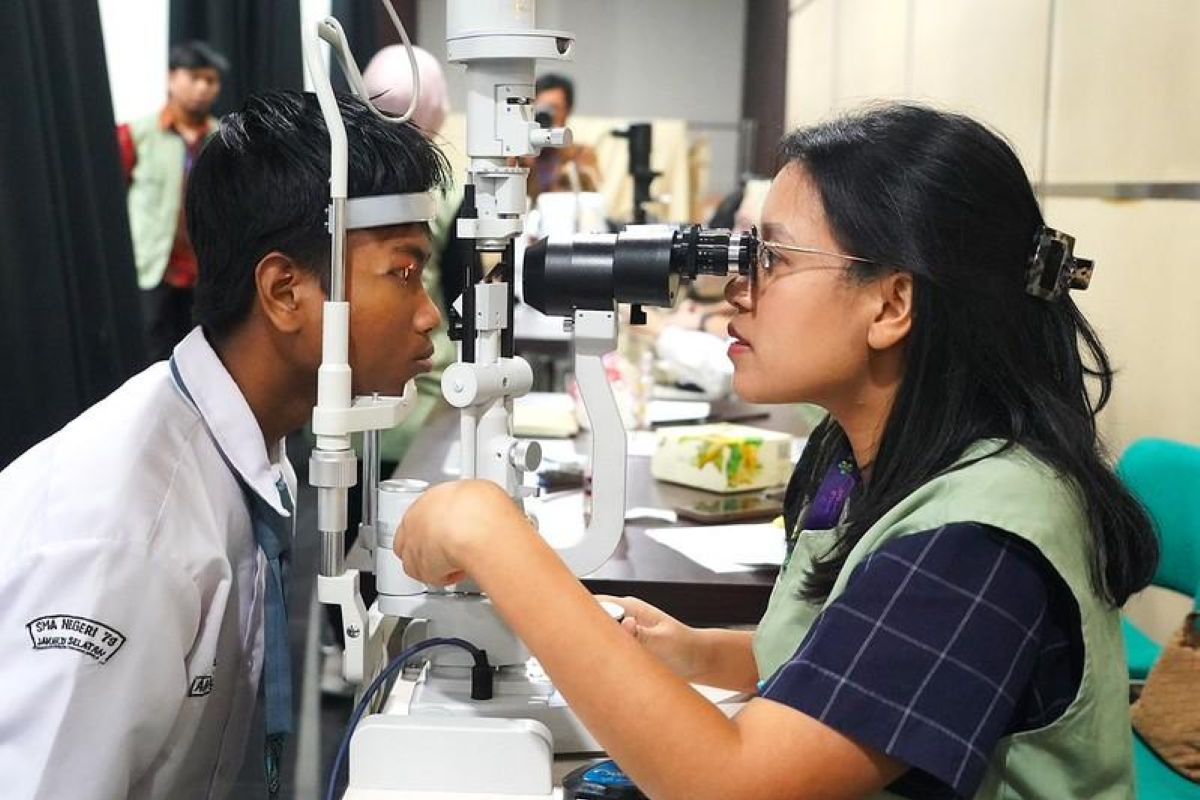
Jakarta (ANTARA) – The Ministry of Health is strengthening early detection of vision problems through its Free Health Check-up Programme (CKG) and Comprehensive Community Eye Care (CCEC) initiative, launched to mark World Sight Day 2026.
“Over the next three years, the programme aims to screen the eyes of more than 60,000 students and workers in five provinces and 19 regencies and municipalities,” Deputy Health Minister Dante Saksono Harbuwono said in Jakarta on Monday.
He said that of the 34 million people who had undergone eye examinations through CKG, around 1.6 million were found to have indications of vision problems.
Dante said eye examinations should be part of efforts to safeguard health from an early age. An estimated 1.1 billion people worldwide have untreated vision problems, and 90 per cent of cases can be prevented or treated.
“Do not wait until your eyes feel strained, blurry or painful. Look after the organ that works for us every day,” Dante said.
To strengthen prevention and treatment, the Ministry of Health is pursuing four strategic measures: expanding eye screening through CKG, increasing access to cataract surgery, ensuring a more even distribution of ophthalmologists, and improving eye-health education in schools and workplaces.
The ministry is also co-ordinating with the Health Care and Social Security Agency (BPJS Kesehatan) and the Indonesian Ophthalmologists Association (PERDAMI) to address disparities between regions in the allocation of cataract surgery services.
Dante added that people should adopt simple habits to protect their eyesight, particularly when using digital devices. One is the 20-20-20 rule: rest the eyes for 20 seconds after every 20 minutes of looking at a screen, by focusing on an object 20 feet, or about six metres, away.
Meanwhile, the ministry’s Director of Non-Communicable Diseases, Siti Nadia Tarmizi, said developing vision centres was one way to bring eye-health services closer to communities.
“This model connects community health centres, health offices, professional organisations, health volunteers and development partners so that people can more easily access eye examinations and services,” she said.
Amanda Huang, Chief of Programmes and Partnerships at The Fred Hollows Foundation, said CCEC was a continuation of its collaboration with the Indonesian Government to extend the reach of community-based eye care.
The programme is designed to help people access screening and treatment for vision problems earlier, including through schools and primary healthcare facilities.
Over the next three years, CCEC aims to train more than 2,000 health workers and teachers, support 16,500 cataract operations and distribute more than 100,000 pairs of glasses. It will also establish 13 new vision centres and strengthen 21 existing ones.
Amanda said the programme was expected to reach people earlier and bring quality eye-health services closer to where they live.
The benefits of eye examinations were also experienced by Fayra Salsabila, a student at State Junior High School 145 in Jakarta, who took part in the screening. The examination found that she had astigmatism of 2.00 in one eye and 1.50 in the other.
She also received free glasses and advice on habits to avoid in order to protect her eyesight.
Source: jawawa.id (https://jawawa.id/newsitem/health-ministry-ckg-and-ccec-strengthen-early-detection-of-vision-problems-1792410763)
Originally published by Antara (Indonesian) (https://www.antaranews.com/berita/5797057/kemenkes-ckg-dan-ccec-perkuat-deteksi-dini-gangguan-penglihatan), translated from Indonesian