
Health Minister: Indonesia's genomic innovation capacity impresses Sweden's Crown Princess
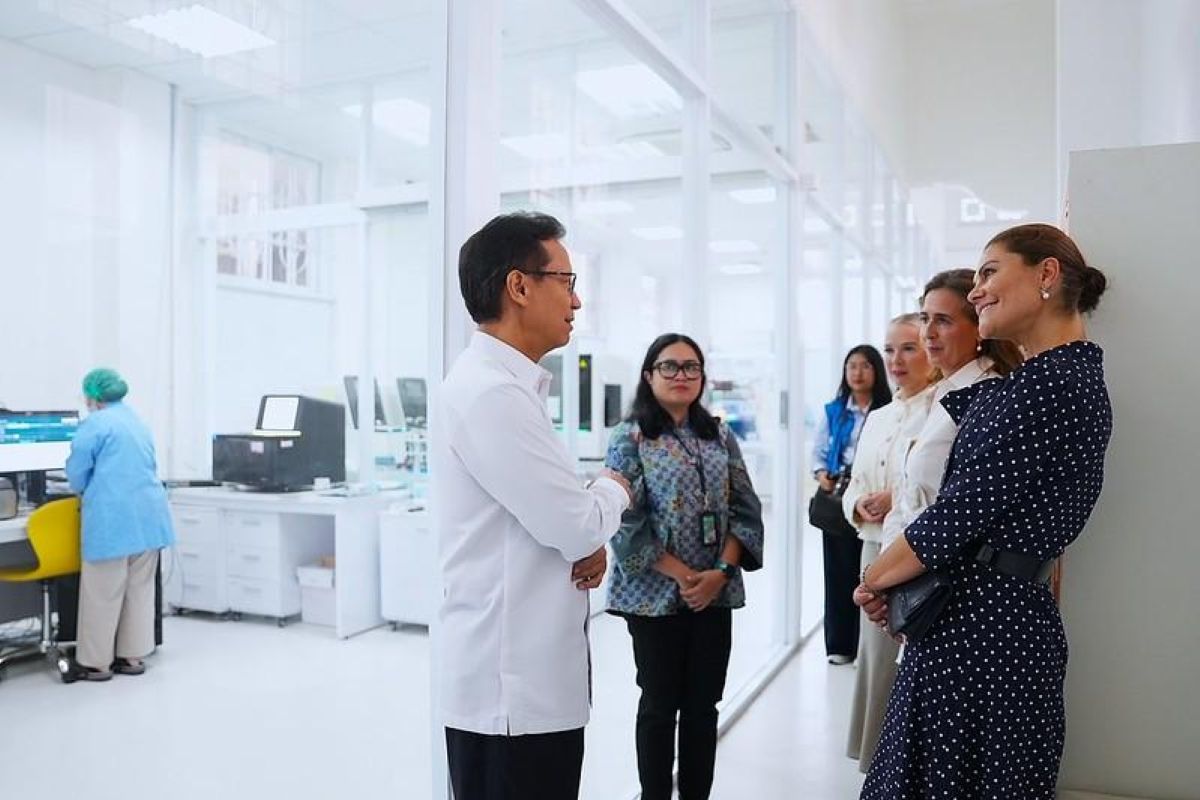
Jakarta (ANTARA) - Health Minister Budi Gunadi Sadikin said that Indonesia’s genomic data capacity, which has reached 4.5 petabytes and will be increased to 10 petabytes to be analysed with artificial intelligence (AI), impressed Sweden’s Crown Princess Victoria Ingrid Alice Désirée.
Budi said in Jakarta on Tuesday that Sweden was interested because they were initially unaware that Indonesia had already been doing this.
Genomic programmes, he said, are usually only carried out in developed countries such as those in Europe, America, the United Kingdom, or the United Arab Emirates, because developed nations want their citizens to live long lives.
“They want to live to 120 or 130 years. They study longevity science, finding out how the human body works so that organs do not deteriorate quickly. When Crown Princess Victoria saw this, she was amazed that Indonesia is able to do it,” he added.
The Crown Princess of Sweden, who is also Goodwill Ambassador for the Sustainable Development Goals at the United Nations Development Programme (UNDP), visited the Centre for Biomedical and Genome Health Research (BB Genomika) at the Eijkman Building, Cipto Mangunkusumo Hospital, Jakarta, on Friday (4/9). The visit aimed to observe firsthand Indonesia’s leap in precision medical technology through the Biomedical and Genomic Science Initiative (BGSI).
He explained that the medical world today is no longer merely searching for pathogens, namely viruses or bacteria, but has penetrated understanding down to the level of genetic material, or DNA.
“In the past, scientists focused on pathogens. The COVID-19 virus, for example, has only around 30,000 DNA base pairs, whereas humans have two billion base pairs. Through genomic science, if someone’s kidney is damaged, we can find out which DNA structure is problematic so it can be repaired precisely,” he said.
To realise precision medicine, the Health Ministry continues to collect genetic data, both from hospital patients and routine public health screenings. The government currently claims to have collected around 70 million health records.
Indonesia’s DNA sequencing capacity is also claimed to have surged sharply. From 1,500 samples in 2025, he said, capacity has now tripled to 4,500 samples. According to him, this genome map is key because every race has a different genetic profile.
He gave the example of breast cancer, where there are genetic mutations known as BRCA1 and BRCA2. If sequencing finds a mutation there, that person is very likely to develop cancer. It would therefore be better to receive treatment earlier.
This genetic infrastructure achievement, he said, apparently exceeded international expectations. He revealed that the Swedish delegation initially did not expect Indonesia to be running a national-scale genomic programme.
Managing this genomic data requires big data infrastructure on a massive scale. The Health Ministry currently stores 4.5 petabytes of genomic data and targets an increase to 10 petabytes. This enormous dataset will be analysed using artificial intelligence (AI) to detect the risk of serious diseases earlier, while also supporting longevity research.
Through the state visit running until 8 September 2026, he hopes there will be follow-up on strategic cooperation between Indonesia and Sweden.
“We certainly hope that going forward there will be programme support through funding or technical donations, especially because this initiative requires extraordinarily large big data management capacity,” Health Minister Budi concluded.
Source: jawawa.id (https://jawawa.id/newsitem/health-minister-indonesias-genomic-innovation-capacity-impresses-swedens-crown-princess-1788843223)
Originally published by Antara (Indonesian) (https://www.antaranews.com/berita/5730864/menkes-kapasitas-inovasi-genomik-ri-membuat-putri-mahkota-swedia-kagum), translated from Indonesian