
Head of BPOM: Use of AI can accelerate drug discovery
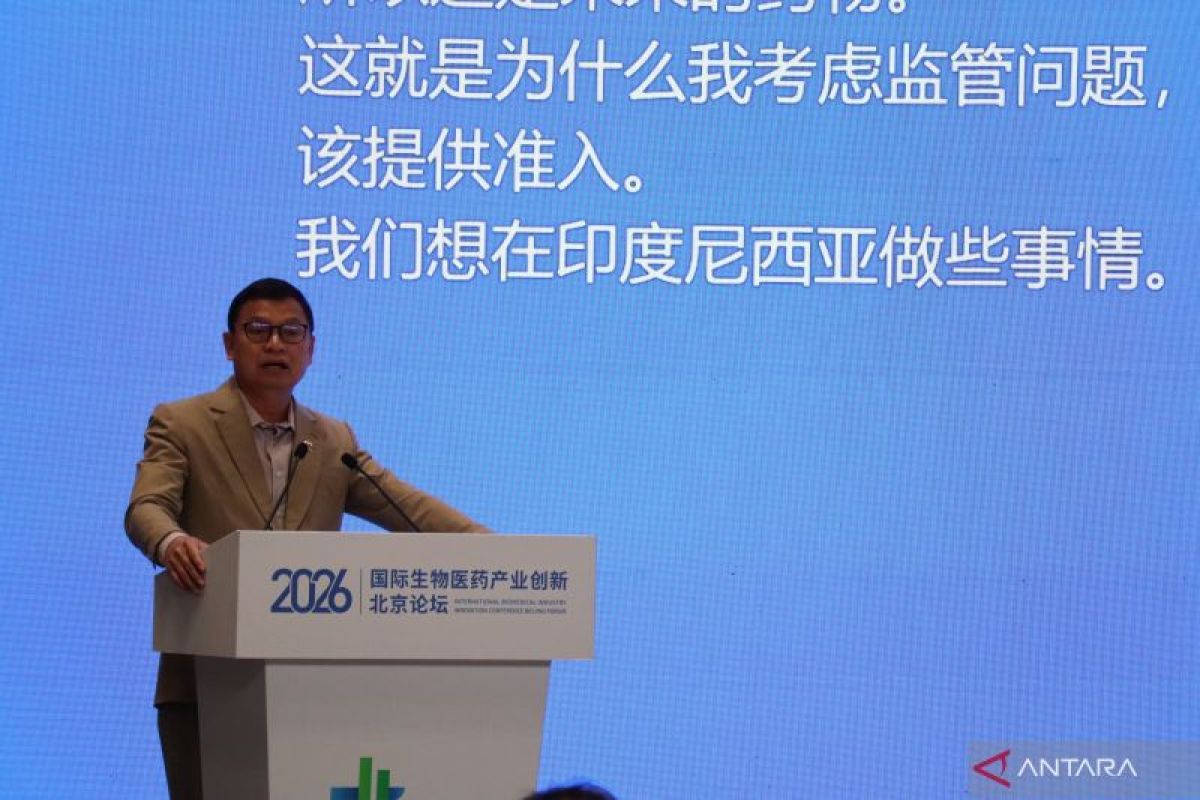
Beijing (ANTARA) - The Head of the Indonesian Food and Drug Authority (BPOM), Taruna Ikrar, stated that artificial intelligence (AI) is a tool that can be utilised to accelerate drug discovery.
“There is a faster drug testing process using AI, such as preclinical trials, simulation tests, and so on; with AI simulations, drug discovery will thus be accelerated,” Taruna Ikrar told ANTARA in Beijing on Sunday.
Taruna Ikrar is in Beijing to meet with several partners, including the National Medical Products Administration (NMPA) of China, to speak at a health seminar organised by Tsinghua University, and to meet with various medical industry players.
Ikrar noted that new drugs must undergo a long, multi-stage process known as “Investigational New Drug,” which requires significant time, starting from the identification of initial molecules—the effort to find molecules that interact with biological targets, known as hit molecules, by screening millions of molecules—followed by the validation of hit molecules, the selection of drug candidates, preclinical trials (both in vitro using laboratory cells and in vivo using animal models), Phase I-III clinical trials in humans, and other testing stages.
“This includes detecting particles, proteins, and their receptors; that can be done using AI, that is its purpose. The same applies to food products; using AI, we can look at the development of a single cell which, in the future, might mean we do not need livestock for meat production,” Iklar explained.
He assessed that AI is already widely used in the regulation and supervision of medicines in China, and therefore Indonesia could learn from those practices.
“AI is an auxiliary tool to make our work easier because with tasks numbering in the millions or even billions, it can be faster. It is more efficient, right? That helps. Secondly, ‘human error’ is reduced,” Ikrar said.
Furthermore, according to Ikrar, the use of AI can also assist in tracking circulating drugs.
“Through AI, we can track, for example, using barcodes, so we know where the product has arrived, where it is being used, who the user is, and so on; this actually makes it safer. Therefore, AI is a tool, an instrument; there is no need to fear it. What is clear is that BPOM has ensured we will not approve anything that is unsafe,” Ikrar asserted.
While presenting material on the “AI + New Medical Technology Conference” at the “International Biomedical Industry Innovation Conference Beijing Forum” organised by Tsinghua University, Ikrar stated that AI can help regulators increase efficiency, simplify certification processes, and make them more effective and practical.
“At BPOM, under my leadership, we have implemented artificial intelligence in various processes, ranging from barcode systems and registration processes to research and clinical trials conducted by scientists,” Ikrar added.
Following the implementation of AI at BPOM, Ikrar said that the data generated annually can be analysed to produce more precise standards.
“Thus, we can be more confident that a product is safe and fit to be available to the public. That is the role of artificial intelligence in regulatory enforcement,” he said.
All units within BPOM, Ikrar added, have also utilised artificial intelligence in several parts of the registration, certification, and distribution processes.
“Artificial intelligence is very important to assist in managing these processes and reducing human error because this technology can work with greater precision. For administrative processes, artificial intelligence is indeed very useful because of that; our government and agency have received special recognition for the implementation of digital systems in public services,” he explained.
Source: jawawa.id (https://jawawa.id/newsitem/head-of-bpom-use-of-ai-can-accelerate-drug-discovery-1789908900)
Originally published by Antara (Indonesian) (https://www.antaranews.com/berita/5750115/kepala-bpom-penggunaan-ai-dapat-percepat-penemuan-obat), translated from Indonesian