
Haze Trapped in the Sky Blocks Sunlight, Making Rain Difficult
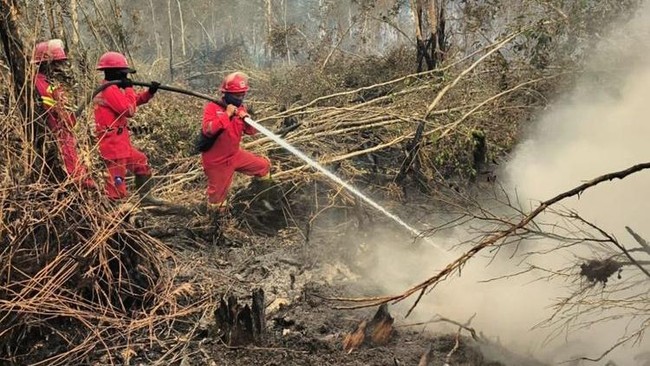
Jakarta, CNBC Indonesia — The Meteorology, Climatology and Geophysics Agency (BMKG) has said that weather-modification operations to bring rain to areas affected by forest and land fires are facing challenges. One obstacle is thick smoke trapped beneath an inversion layer, which prevents sunlight from getting through.
BMKG chief Teuku Faisal Fathoni explained that smoke from the fires is currently trapped below an altitude of about 7,000 feet. This makes it difficult for sunlight to penetrate the haze, even though sunlight is needed to support evaporation and the formation of rain clouds.
“The smoke is trapped below an altitude of 7,000 feet. Above it there is an inversion layer, which we are breaking using dry ice,” Faisal said when met at the Coordinating Ministry for Infrastructure and Regional Development in Jakarta on Thursday (15 October 2026).
Faisal said BMKG is using dry-ice technology to break the inversion layer. Once it has been opened, the smoke is expected to rise, allowing sunlight to enter and increase evaporation, which supports the growth of rain clouds.
“Then, once it has opened, the smoke will move out and sunlight can get through. That can increase evaporation and promote the growth of rain clouds,” he said.
“Only after that can we carry out weather-modification operations again. They can bring rain to areas where firefighting has been challenging, particularly peatland and mineral-soil areas,” he added.
Faisal said dry ice is one of the measures being used to help tackle the fires. The process is still under way, however, and it is not yet possible to say how long it will take to produce results.
“The use of dry ice depends on the conditions. We are trying to open the layer first. The smoke is very thick, reaching up to 7,000 feet. I have reported this to President Prabowo Subianto. There is an inversion layer trapping the smoke, so we will first break that layer with dry ice. The smoke can then rise and disperse, allowing sunlight to come in, evaporation to take place and rain clouds to form,” Faisal explained.
He added that rain clouds are difficult to form without sunlight. This is also an obstacle to weather-modification operations in areas still affected by fires.
“Without sunlight getting through, it is very difficult for rain clouds to form, so weather-modification operations are very difficult for us to carry out,” he said.
Fires in Kalimantan remain a challenge
Faisal said the fire situation in Kalimantan remains a concern, particularly in southern West Kalimantan and Central Kalimantan. Rain has begun to fall in some parts of West Kalimantan, but it has not yet reached the south uniformly.
“In general, rain has started to fall in West Kalimantan, except in the southern part. It is the same in Central Kalimantan, where fires in the south are now very severe,” he said.
To speed up the response, BMKG has also begun operations in several affected areas. Faisal said operations in South Sumatra are under way, with a command post in Lampung. In Central Kalimantan, operations are being managed from a command post in Banjarmasin, South Kalimantan.
Despite these efforts, BMKG expects natural rain in areas still affected by fires to arrive only around early November. The agency is therefore continuing to use dry-ice technology and weather-modification operations to help bring rain.